
 BY
BY 
Dystopian fiction is political philosophy with the argument stripped of its academic courtesy. Where a treatise diagnoses the statist tendency and names its mechanisms, the novel shows you what it feels like to live inside them – the knock at the door, the revised textbook, the neighborhood that disappeared from the map. The genre works because it forces a specific imaginative act: it asks the reader to locate himself inside the system being described, not as a theorist observing from outside, but as the man standing in the queue, holding the papers, waiting for the official to make a decision about his life.
What connects the books on this list is not a shared aesthetic or a common literary movement. It is a shared structural argument: that concentrated power tends toward total power, that comfort and managed perception are tools of control as effective as any secret police, and that the citizen who trades liberty for security or convenience has made a bargain he cannot reverse at will. Some of these novels dress that argument in cold concrete and gray uniforms. Others dress it in pleasure, in abundance, in a world that has engineered away every cause for complaint. The form of the cage varies. The logic of the cage does not. For the ideological scaffolding underneath these stories – the non-fiction case for why the libertarian critique of centralized authority is not paranoia but pattern recognition – see the companion list at SGI’s libertarian reading list.
Start with Orwell. Whatever you think you already know about 1984, read it again as an adult with a government ID in your wallet and a device in your pocket that logs your location. It lands differently.
Table of Contents
1984, George Orwell (1949)
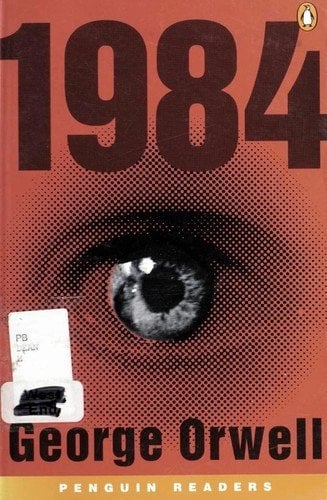
1984 remains the definitive literary map of the total state. Orwell did not invent the idea of surveillance as a governance technology; he rendered it with enough specificity that the reader cannot dismiss it as abstraction. The two-minute hate, the memory hole, the rewritten newspaper – these are not science fiction devices. They are descriptions of administrative functions that every modern bureaucracy performs in some diluted form. Orwell was watching the early postwar Labour government and extrapolating the logic of its tendencies to their conclusion.
The horror of Airstrip One is not that it is brutal, though it is. The horror is that it is stable. The regime persists not because every citizen is a coward but because the structure of the system makes sustained resistance nearly impossible to organize and nearly impossible to think. Read it. Then read the appendix on Newspeak and ask what happens to a political position that can no longer be articulated in the available vocabulary.
“War is peace. Freedom is slavery. Ignorance is strength.”
- George Orwell, 1984
Animal Farm, George Orwell (1945)
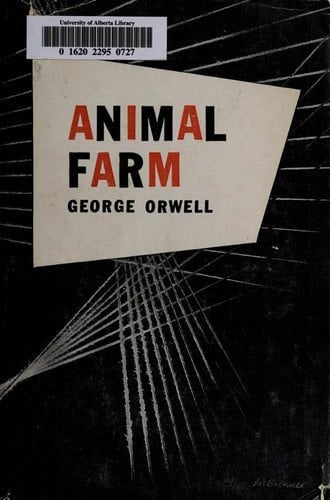
Animal Farm is the most efficient dismantling of revolutionary socialist mythology in the literary canon – compressed into fewer than one hundred pages and accessible to a reader of almost any age. The allegory maps the Bolshevik Revolution and its Stalinist aftermath with enough precision that Soviet censors immediately understood the target. The pigs do not set out to become tyrants. They rationalize each consolidation of power as a temporary necessity, each revision of the founding principles as a clarification, until the commandments have been edited into their opposites and no one who remembers the original version is left alive to object.
The structural lesson is not about pigs or Soviets. It is about what happens to any revolutionary movement once it captures the apparatus of the state and discovers that the apparatus is useful. The promise of equality becomes the instrument of hierarchy. The logic is not a historical accident; it is the predictable output of concentrated, unaccountable power operating without external constraint. This is where the fiction connects directly to the non-fiction case against statism in any form.
“All animals are equal, but some animals are more equal than others.”
- George Orwell, Animal Farm
Brave New World, Aldous Huxley (1932)
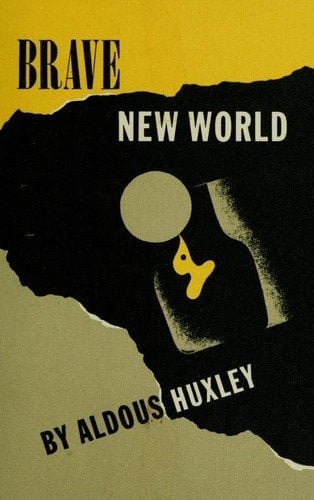
Brave New World is the harder book to argue against, which is precisely why it is the more dangerous one. Orwell’s Oceania requires a boot on a neck. Huxley’s World State requires only that everyone be kept comfortable, entertained, and pharmaceutically even-tempered. There is no Thought Police because there is no dissident thought worth policing – the population has been conditioned from decanting to find the right things pleasant and the wrong things repellent. The state does not need coercion when it has conditioning.
The question Huxley forces is whether liberty voluntarily surrendered for comfort constitutes a loss at all – and whether a population that has never known the alternative can register what it is missing. The World State does not look like a prison from inside. That is the point. In an era of algorithmic content feeds, on-demand everything, and a surveillance capitalism model built on predicting and satisfying desire before it becomes conscious, Huxley’s 1932 novel reads less like prophecy and more like a progress report.
“A really efficient totalitarian state would be one in which the all-powerful executive of political bosses and their army of managers control a population of slaves who do not have to be coerced, because they love their servitude.”
- Aldous Huxley, Brave New World
Island, Aldous Huxley (1962)
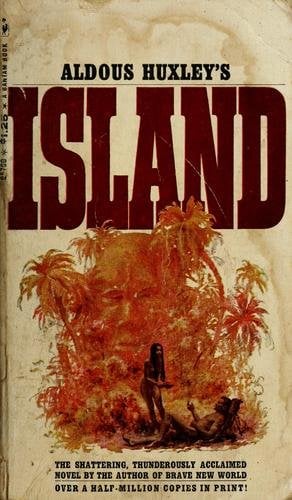
Island is Huxley’s attempt to write the utopia that Brave New World was the dystopian shadow of – a thought experiment in whether a genuinely free, humane, and self-governing society could be constructed and sustained. The island of Pala is organized around the premise that human beings, properly educated and properly situated, do not require a managerial class to administer their choices. The society is decentralized, non-coercive, and deliberately small-scale – a direct rebuke to the gigantism of both the capitalist corporation and the socialist planning committee.
The novel is also a tragedy. Pala is destroyed not by internal failure but by external geopolitical pressure – oil interests, a neighboring regime, the logic of the larger world intruding on the smaller experiment. Read alongside Brave New World, Island completes the argument: Huxley was not simply diagnosing what goes wrong. He was also asking what going right would require, and why the world’s existing power structures would not permit it. That is a realpolitik argument dressed in a utopian novel.
“It’s dark because you are trying too hard. Lightly child, lightly. Learn to do everything lightly.”
- Aldous Huxley, Island
Fahrenheit 451, Ray Bradbury (1953)
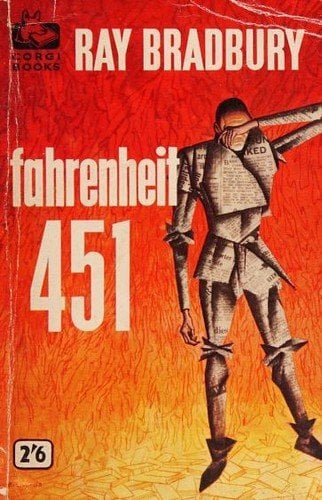
Fahrenheit 451 is not primarily a novel about book burning. It is a novel about the population that requests the book burning – the citizens who found serious literature irritating, then offensive, then intolerable, long before any government official reached for a match. Captain Beatty’s speech to Montag explaining the history of censorship is one of the most precise accounts of how managed information environments emerge through democratic demand rather than top-down imposition. The regime did not suppress the books. The market suppressed the books first.
Bradbury wrote this during the early television era, watching a medium designed for passive consumption begin to restructure what people expected from an evening at home. The firemen in his novel are not ideological enforcers in the Soviet sense; they are municipal workers doing a job the public has outsourced to them. That distinction matters. The dystopia of Fahrenheit 451 is not imposed. It is administered, at scale, with the more or less genuine consent of the administered. The reader who recognizes the mechanism is already partway out of it.
“You don’t have to burn books to destroy a culture. Just get people to stop reading them.”
- Ray Bradbury, Fahrenheit 451
Atlas Shrugged, Ayn Rand (1957)
Atlas Shrugged asks a question the managerial class cannot answer without discrediting itself: what happens when the people the regime extracts value from simply stop cooperating? Ayn Rand‘s novel is a study in the anatomy of a kleptocratic regulatory state – the way productive capacity is progressively encumbered by people who produce nothing themselves but have secured the authority to redistribute what others produce. The mechanics of Taggart Transcontinental’s decline are not dated. They are a usable template for reading any industry that has been captured by the corporate-government complex.
The objections to Rand are well known and some of them are valid – the prose is relentless, the heroes are improbable, the sixty-page radio address at the novel’s end demands a particular kind of stamina. Read it anyway. The embedded argument about what a regulated, over-taxed, producer-punishing economy does to the human beings operating inside it is not available anywhere else in this form. No non-fiction treatment has the same visceral effect. The famous soliloquy contains Rand’s full Objectivist philosophy; read it as argument, not as speech, and it holds up better than its detractors admit.
“Sanction of the victim is the root of the world’s evil.”
- Ayn Rand, Atlas Shrugged
Ender’s Game, Orson Scott Card (1985)
Ender’s Game is, on its surface, a military science fiction novel about children trained to fight an interstellar war. Underneath that frame it is a sustained meditation on managed perception as a governance and military technology – specifically, on what happens when the people executing a policy are deliberately kept ignorant of what that policy actually is. Ender does not know what he is doing when he does it. The commanders above him understand that informed consent would have produced a different outcome, so they engineered a situation where it was never offered.
The question Card is asking is not unique to science fiction. It applies to every citizen who has discovered, after the fact, that the war he supported, the regulation he accepted, or the emergency measure he tolerated was operating on premises he was never shown. The simulation framing in the novel’s climax is Card’s mechanism for making that discovery visceral rather than abstract. The book is marketed to young adults. The argument inside it is for anyone who has had a government lawyer explain, after the decision was already made, what the decision was.
“In the moment when I truly understand my enemy, understand him well enough to defeat him, then in that very moment I also love him.”
- Orson Scott Card, Ender’s Game
Foreign Enemies and Traitors, Matthew Bracken (2009)

Foreign Enemies and Traitors is the third volume in Bracken’s Enemies trilogy and the one that presses hardest on the specific American scenario: a federal government that has crossed the line from constitutional overreach into open coercion, deploying foreign mercenaries against a domestic civilian population that refuses relocation into emergency management facilities. The premise is not drawn from fantasy. It is assembled from executive order language, FEMA authority documentation, and the legal architecture of domestic emergency powers that already exists – dressed in fictional clothing and run to its operational conclusion.
What Bracken captures that most political non-fiction misses is the texture of resistance at the individual and small-group level – what it costs, who does it, and what the state’s response actually looks like when the gloves come off. The novel operates as a serious counter to the comfortable assumption that constitutional rights are self-enforcing. They are not. They are enforced, when they are enforced at all, by people willing to pay a price. This is military fiction with a hard political argument running through it.
“Freedom is not free. It must be purchased anew by each generation willing to pay the price.”
- Matthew Bracken, Foreign Enemies and Traitors
Snow Crash, Neal Stephenson (1992)
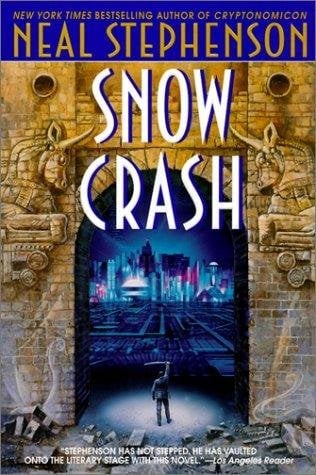
Snow Crash is set in a near-future America where the federal government has effectively dissolved into irrelevance and been replaced by a patchwork of corporate franchise-states, private security contractors, and informal market arrangements. Stephenson did not intend this as a libertarian utopia – the world of Snow Crash is chaotic, dangerous, and stratified – but he mapped the logical terminus of neo-feudal corporate governance with more accuracy than most political economists managed in the same decade. The Mafia delivers pizza with contractual precision. The federal government delivers nothing.
The novel also introduced the concept of the metaverse, the memetic virus as a cognitive weapon, and the information-as-control thesis that took another twenty years to become conventional analysis. Stephenson was working through questions about language, code, and perception management that now describe the operating environment of every major social media platform. Read it as a novel. Then ask how much of the infrastructure Stephenson invented in 1992 exists, in recognizable form, today.
“Until a man is twenty-five, he still thinks, every so often, that under the right circumstances he could be the baddest motherf***er in the world.”
- Neal Stephenson, Snow Crash
Submission, Michel Houellebecq (2015)
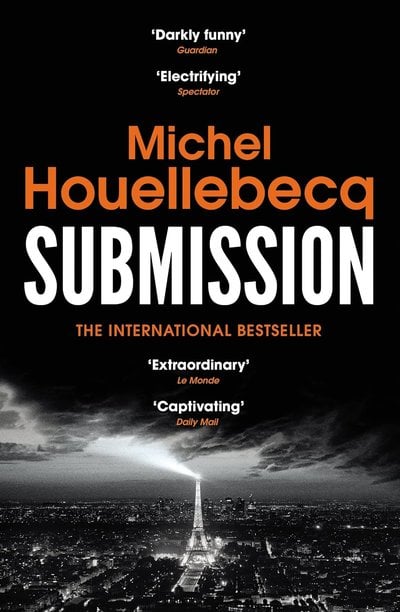
Submission is a novel about civilizational exhaustion. The France Houellebecq depicts does not resist the political transformation at its center because it has lost the will and the vocabulary to mount a defense of what it was. The protagonist, a Sorbonne literature professor, watches the political realignment happen with the detached curiosity of a man who has no strong stake in the outcome – whose secularism has emptied out into mere indifference, and whose liberalism has nothing left to liberalize. The novel is not a tract about Islam. It is a diagnosis of a civilization that has nothing left worth defending.
The structural argument Houellebecq is making sits at the intersection of Sam Francis’s analysis of the managerial regime and James Burnham’s account of the West’s failure of nerve – the idea that ruling classes that have lost confidence in their own inheritance do not hold. They negotiate. They accommodate. They find the arrangement comfortable enough and sign the papers. The horror of Submission is that no one in it is a villain. Everyone is simply making a reasonable calculation about their own comfort. That is how civilizations end – not with a final battle but with a shrug and a revised contract of employment.
“It’s an odd feeling, leaving a world you’ve known.”
- Michel Houellebecq, Submission
Caliphate, Tom Kratman (2008)

Caliphate is built around a straightforward speculative premise: if current demographic and political trajectories in Western Europe continue without interruption through the twenty-second century, what does the legal and social order look like for the non-Muslim populations living under the resulting political settlement? Kratman is a retired Army officer and he builds his world with the procedural specificity of someone who understands how institutions actually function under occupation – the tax structures, the legal distinctions, the categories of persons, the mechanisms of enforcement. The dhimmi system he depicts is grounded in historical precedent, not in invention.
The novel is uncomfortable by design. Kratman is not interested in softening the implications of the scenarios he constructs. Whether or not his particular extrapolation is the most probable future, the underlying question he is forcing – what happens to a population that outsources its cultural and political continuity to institutions that do not share its commitments – is not answerable by looking away. Read alongside Submission, Caliphate represents the harder-edged version of the same civilizational argument: comfort and state dependency are not neutral conditions. They have downstream costs.
“There is no such thing as a soft tyranny. There is only tyranny, wearing different masks.”
- Tom Kratman, Caliphate
Final Thoughts
Taken together, these novels form a single argument with eleven different illustrations. The argument is this: concentrated power, whether it operates through terror, through comfort, through managed information, or through the quiet exhaustion of a population that has stopped believing in its own inheritance, tends toward the same end state. The form varies. The logic is consistent. Orwell shows you the boot. Huxley shows you the pill. Bradbury shows you the screen. Houellebecq and Kratman show you the shrug. What none of them show you – because fiction is not required to – is the non-fiction structure underneath: the theory of the state, the account of how power consolidates, the argument for what a genuinely free order would require. For that structural foundation, the political and social science reading list is the natural next stop.
The single book that closes this loop most directly is The Managerial Revolution by James Burnham. Burnham wrote in 1941 that the old ownership class was being displaced not by the proletariat – as Marx had predicted – but by a new class of technical and administrative managers who would control the state, the corporation, and the military regardless of which party held nominal power. Every regime depicted in these novels, from Oceania’s Inner Party to the World State’s Controllers to the accommodating French university administration in Submission, is a downstream expression of the managerial logic Burnham named. The fiction is the symptom. Burnham is the diagnosis. Read the novels first so the diagnosis lands with the weight it deserves. For more on the case for liberty and the intellectual tradition behind it, the SGI libertarian books list extends the argument into primary sources.