
 BY
BY Table of Contents
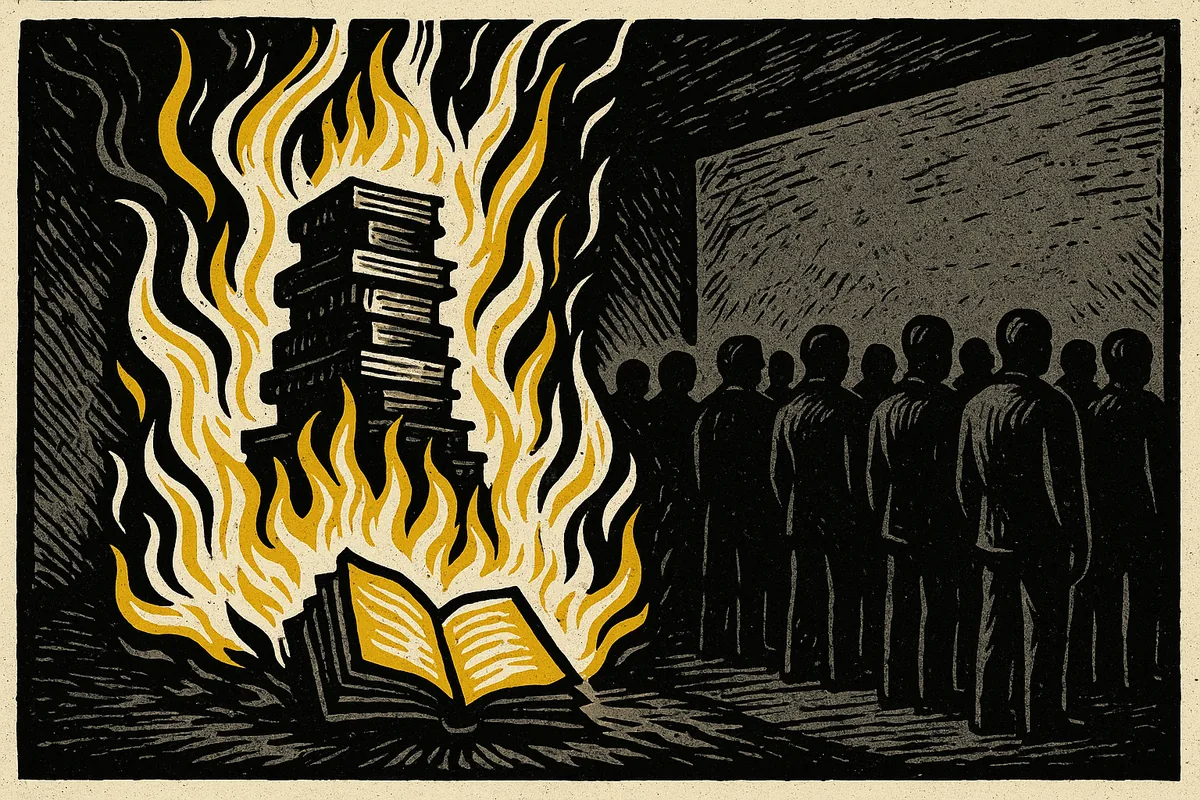
Censorship, in its mature form, does not require a censor. That is the actual argument of Fahrenheit 451, and it is the one most readers miss because the firemen are so cinematically satisfying as villains. Ray Bradbury was precise about this: the public stopped reading of its own accord. The firemen came later, as a sanitation service. The regime that burns books in this novel did not seize a reading public and break it – it inherited a public that had already broken itself, and then offered it the courtesy of making the abandonment official.
What the quotes below map is the full architecture of that collapse. Beatty, the fire chief, is the indispensable voice here – a man who read everything, understood what it cost him, and chose the fire anyway. He explains the system more honestly than any of its victims do, which is Bradbury’s sharpest structural move. Faber knows what was lost and spent decades doing nothing about it. Clarisse, seventeen years old, is more dangerous to the managerial comfort-state than any underground press, because she asks questions without irony and means them. Montag is the convert, which means he is also the man who has to account for every year before the conversion. And Granger, out past the city with the book-memorizers, has already done the math on what survives and what doesn’t.
The organizing pressure across all five sections is a single diagnostic question: when a civilization surrenders its inner life voluntarily, for comfort, for speed, for the narcotic of constant sensation – what exactly has it surrendered, and to whom? Bradbury answered that in 1953. The answer has not aged poorly.
The Pleasure of Burning
“It was a pleasure to burn.”
- Ray Bradbury, Fahrenheit 451, Part 1: 'The Hearth and the Salamander' (opening line)
“A book is a loaded gun in the house next door. Burn it. Take the shot from the weapon. Breach man’s mind. Who knows who might be the target of the well-read man?”
- Ray Bradbury, Fahrenheit 451, Part 1: 'The Hearth and the Salamander' (Beatty)
“What is there about fire that’s so lovely? No matter what age we are, what draws us to it?”
- Ray Bradbury, Fahrenheit 451, Part 1: 'The Hearth and the Salamander' (Beatty)
“If you don’t want a house built, hide the nails and wood. If you don’t want a man unhappy politically, don’t give him two sides to a question to worry him; give him one. Better yet, give him none. Let him forget there is such a thing as war.”
- Ray Bradbury, Fahrenheit 451, Part 1: 'The Hearth and the Salamander' (Beatty)

“Cram them full of noncombustible data, chock them so damned full of ‘facts’ they feel stuffed, but absolutely ‘brilliant’ with information. Then they’ll feel they’re thinking, they’ll get a sense of motion without moving.”
- Ray Bradbury, Fahrenheit 451, Part 1: 'The Hearth and the Salamander' (Beatty)
Why Books Stay Dangerous
“There must be something in books, things we can’t imagine, to make a woman stay in a burning house; there must be something there. You don’t stay for nothing.”
- Ray Bradbury, Fahrenheit 451, Part 1: 'The Hearth and the Salamander' (Montag)
“The books are to remind us what asses and fools we are.”
- Ray Bradbury, Fahrenheit 451, Part 2: 'The Sieve and the Sand' (Faber)
“And I thought about books. And for the first time I realized that a man was behind each one of the books. A man had to think them up.”
- Ray Bradbury, Fahrenheit 451, Part 1: 'The Hearth and the Salamander' (Montag)

“If they give you ruled paper, write the other way.”
- Ray Bradbury, Fahrenheit 451 (epigraph, attributed to Juan Ramón Jiménez)

“Books were only one type of receptacle where we stored a lot of things we were afraid we might forget. There is nothing magical in them at all. The magic is only in what books say, how they stitched the patches of the universe together into one garment for us.”
- Ray Bradbury, Fahrenheit 451, Part 2: 'The Sieve and the Sand' (Faber)
“It took some man a lifetime maybe to put some of his thoughts down, looking around at the world and life, and then I came along in two minutes and boom! it’s all over.”
- Ray Bradbury, Fahrenheit 451, Part 1: 'The Hearth and the Salamander' (Montag)
The Tyranny of Comfort
“Remember, the firemen are rarely necessary. The public itself stopped reading of its own accord.”
- Ray Bradbury, Fahrenheit 451, Part 1: 'The Hearth and the Salamander' (Beatty)
“Oh God, the terrible tyranny of the majority. We all have our harps to play. And it’s up to you to know with which ear you’ll listen.”
- Ray Bradbury, Fahrenheit 451, Part 2: 'The Sieve and the Sand' (Faber)
“Nobody listens any more. I can’t talk to the walls because they’re yelling at me. I can’t talk to my wife; she listens to the walls.”
- Ray Bradbury, Fahrenheit 451, Part 2: 'The Sieve and the Sand' (Montag)
“No one has time any more for anyone else.”
- Ray Bradbury, Fahrenheit 451, Part 1: 'The Hearth and the Salamander' (Clarisse)

“With school turning out more runners, jumpers, racers, tinkerers, grabbers, snatchers, fliers, and swimmers instead of examiners, critics, knowers, and imaginative creators, the word ‘intellectual,’ of course, became the swear word it deserved to be.”
- Ray Bradbury, Fahrenheit 451, Part 1: 'The Hearth and the Salamander' (Beatty)
“But time to think? If you’re not driving a hundred miles an hour, at a clip where you can’t think of anything else but the danger, then you’re playing some game or sitting in some room where you can’t argue with the four-wall televisor.”
- Ray Bradbury, Fahrenheit 451, Part 1: 'The Hearth and the Salamander' (Beatty)

“There is more than one way to burn a book. And the world is full of people running around with lit matches.”
- Ray Bradbury, Fahrenheit 451, 50th Anniversary Edition Coda (2003 Simon & Schuster)
The Cost of Being Bothered
“We need not to be let alone. We need to be really bothered once in a while. How long is it since you were really bothered? About something important, about something real?”
- Ray Bradbury, Fahrenheit 451, Part 2: 'The Sieve and the Sand' (Faber)
“Maybe the books can get us half out of the cave. They just might stop us from making the same damn insane mistakes!”
- Ray Bradbury, Fahrenheit 451, Part 2: 'The Sieve and the Sand' (Montag)
“That’s the good part of dying; when you’ve nothing to lose, you run any risk you want.”
- Ray Bradbury, Fahrenheit 451, Part 2: 'The Sieve and the Sand' (Faber)
“If you hide your ignorance, no one will hit you and you’ll never learn.”
- Ray Bradbury, Fahrenheit 451, Part 2: 'The Sieve and the Sand' (Faber)
“I don’t talk things, sir. I talk the meaning of things. I sit here and know I’m alive.”
- Ray Bradbury, Fahrenheit 451, Part 2: 'The Sieve and the Sand' (Faber)
“’Stuff your eyes with wonder,’ he said, ‘live as if you’d drop dead in ten seconds. See the world. It’s more fantastic than any dream made or paid for in factories.’”
- Ray Bradbury, Fahrenheit 451, Part 3: 'Burning Bright' (Granger, quoting his grandfather)
What Survives the Fire
“Don’t ask for guarantees. And don’t look to be saved in any one thing, person, machine, or library. Do your own bit of saving, and if you drown, at least die knowing you were headed for shore.”
- Ray Bradbury, Fahrenheit 451, Part 2: 'The Sieve and the Sand' (Faber)
“We cannot tell the precise moment when friendship is formed. As in filling a vessel drop by drop, there is at last a drop which makes it run over; so in a series of kindnesses there is at last one which makes the heart run over.”
- Ray Bradbury, Fahrenheit 451, Part 2: 'The Sieve and the Sand' (Montag reading aloud, from James Boswell's Life of Dr. Johnson, 1791)
“We’ll pass the books on to our children, by word of mouth, and let our children wait, in turn, on the other people. A lot will be lost that way, of course. But you can’t make people listen. They have to come round in their own time.”
- Ray Bradbury, Fahrenheit 451, Part 3: 'Burning Bright' (Granger)
“Everyone must leave something behind when he dies, my grandfather said. A child or a book or a painting or a house or a wall built or a pair of shoes made. Or a garden planted. Something your hand touched some way so your soul has somewhere to go when you die.”
- Ray Bradbury, Fahrenheit 451, Part 3: 'Burning Bright' (Granger, quoting his grandfather)
Final Thoughts
Bradbury wrote Fahrenheit 451 in 1953, in a UCLA library basement on a coin-operated typewriter. He thought he was writing about radio and television - the noise that was eating his attention even then. He didn’t have to imagine smartphones, algorithmic feeds, or the way an opinion now dies the moment it leaves the safety of consensus. He was right early because he saw the mechanism: censorship by force is the last step, not the first. The first step is when reading stops being interesting.
If Bradbury’s argument lands and you want it pressed harder, read Neil Postman’s Amusing Ourselves to Death. Postman wrote in 1985 with the benefit of three decades of television, and made the same case Bradbury did with the polemical clarity of a man who studied media for a living: that the danger to a free society is not Orwell’s boot but Huxley’s distraction. Bradbury saw it first. Postman explained why.
Bradbury also was not the first to see this clearly. In 1821, the German poet Heinrich Heine wrote in his play Almansor: “Where they have burned books, they will end in burning human beings.” A century later he was proved right at Bebelplatz, in the spring of 1933. Bradbury picked up the same thread two decades after that and asked the harder question. What if the firemen didn’t have to be sent? For more on that thread, see our Censorship Quotes page, where Heine’s line has its permanent home.