
 BY
BY 
Libertarianism is the political philosophy that takes individual liberty as the organizing principle of a just society – not a slogan, not a campaign theme, but a hard structural commitment. The state exists to protect persons and property. Anything beyond that is coercion wearing a policy brief. That is a simple proposition, and the fact that it sounds radical to most ears tells you everything about the ideological water every American swims in from kindergarten forward. Government schools do not assign books that argue against government. That is not a conspiracy; it is just institutional self-interest doing what institutional self-interest does.
What follows is the spine of the libertarian canon – the books that built the intellectual architecture of the modern liberty movement. Smith on why markets produce what central planners cannot. Mises on the logic of human action. Hayek on why collectivism always ends in a boot on someone’s throat. Hazlitt on why the policy that sounds compassionate tends to destroy the thing it claims to protect. These are not fringe texts. They are the foundational arguments that the regime’s credentialed class spent most of the twentieth century working to bury under Keynesian consensus and departmental gatekeeping. They failed. The books are still here.
Read these in any order you like – though if you are starting from zero, Hazlitt is the entry point and Mises is where you end up once you realize you want the full structure. Either way, start reading. The case for liberty does not make itself.
Table of Contents
The Wealth of Nations, Adam Smith (1776)
Before any of the formal libertarian tradition existed, Adam Smith asked the right question: why do some nations produce abundance while others produce misery? His answer was not government planning. It was the division of labor, voluntary exchange, and the price system coordinating millions of strangers without any central director. The “invisible hand” is not a metaphor for magic – it is a structural description of how dispersed information gets processed through markets faster and more accurately than any bureau can manage.
Every argument for industrial policy, price controls, or managed trade that has followed is an argument against Smith. Those arguments have not gotten better with age.
“It is not from the benevolence of the butcher, the brewer, or the baker that we expect our dinner, but from their regard to their own interest.”
- Adam Smith, The Wealth of Nations
On Liberty, John Stuart Mill (1859)
John Stuart Mill drew a line that every subsequent political argument has had to reckon with: a person’s conduct is the legitimate concern of society only when it harms others. Everything else – belief, speech, the way you run your household – belongs to the individual.
Mill was not writing about a hypothetical tyranny. He was writing about the social pressure of majorities and the creeping conformism that does not need a law to operate; it just needs a culture willing to ostracize deviation. That problem has not diminished. The mechanism has been upgraded. On Liberty is still the clearest account of why that pressure is not benign even when the people applying it are convinced they are doing good.
“The only purpose for which power can be rightfully exercised over any member of a civilised community, against his will, is to prevent harm to others.”
- John Stuart Mill, On Liberty
The Road to Serfdom, Friedrich Hayek (1944)
Friedrich Hayek wrote The Road to Serfdom while the socialist experiment was still being defended by serious Western intellectuals who should have known better. His argument is structural, not polemic: central planning requires that someone decide what the common good is, that decision requires enforcement, and enforcement at scale requires the kind of men willing to enforce it. The planners who mean well do not end up running the system. The ones who do not mean well do. That is not a historical accident – it is a selection mechanism built into the logic of collectivism.
Every technocrat who promises competent management of the economy is offering you the same road. Hayek marked where it ends.
“The more the state ‘plans,’ the more difficult planning becomes for the individual.”
- Friedrich Hayek, The Road to Serfdom
Human Action, Ludwig Von Mises (1949)
Ludwig von Mises built Human Action from the ground up – starting with the single observation that human beings act purposefully to improve their condition, and deriving from that premise an entire science of economics. The Austrian school’s insight is that prices are not arbitrary numbers; they are information, compressed and transmitted by millions of individual decisions that no central authority can replicate or replace.
When the state distorts prices – through inflation, wage controls, tariffs – it does not manage the economy; it blinds it. Human Action is the most complete account of why that is true. It is long. Read it anyway. The chapter on socialism alone is worth the time.
“The market economy is the social system of the division of labor under private ownership of the means of production.”
- Ludwig von Mises, Human Action
Capitalism and Freedom, Milton Friedman (1962)
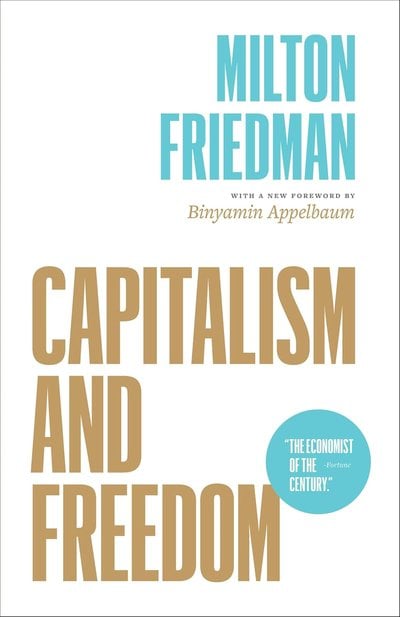
Milton Friedman makes an argument that sounds obvious once stated and is ignored constantly in practice: economic freedom and political liberty are not separate things. Concentrate enough economic power in the state and political liberty follows it into contraction. Friedman traces this across military conscription, licensing regimes, public schooling, and monetary policy – each one an area where the free market alternative produces better outcomes and costs the individual less coercion.
The book was written in 1962. Every case study in it has gotten worse since. Read it as a diagnostic, not a historical artifact.
“A society that puts equality before freedom will get neither. A society that puts freedom before equality will get a high degree of both.”
- Milton Friedman, Capitalism and Freedom
Man, Economy and State, Murray Rothbard (1962)
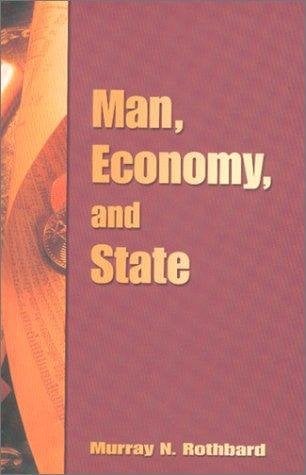
Murray Rothbard set out to write the treatise that completed and extended the Misesian framework, and that is exactly what Man, Economy and State is. Over fourteen hundred pages of clear prose – not padded, not academic throat-clearing – Rothbard walks through how voluntary exchange generates prices, how prices coordinate production, how money emerges from markets rather than being decreed into existence, and why every government intervention in that process produces the opposite of its stated purpose.
The companion volume, Power and Market, applies the analysis to the full range of state interventions. If you want to understand why the thing the congressman said would help you at the checkout counter did not help you at the checkout counter, start here.
“The free market is the name for a network of exchanges where no one uses violence or the threat of violence to extract something from another.”
- Murray Rothbard, Man, Economy and State
Economics in One Lesson, Henry Hazlitt (1946)
The one lesson is this: good economic analysis looks at the effects of a policy on all groups, not just the visible beneficiaries, and over the long run, not just the immediate term. Henry Hazlitt applies that single principle to rent control, tariffs, farm subsidies, public works spending, and a dozen other interventions that were politically popular in 1946 and remain politically popular today. The policy that appears to help the group you can see always harms the group you cannot see – the jobs not created, the housing not built, the goods not produced.
This is the entry point. If someone near you believes government management of prices is compassionate, hand them this book. It is short enough that they have no excuse not to finish it.
“The art of economics consists in looking not merely at the immediate but at the longer effects of any act or policy.”
- Henry Hazlitt, Economics in One Lesson
Anarchy, State, and Utopia, Robert Nozick (1974)

Robert Nozick was a Harvard philosopher who read Rawls’s A Theory of Justice – the twentieth century’s most influential academic case for redistribution – and wrote a point-by-point refutation that the philosophical establishment spent the next several decades refusing to answer adequately. His argument: individuals have rights, those rights function as constraints on what the state may do, and a state that taxes one person to benefit another is engaged in something that cannot be distinguished from forced labor at the level of principle.
The minimal state – courts, police, contract enforcement, nothing more – is the most a just government can legitimately be. Everything beyond it requires violating someone’s rights. That is a hard claim. Nozick proves it rigorously.
“Individuals have rights, and there are things no person or group may do to them without violating their rights.”
- Robert Nozick, Anarchy, State, and Utopia
Atlas Shrugged, Ayn Rand (1957)
Ayn Rand made the libertarian case in the form of a novel because she understood that arguments that reach only the intellect lose to arguments that reach the gut. Atlas Shrugged is not subtle – Rand did not do subtle – but it dramatizes with force what the dry economics texts demonstrate structurally: when the productive are systematically looted by a political class that calls the looting fairness, they eventually stop producing.
Dagny Taggart’s railroad is a vehicle for showing what collapse looks like from the inside, at the operational level, when every decision gets filtered through political favoritism instead of economic reality. Rand’s Objectivism parts ways with libertarian orthodoxy in places, but the indictment of collectivism lands all the same. Also read The Fountainhead.
“Do not let the hero in your soul perish, in lonely frustration for the life you deserved but never have been able to reach.”
- Ayn Rand, Atlas Shrugged
The Moon Is a Harsh Mistress, Robert Heinlein (1966)
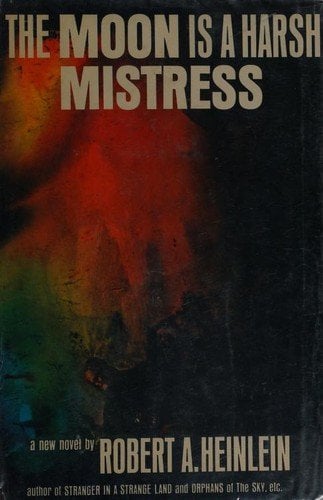
Robert Heinlein set his revolution on the Moon because a lunar penal colony is the logical endpoint of absentee managerial rule – a population treated as a resource extraction operation by a distant authority that cannot see it clearly and does not particularly care to. The libertarian arguments in The Moon Is a Harsh Mistress are structural: voluntary association, natural law operating without formal government, and the clear moral case for resisting rule imposed from the outside without consent.
Heinlein‘s lunar society is not pretty by conventional standards, but it is coherent. The book also happens to be his best piece of fiction. The phrase TANSTAAFL – There Ain’t No Such Thing As A Free Lunch – entered the political vocabulary here. It belongs in any serious libertarian‘s library for that alone.
“There is no worse tyranny than to force a man to pay for what he does not want merely because you think it would be good for him.”
- Robert Heinlein, The Moon Is a Harsh Mistress
Final Thoughts
Ten books. Several centuries of accumulated argument for a single proposition: that individuals, left to order their own affairs through voluntary exchange and association, produce better outcomes than any administrative class can engineer. Smith demonstrates it historically. Mises and Hayek demonstrate it theoretically. Hazlitt demonstrates it at the policy level. Nozick demonstrates it philosophically. Rand and Heinlein make it visceral. The canon holds together because the underlying claim is true – and because the managerial state that has been expanding through both Democratic and Republican administrations for the better part of a century has not gotten better at disproving it. Every new bureau, every new licensing regime, every new round of currency debasement is fresh evidence for the argument these books made decades ago.
What this list does not fully address is the question of democratic legitimacy itself – whether the mechanism by which the managerial state expands is itself the problem, not just its excesses. That argument is made with precision and force in Democracy: The God That Failed by Hans-Hermann Hoppe. Hoppe draws on Rothbard and the Austrian tradition to show that democratic government has a structural tendency to expand the state and discount the future – not because of bad politicians, but because of the incentive architecture of democracy itself. It is the book that closes the loop between the economic arguments on this list and the political question those arguments inevitably raise. Read it after Rothbard. Then read the introduction again.