
 BY
BY Table of Contents
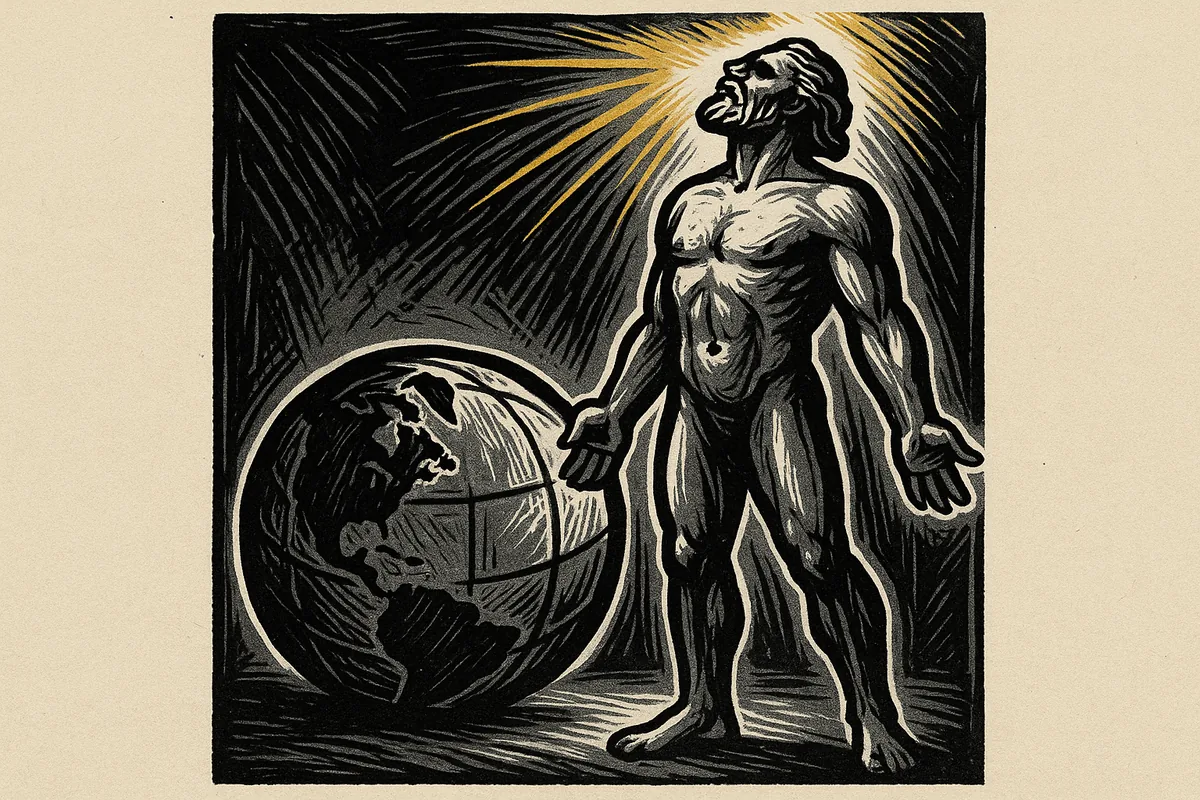
A productive civilization is not self-sustaining by accident. It runs on the judgment, the nerve, and the continued willingness of a specific kind of person – the person who actually builds things – to keep showing up. Atlas Shrugged is Ayn Rand‘s argument about what happens when that willingness runs out: not through conquest, not through plague, but through a slow, structured campaign by the second-rate to make the first-rate feel guilty for existing. The novel is a polemic in the original sense of the word. It picks a side and holds it for a thousand pages without apology, because Rand believed apology was already a concession to the other side’s premise.
What makes the book worth returning to – and what makes this particular set of quotes worth sitting with – is not the plot. It is the diagnosis. Rand is not describing a policy failure or a bad administration. She is describing a civilizational pathology: the systematic inversion of the relationship between production and parasitism, dressed up in the language of the common good. Her characters are not archetypes assembled for allegorical convenience. Each one is a case study in how that pathology operates and how it is resisted – or, more often, how it is enabled by the very people it destroys. The inventor who withdraws. The heir who plays the fool to protect what he values. The industrialist who keeps apologizing to the men prosecuting him. The executive who cannot bring herself to stop running a railroad for a world determined to run itself off the rails.
You do not have to accept Rand’s metaphysics, her ethics, or her opinions on architecture to get something sharp and useful out of these passages. The machinery she is describing – guilt as a control mechanism, productivity as a target, competence pathologized as selfishness – did not stop running when the novel went to print in 1957. If anything, the managerial class she caricatured has since professionalized. Read the quotes that follow with that in mind, and Galt’s strike starts to look less like fiction.
John Galt and the Strike of the Mind
“For twelve years, you have been asking: Who is John Galt? This is John Galt speaking. I am the man who loves his life. I am the man who does not sacrifice his love or his values.”
- Ayn Rand, Atlas Shrugged
“Rationality is the recognition of the fact that existence exists, that nothing can alter the truth and nothing can take precedence over that act of perceiving it, which is thinking – that the mind is one’s only judge of values and one’s only guide of action –
that reason is an absolute that permits no compromise.”
- Ayn Rand, Atlas Shrugged, Part 3: 'A Is A' (John Galt's radio address, Chapter 7)
“I started my life with a single absolute: that the world was mine to shape in the image of my highest values and never to be given up to a lesser standard, no matter how long or hard the struggle.”
- Ayn Rand, Atlas Shrugged, Part 3: 'A Is A' (John Galt's radio address, Chapter 7)
“Do not let your fire go out, spark by irreplaceable spark, in the hopeless swamps of the approximate, the not-quite, the not-yet, the not-at-all.
Do not let the hero in your soul perish, in lonely frustration for the life you deserved, but have never been able to reach.
The world you desire can be won. It exists, it is real, it is possible, it is yours.”
- Ayn Rand, Atlas Shrugged, Part 3: 'A Is A' (John Galt's radio address, Chapter 7)
“Ask yourself whether the dream of heaven and greatness should be left waiting for us in our graves – or whether it should be ours here and now and on this earth.”
- Ayn Rand, Atlas Shrugged, Part 3: 'A Is A' (John Galt's radio address, Chapter 7)
“The symbol of all relationships among such men, the moral symbol of respect for human beings, is the trader. We, who live by values, not by loot, are traders, both in matter and in spirit. A trader is a man who earns what he gets and does not give or take the undeserved.”
- Ayn Rand, Atlas Shrugged, Part 3: 'A Is A' (John Galt's radio address, Chapter 7)
“Happiness is not to be achieved at the command of emotional whims.
Happiness is not the satisfaction of whatever irrational wishes you might blindly attempt to indulge.
Happiness is a state of non-contradictory joy – a joy without penalty or guilt, a joy that does not clash with any of your values and does not work for your own destruction.”
- Ayn Rand, Atlas Shrugged, Part 3: 'A Is A' (John Galt's radio address, Chapter 7)
“We never make assertions, Miss Taggart. That is the moral crime peculiar to our enemies.
We do not tell – we show. We do not claim – we prove.
It is not your obedience that we seek to win, but your rational conviction.”
- Ayn Rand, Atlas Shrugged, Part 2: 'Either-Or' (Hugh Akston speaking to Dagny)
“I swear by my life and my love of it that I will never live for the sake of another man, nor ask another man to live for mine.”
- Ayn Rand, Atlas Shrugged, Part 3: 'A Is A' (Galt's oath, inscribed over the entrance to the power plant in Galt's Gulch)
“My morality, the morality of reason, is contained in a single axiom: existence exists – and in a single choice: to live.
The rest proceeds from these.
To live, man must hold three things as the supreme and ruling values of his life: Reason – Purpose – Self-Esteem.”
- Ayn Rand, Atlas Shrugged, Part 3: 'A Is A' (John Galt's radio address, Chapter 7)
“The only proper purpose of a government is to protect man’s rights, which means: to protect him from physical violence.
A proper government is only a policeman, acting as an agent of man’s self-defense, and, as such, may resort to force only against those who start the use of force.”
- Ayn Rand, Atlas Shrugged, Part 3: 'A Is A' (John Galt's radio address, Chapter 7)
Francisco’s Defense of Money
“I don’t like people who speak or think in terms of gaining anybody’s confidence. If one’s actions are honest, one does not need the predated confidence of others, only their rational perception.
The person who craves a moral blank check of that kind, has dishonest intentions, whether he admits it to himself or not.”
- Ayn Rand, Atlas Shrugged, Part 1: 'Non-Contradiction' (Francisco d'Anconia to Hank Rearden)
“Let me give you a tip on a clue to men’s characters: the man who damns money has obtained it dishonorably; the man who respects it has earned it.”
- Ayn Rand, Atlas Shrugged, Part 2: 'Either-Or' (Francisco d'Anconia's Money Speech, Chapter 2)
“Run for your life from any man who tells you that money is evil. That sentence is the leper’s bell of an approaching looter.
So long as men live together on earth and need means to deal with one another, their only substitute, if they abandon money, is the muzzle of a gun.”
- Ayn Rand, Atlas Shrugged, Part 2: 'Either-Or' (Francisco d'Anconia's Money Speech, Chapter 2)
“But you say that money is made by the strong at the expense of the weak? What strength do you mean?
It is not the strength of guns or muscles. Wealth is the product of man’s capacity to think.”
- Ayn Rand, Atlas Shrugged, Part 2: 'Either-Or' (Francisco d'Anconia's Money Speech, Chapter 2)
Hank Rearden and the Sanction of the Victim
“Whatever it was, he thought, whatever the strain and the agony, they were worth it, because they had made him reach this day – this day when the first heat of the first order of Rearden Metal had been poured, to become rails for Taggart Transcontinental.”
- Ayn Rand, Atlas Shrugged, Part 1: 'Non-Contradiction' (narrator, Rearden POV)
“People think that a liar gains a victory over his victim.
What I’ve learned is that a lie is an act of self-abdication, because one surrenders one’s reality to the person to whom one lies, making that person one’s master, condemning oneself from then on to faking the sort of reality that person’s view requires to be faked.
The man who lies to the world, is the world’s slave from then on. There are no white lies, there is only the blackest of destruction, and a white lie is the blackest of all.”
- Ayn Rand, Atlas Shrugged, Part 2: 'Either-Or' (narrator, Rearden POV)
“I thought that any human being who accepts the help of another, knows that good will is the giver’s only motive and that good will is the payment he owes in return.
But I see that I was wrong. You were getting your food unearned and you concluded that affection did not have to be earned, either.
You concluded that I was the safest person in the world for you to spit on, precisely because I held you by the throat. You concluded that I wouldn’t want to remind you of it and that I would be tied by the fear of hurting your feelings.
All right, let’s get it straight: you’re an object of charity who’s exhausted his credit long ago.”
- Ayn Rand, Atlas Shrugged, Part 2: 'Either-Or' (Hank Rearden to his brother Philip)
Dagny Taggart and the Refusal to Quit
“I’m not going to help you pretend – by arguing with you – that the reality you’re talking about is not what it is, that there’s still a way to make it work and to save your neck. There isn’t.”
- Ayn Rand, Atlas Shrugged, Part 1: 'Non-Contradiction' (Dagny Taggart to her brother James)
“Don’t think of them now. Never think of pain or danger or enemies a moment longer than is necessary to fight them. You’re here. It’s our time and our life, not theirs.”
- Ayn Rand, Atlas Shrugged, Part 3: 'A Is A' (John Galt to Dagny in Galt's Gulch)
“What greater wealth is there than to own your life and to spend it on growing? Every living thing must grow. It can’t stand still. It must grow or perish.”
- Ayn Rand, Atlas Shrugged, Part 3: 'A Is A' (Ellis Wyatt in Galt's Gulch)
The Looters and the Tyranny of the Second-Rate

“Man? What is man? He’s just a collection of chemicals with delusions of grandeur.”
- Ayn Rand, Atlas Shrugged, Part 1: 'Non-Contradiction' (Dr. Pritchett at Lillian Rearden's anniversary party)
“Miss Taggart, do you know the hallmark of the second-rater? It’s resentment of another man’s achievement.
Those touchy mediocrities who sit trembling lest someone’s work prove greater than their own – they have no inkling of the loneliness that comes when you reach the top. The loneliness for an equal – for a mind to respect and an achievement to admire.
They bare their teeth at you from out of their rat holes, thinking that you take pleasure in letting them know how much beneath you they are. You don’t.
You’d give a year of your life to meet a man you couldn’t beat.”
- Ayn Rand, Atlas Shrugged, Part 2: 'Either-Or' (Dr. Robert Stadler to Dagny)

“People don’t want to think. And the deeper they get into trouble, the less they want to think.
But by some sort of instinct, they feel that they ought to and it makes them feel guilty.
So they’ll bless and follow anyone who gives them a justification for not thinking. Anyone who makes a virtue – a highly intellectual virtue – out of what they know to be their sin, their weakness and their guilt.”
- Ayn Rand, Atlas Shrugged, Part 2: 'Either-Or' (Floyd Ferris to Dr. Robert Stadler)
“There’s no way to rule innocent men.
The only power any government has is the power to crack down on criminals.
Well, when there aren’t enough criminals, one makes them. One declares so many things to be a crime that it becomes impossible for men to live without breaking laws.”
- Ayn Rand, Atlas Shrugged, Part 2: 'Either-Or' (Floyd Ferris to Hank Rearden, the Rearden Metal patent coercion scene)
Final Thoughts
Atlas Shrugged was published in 1957, written across thirteen years, the longest novel of Rand’s life and the last she would ever write. Some readers find it indispensable; others find it intolerable. There is rarely a middle. The middle, in many ways, is what Rand was trying to diagnose.
If Rand’s argument lands and you want it pressed harder, read her The Virtue of Selfishness. It is the philosophical apparatus of Atlas Shrugged stripped of the narrative scaffolding - Rand and Nathaniel Branden making the argument directly, in essay form. If the argument doesn’t land and you want the most serious counterargument, read Whittaker Chambers’s 1957 review of Atlas Shrugged in National Review, “Big Sister Is Watching You.” Chambers - Soviet spy turned anti-communist witness, the man who put Alger Hiss in prison - was uniquely qualified to dismantle Rand on her own terms. He agreed with her about the threat and rejected her answer. Still the most-cited dismantling fifty-some years on.
For more Rand without the 1,168-page commitment, see our Ayn Rand Quotes page. For the same case made by other authors in different registers, see our Capitalism Quotes page.