
 BY
BY Negative Rights
Table of Contents
Negative rights are rights that require others only to refrain from action - to leave you alone, keep their hands off your property, and not interfere with your dealings. The duty they impose is a duty of non-interference, nothing more.
Negative rights are the rights that ask nothing of anyone except that they stay out of your way. No labor is owed to you, no property, no service. The only duty a negative right imposes is the duty of non-interference: do not take what is mine, do not block what I have the right to do, do not conscript my resources for your ends.
The Founders built their constitutional order on this foundation. Locke gave them the theory: life, liberty, and property belong to the individual before the state exists. The state exists, if it is legitimate at all, to protect those prior claims, not to redistribute them.
The Core Distinction

Your neighbor builds a fence on his own lot. Nobody owes him lumber or labor. They owe him one thing: leave it alone. That is a negative right at work.
A positive right works the other way. It places an affirmative duty on somebody else - usually the state - to supply something: a lawyer, a doctor’s visit, a school lunch. A negative right places only a prohibitive duty: do not interfere.
Isaiah Berlin gave the clearest modern statement in his 1958 Oxford lecture, “Two Concepts of Liberty.” Negative liberty is freedom from - the absence of obstacles imposed by other people. Positive liberty is freedom to - the capacity to act. The classical liberal tradition treated the negative sense as the prior one.
Everyone can refrain from aggression at the same time. Not everyone can be simultaneously supplied with every claimed entitlement. That asymmetry is the whole ballgame.
Where the Idea Comes From

John Locke’s Second Treatise laid the groundwork. Life, liberty, and estate are natural rights held against all comers. The farmer does not owe you a harvest. He owes you only that he leave your field alone.
Étienne de la Boétie made the older case in his Discourse on Voluntary Servitude. Tyranny persists because subjects keep cooperating. The whole argument rests on a prior assumption: that individuals hold a natural standing to be left alone.
Murray Rothbard systematized this in The Ethics of Liberty, available at Mises.org. All legitimate rights are negative in structure, he argued. They derive from self-ownership and extend to justly acquired property. Their enforcement requires nothing beyond prohibiting aggression.
Welfare rights, in Rothbard’s account, are category errors. Demands that someone else’s labor be conscripted to satisfy a claimed need. Russell Kirk arrived at the same place by a different road. The state’s expansion of positive entitlements does not fulfill rights - it displaces the family, the parish, and the voluntary association that once handled these needs without compulsion. For the long version of that argument, read Kirk’s The Conservative Mind.
How It Works in Practice
Private property is the cleanest example. Your negative right to your house means no one may enter without your say-so. It does not require a deed registry or a fence. It requires only that others keep their hands off.
Free exchange runs on the same logic. Two men agree on a price and shake hands. No third party’s permission is needed. Licensing boards, transaction taxes, and mandatory middlemen each impose a positive duty on someone who would otherwise owe nothing.
The minarchist case for limited government rests largely here. Fewer positive duties the state can mandate means more room for voluntary dealing.
The Sixth Amendment example shows where the collision gets sharp. The guarantee of counsel to the accused reads, for the defendant, as a positive right - the state must supply a lawyer. For the taxpayer, or the attorney pressed into service, it is a positive duty imposed without consent. Fifty defendants and five public defenders do not resolve through good intentions. Scarcity is real.
What Liberty Frees You To Build
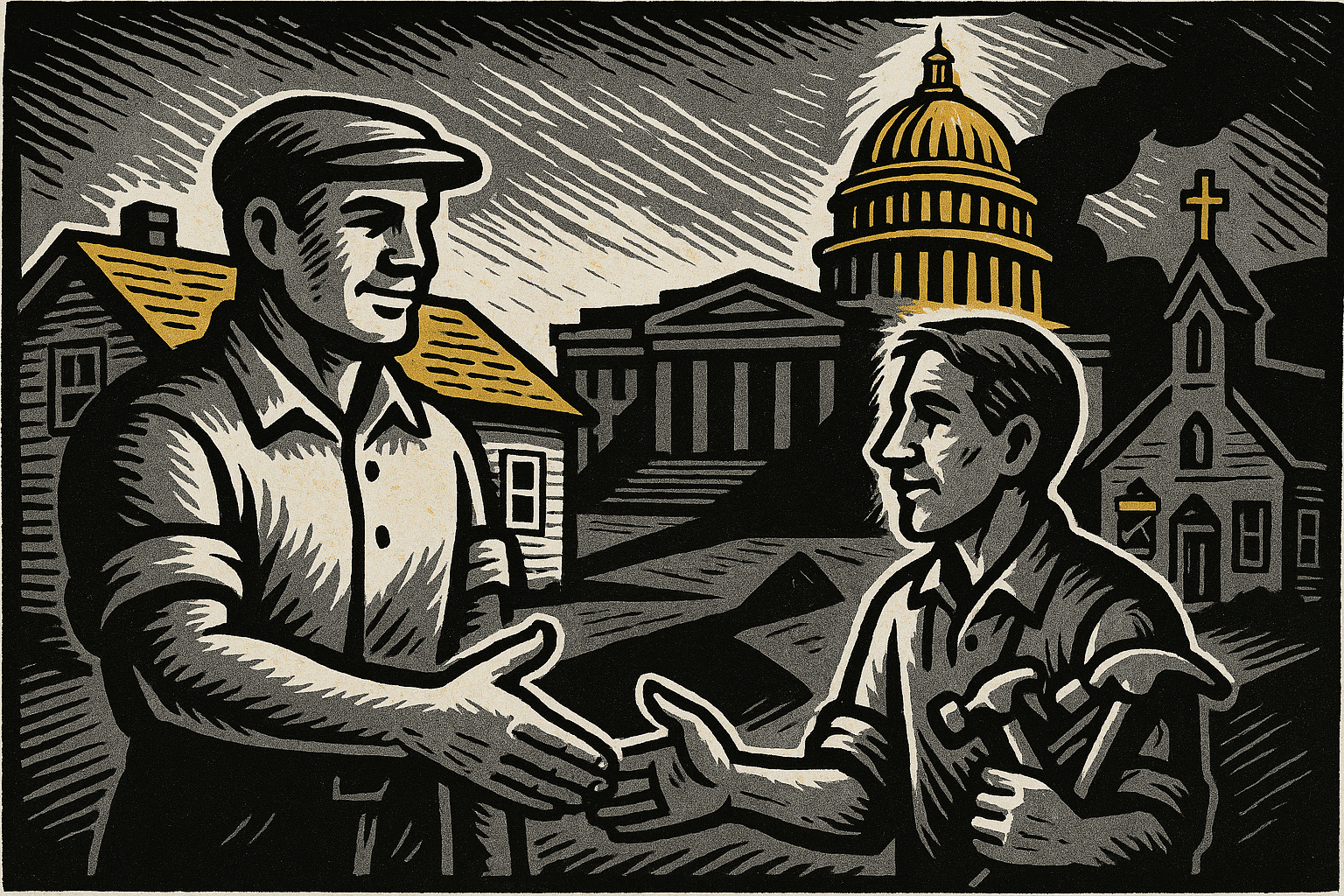
A man with a paid-off house and a small business has something real. He can hire the kid down the street whose father just died. He can carry a slow month for an apprentice. He can tell his sister to move in and figure it out later. That is not charity in the abstract. That is a man with margin acting like a man.
Strip that margin away - through taxes, through compliance costs, through the years spent credentialing for permission to do obvious work - and his generosity becomes a forwarded link to a GoFundMe. He still wants to help. He has nothing left to help with.
This is the affirmative case for negative rights. Not that you are free to do whatever pleases you. That is libertinism, and it is not what the tradition argues. The case is that the duty to care for the people you can name - the neighbor whose roof is going, the old widower at the end of the block, the kid at the community college who needs a foreman willing to take a chance - requires resources the state has already taxed away and responsibilities the state has already claimed for itself.
Russell Kirk called these the permanent things. The family. The parish. The neighborhood. The trade passed from one generation to the next. The managerial state does not destroy them by accident. It displaces them on purpose, substituting an administrative program for every web of mutual obligation it can reach. When the county runs the food pantry, the church does not need to. When the school counselor handles the troubled kid, the men on the block do not need to. The state does not merely crowd out private charity. It crowds out the relationships that make a town a town.
Negative rights clear the ground. What gets built on that ground is the whole point.
Why This Matters Now
The drift from negative to positive rights in American law is how the managerial state grows. Once a positive entitlement is recognized - to housing, healthcare, a living wage - the state needs both the money to fund it and the bureaucracy to deliver it. Both justify more taxation and more regulation.
Negative rights theory does not deny that human beings have real needs. A hungry man has a real problem. The theory denies that need generates an enforceable claim against a specific other person absent voluntary agreement. The baker’s labor is not conscriptable because a stranger is hungry.
The distinction matters because the alternative has no stopping place. Collapse every need into an enforceable claim and there is nothing left that cannot be seized.
The paleolibertarian and paleoconservative traditions share this skepticism of positive rights, even if they reach it by different roads. Both understand that when the state assumes responsibility for every human want, it hollows out every institution that once stood between the individual and the government.
The contrast between negative and positive rights is where almost every serious policy argument starts. Get that distinction wrong and the rest of the argument goes sideways.
« Back to Glossary Index