
 BY
BY Neo-feudalism
Table of Contents
Neo-feudalism is the term for a social and economic order in which wealth, capital, and political power are so concentrated in a narrow class that the broad population is reduced to a condition resembling medieval serfdom. Nominal freedoms remain on paper. Real independence does not.
Neo-feudalism is not a metaphor. It is a description of who holds the assets and who pays rent to hold them. The managerial class that James Burnham mapped in the 1940s has completed what he only predicted: it controls the capital, the credentialing systems, and the regulatory apparatus that keeps competitors out. What changed since Burnham is the scale of extraction. Housing, healthcare, and a college credential now consume decades of a working man’s income, and the renter who cannot accumulate cannot exit.
The affirmative answer is not complicated. A paid-off house is leverage. A trade your nephew learns from you is leverage. Savings that do not require a loan for a funeral are leverage. The system needs you renting. Stop renting.
Where the Term Comes From
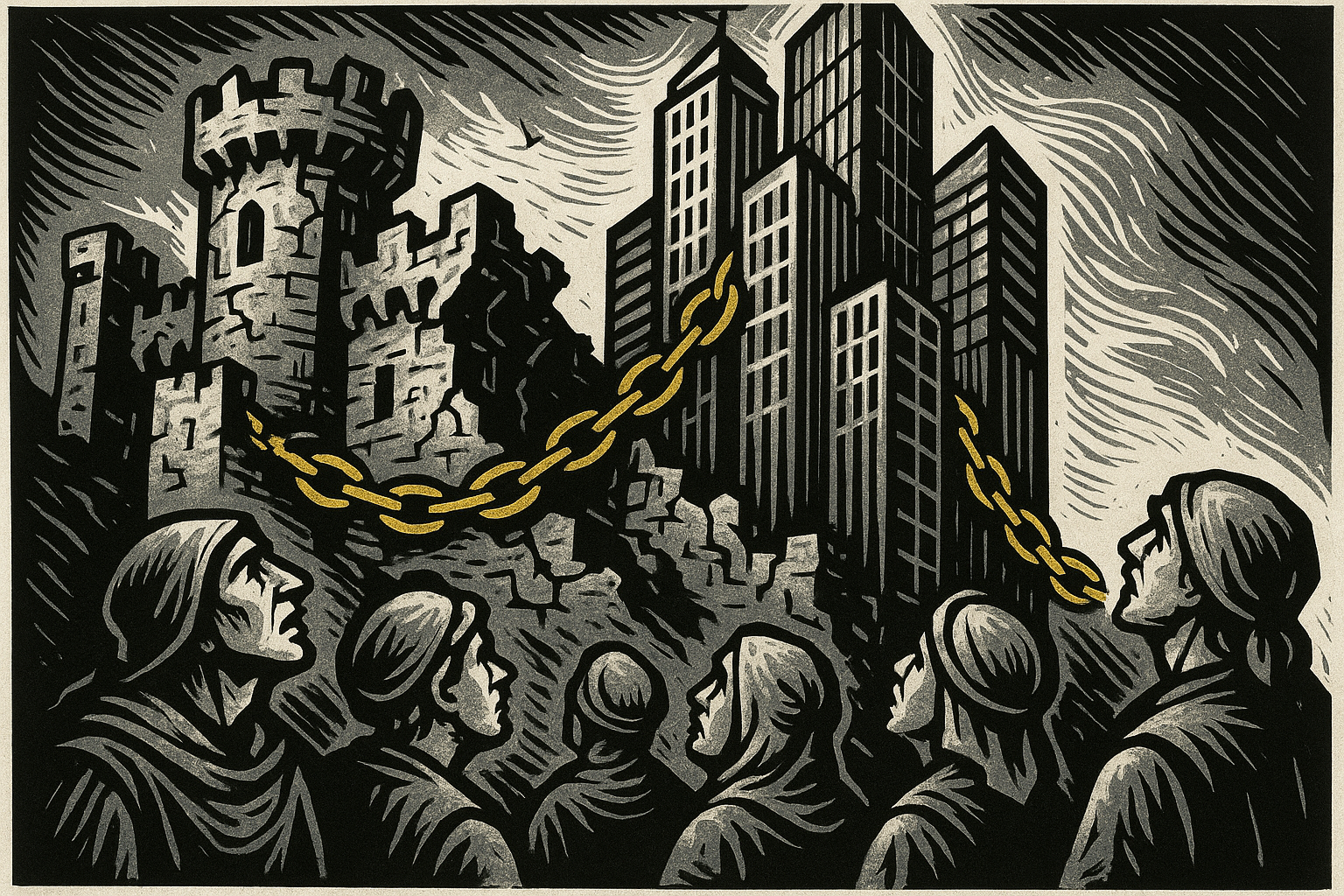
The medieval feudal order rested on three hard facts. Land belonged to a small nobility. The peasantry owed rents and labor to those landholders. Organized violence was the exclusive property of the mounted warrior class.
Neo-feudalism is the thesis that late modernity has rebuilt all three of those facts under new institutional forms. The titles changed. The dependency did not.
James Burnham got there first. His 1941 book The Managerial Revolution argued that ownership and control were separating - that a new managerial class was displacing both old capital owners and ordinary democratic majorities. Sam Francis extended that line, arguing the managerial state generates a self-perpetuating elite insulated from both market discipline and electoral correction. For the long version, read Francis’s Beautiful Losers.
Pat Buchanan was naming the same condition in plain English twenty years before it became fashionable. Neo-feudalism is the endpoint: a regime where a managerial gentry owns the commanding heights while the middle class rents its existence from them.
Three Mechanisms That Produce It
A renter trying to buy a house in 2024 and a homeowner who bought in 1985 are not operating in the same economy. That gap did not open by accident. Three mechanisms produce it.
- The Cantillon Effect. The Federal Reserve expands the money supply. The income tax redirects earnings before the earner touches them. Newly created money benefits first those closest to the point of issuance: large financial institutions, government contractors, favored industries. By the time it reaches wages and savings accounts, asset prices have already moved. Mises.org carries the full analysis of how inflation and fractional-reserve banking run a one-way transfer from patient savers to well-connected borrowers.
- Credential Capture. Access to professional employment is increasingly gated behind graduate degrees that run upward of $70,000 in borrowed money. The degree does not primarily signal competence. It signals willingness to submit to an expensive and ideologically uniform institution. The debt that follows functions as indenture, binding the graduate to employers large enough to service it. Surveillance-capitalism firms that consolidate those graduates understand the arrangement clearly.
- The Monopolization of Force. Classical republican theory, from Aristotle through the American founders, held that a citizenry capable of bearing arms was the ballast of self-governance. The distance between an infantry rifle and the weapons systems of a modern national-security state has grown considerably. The deterrent function of an armed citizenry still operates at the local and social level. But the power calculus has shifted from what earlier republican thinkers assumed.
The Middle Class as the Indicator to Watch
Jefferson called it the yeoman farmer. The twentieth century called it the small businessman and the homeowner with a paid-off house. Whatever the name, a broad property-owning middle class is the ballast against oligarchic consolidation.
When that class shrinks, economic hardship follows. So does political demobilization.
People without equity in the system - without homes, businesses, or savings worth protecting - have less reason to show up at the school board meeting, join the parish council, or run for township supervisor. Russell Kirk spent a career arguing that those mediating institutions between the individual and the state were the real substance of a free society. Neo-feudalism hollows them out by hollowing out the class that staffs them.
Home ownership among younger cohorts has declined steadily. Average household debt exceeds $90,000 when you add mortgages, auto loans, credit cards, and student obligations. Small business formation has trended downward relative to population for decades. Each of those numbers is a symptom.
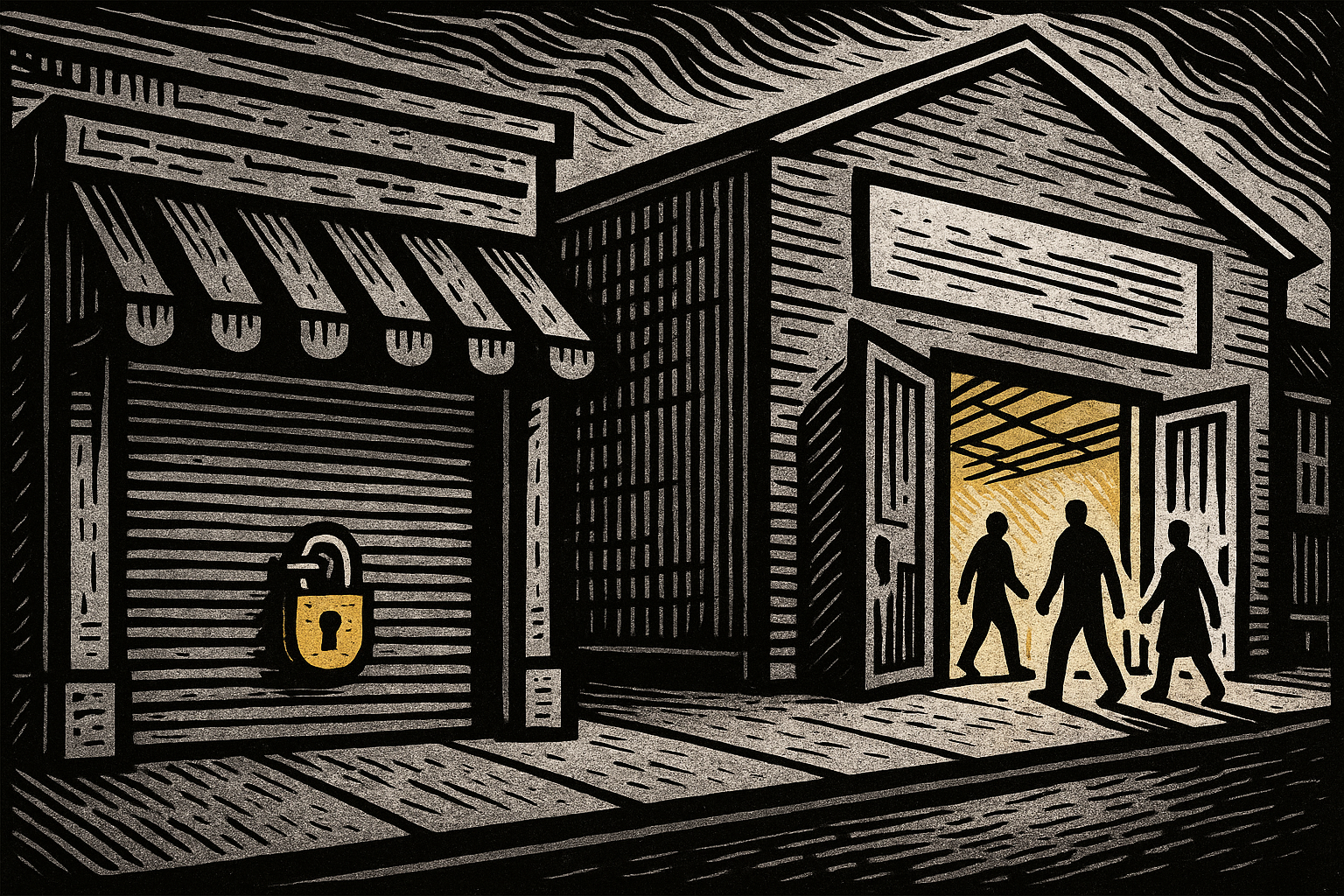
COVID-era lockdown policy made the process visible. It shuttered small businesses while large-box retailers stayed open. That was a consolidation event, not a public-health neutrality.
How Neo-Feudalism Differs From Related Terms
Kleptocracy names theft by rulers. It emphasizes the personal venality of those in power. Neo-feudalism emphasizes the outcome regardless of intent.
The corporate-government complex does not require a conspiracy. It requires only that regulators prefer large, legible institutions over small, distributed ones, and that monetary policy systematically rewards leverage. The serfs appear whether or not anyone planned for them.
Simple oligarchy describes rule by the wealthy. Neo-feudalism adds the feudal element, which is dependency. In oligarchy, the poor are excluded. In a neo-feudal order, the middle class is incorporated as dependent tenants - renting housing from institutional landlords, servicing student debt to credentialed gatekeepers, tethered to employer-provided health coverage that cannot travel from job to job.
The chains are financial and credentialing rather than agrarian. The relationship is still recognizable.
Those working in the paleolibertarian or paleoconservative tradition find neo-feudalism a useful diagnostic because it names a civilizational direction, not a policy error. One bill in Congress will not fix it. The implied remedy is a recovery of distributed ownership, local governance, hard money, and the cultural habits that sustain an independent middle class.
What to Do With the Diagnosis
Ownership matters more than income. A paid-off house, a small business, a tangible trade, or a productive piece of land represents a different kind of security than a salary contingent on an employer’s goodwill.
Etienne de la Boetie argued in The Politics of Obedience that voluntary servitude is sustained by dependency. Withdrawing cooperation while building alternative structures is the realistic path to freedom. That argument applies here.
Debt avoidance is a political act as much as a financial one. The assumption that the credential treadmill is the only road to a productive life has been one of the more effective pieces of perception management the managerial order has run.
Local institutions - churches, trade associations, mutual aid networks, the county fair, the volunteer fire company - rebuild the social capital that neo-feudalism requires you to rent from someone else.
The concentrated state and the concentrated corporation reinforce each other. You cannot fix one without addressing the other. That is the argument the Old Right was making before it was fashionable, and it is the argument worth returning to now.
« Back to Glossary Index