
 BY
BY 
Political non-fiction is a diagnostic instrument. Its purpose is not to flatter the reader or confirm what the regime’s approved curriculum already taught – it is to name the machinery that shapes your life before you ever get a vote, cast a ballot, or hire a lawyer. The books on this list do that work. They cover surveillance architecture, the slow death of constitutional limits, the concentration of wealth into a new oligarchic class, the psychology of mass persuasion, and the civilizational questions that statist politics is structurally incapable of answering. That is not an accident. These subjects connect. Read enough of them together and the outline of a system emerges – a kleptocratic, managerial order that reproduces itself through information control, credential gatekeeping, and the steady erasure of the institutional checks the Founding Fathers built precisely to prevent it.
This list does not pretend to be ideologically neutral. Neutral reading lists are a genre of their own kind of propaganda – the kind that tells you all perspectives are equally weighted and equally comfortable. They are not. Some of these books will unsettle assumptions you did not know you were carrying. A few concern war, power, and human nature in ways that the respectable consensus finds inconvenient. Several land squarely in the tradition of classical liberalism and its harder-edged descendants; others approach the same structural problems from different angles and arrive at conclusions that rhyme. If you are new to serious political reading, start at book one and follow the thread. If you are a seasoned reader, the gaps in your shelf will be obvious by page three of the first entry.
Table of Contents
No Place to Hide: Edward Snowden, the NSA, and the U.S. Surveillance State, Glenn Greenwald (2014)
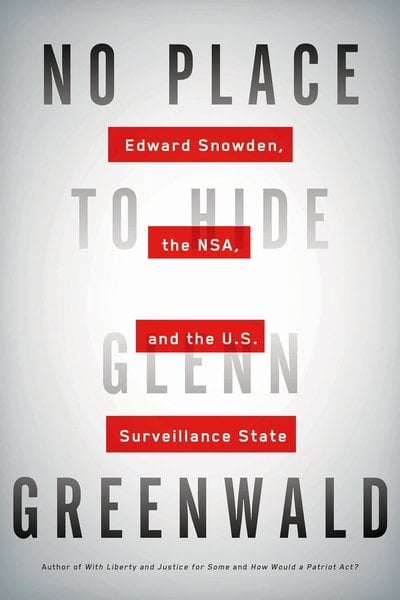
The central argument here is not that the NSA overstepped a boundary – it is that the boundary was methodically dismantled over decades, with the full cooperation of Congress, the courts, and the corporate-government complex that profits from mass data collection. Greenwald was the journalist who received Snowden’s documents directly, and this account is neither secondhand nor hedged. The surveillance apparatus described is not a rogue program; it is the normal operating condition of the modern security state, applied to every citizen regardless of suspicion.
What makes this book structurally important – beyond the revelations themselves – is its insistence on naming the institutional logic driving mass surveillance. Governments do not build total-information systems out of necessity; they build them because power, once available, is used. The perception management operation that followed Snowden’s disclosures – the framing of a whistleblower as a traitor – is itself a case study in how the managerial state controls the narrative around its own abuses. Read it alongside the history of the CIA on this list for full effect.
“The true measure of a society is found not in how it treats its most conformist members, but its most radical.”
- Glenn Greenwald, No Place to Hide
The Federalist Papers In Modern Language: Indexed for Today’s Political Issues, Mary E. Webster (1999)
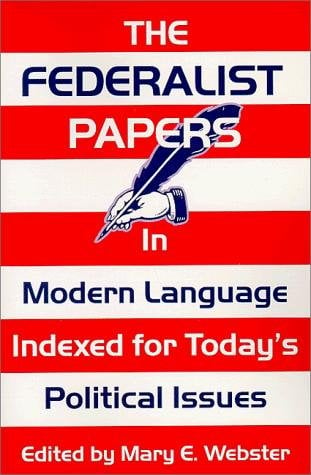
The Federalist Papers are not a historical curiosity. They are the closest thing to an operator’s manual for the constitutional order the Founding Fathers constructed – and they remain the most reliable guide to what that order was designed to prevent. Webster’s modernized edition removes the archaic syntax that causes contemporary readers to bounce off the primary source and gets the arguments onto the page clearly. The case for enumerated powers, separated authority, and structural checks on faction reads, in this translation, like a warning written specifically for the present moment.
The indexing by contemporary political issue is what elevates this edition above a simple reprint. You can locate Madison or Hamilton’s reasoning on executive overreach, standing armies, or the corruption of representative government and apply it directly to the question in front of you. The negative rights framework baked into the original design – government constrained, not empowered, by its founding document – comes through with full force. If you have opinions about constitutional law and have not read the Federalist Papers, those opinions are built on sand.
“If men were angels, no government would be necessary.”
- James Madison (via Mary E. Webster), The Federalist Papers In Modern Language
What Would the Founding Fathers Think: A Young American’s Guide to Understanding What Makes Our Nation Great and How We’ve Strayed, David Bowman (2012)

The question in the title is not rhetorical. It is a structural test – place current policy, current institutional behavior, and current political culture alongside what the men who built the republic explicitly intended, and measure the distance. Bowman writes accessibly, but the argument is not soft. The Founding Fathers built a system premised on limited government, local accountability, and the hard-won suspicion that concentrated power corrupts regardless of the intentions of those holding it. What exists now is something different in kind, not just degree.
The book works well as a civic primer for readers who missed a genuine constitutional education – which, given what passes for civics instruction in most public schools, is most readers. The framing through a younger person’s perspective keeps the argument concrete rather than abstract: what does limited government mean when you actually try to do something the state has decided it must regulate? The libertarian instinct running through the analysis aligns more with the original constitutional design than with anything that now calls itself conservatism in official Washington.
“The Founding Fathers knew that the price of liberty is eternal vigilance, and that government tends always to grow.”
- David Bowman, What Would the Founding Fathers Think
Legacy of Ashes: The History of the CIA, Tim Weiner (2007)
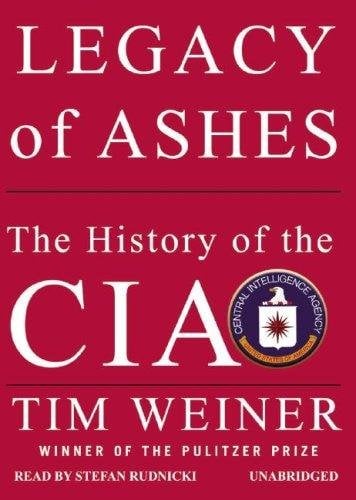
Weiner’s argument is caustic and meticulously sourced: the CIA has failed at its core mission – producing accurate, actionable intelligence – for most of its institutional life, and the failure is structural rather than a matter of bad personnel. The rot runs from the directorship down. Covert operations launched on bad information, political intelligence shaped to confirm what policymakers wanted to hear, congressional oversight treated as an obstacle – these are not aberrations but recurring institutional features. The agency that was supposed to prevent strategic surprise has delivered strategic surprise repeatedly, from Korea to Vietnam to the Soviet collapse to September 2001.
The deeper implication, which Weiner does not shy from, is that a permanent bureaucratic apparatus operating with minimal accountability and a classified budget is not a recipe for competence – it is a recipe for empire-building, turf protection, and the substitution of institutional self-preservation for actual national security. The realpolitik case for competent intelligence services only holds if the services are actually competent. Weiner demonstrates, decade by decade, that the premise fails.
“The CIA’s fundamental problems were not created by bad people. They were created by the institution itself.”
- Tim Weiner, Legacy of Ashes
Human Smoke: The Beginnings of World War II, the End of Civilization, Nicholson Baker (2008)

The received narrative of World War II is the last truly sacred myth of the American civic religion – the Good War, the Greatest Generation, the unambiguous triumph of civilization over barbarism. Baker does not argue against fighting fascism. He does something more uncomfortable: he assembles the documentary record of Allied decision-making, month by month, in the years before and during the war, and lets the primary sources speak. What emerges is a portrait of leaders on both sides who made choices that guaranteed mass civilian death when alternatives existed – including, for significant stretches, negotiated settlements that would have halted the killing.
The book has been called revisionist as though that word settles the argument. It does not. History that examines the full record rather than the approved portion is not revisionism – it is history. Baker’s method is collage rather than linear argument, which gives the work an unsettling cumulative weight: each vignette is sourced, each quotation is real, and the picture they build together cannot be waved away. For anyone serious about the relationship between state power, realpolitik, and the human cost of great-power conflict, this is indispensable reading.
“Churchill knew that bombing killed civilians. He’d been told. He wanted to bomb anyway.”
- Nicholson Baker, Human Smoke
The Coming of Neo-Feudalism: A Warning to the Global Middle Class, Joel Kotkin (2020)
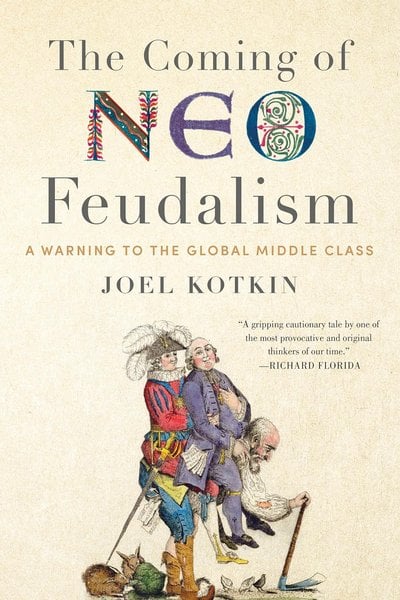
Kotkin names the emerging order plainly: neo-feudalism. The term is precise, not hyperbolic. What characterizes feudalism as a social structure is not the costumes or the castles but the concentration of land, capital, and political access in a hereditary or self-perpetuating elite, with a dependent population beneath it that has no realistic path to independent property or competitive standing. That structure is reassembling itself through the mechanisms of the knowledge economy, financialization, and the regulatory capture of the corporate-government complex. The middle class – which was historically the social stratum that made republican self-government possible – is being compressed out of existence.
Kotkin documents the mechanism across multiple sectors: housing markets locked by zoning and NIMBYism that protects gentry property values; higher education that reproduces credential aristocracy rather than genuine social mobility; tech platforms that function as private kleptocratic toll-collectors on the information economy. The warning in the subtitle is not abstract. When the independent middle disappears, what replaces republican governance is a managed oligarchy – benevolent in its self-presentation, suffocating in its structural effects. This book explains the mechanism before it completes.
“The new feudalism replaces the church with the corporation and the lord’s manor with the gated community.”
- Joel Kotkin, The Coming of Neo-Feudalism
The Storm Before the Calm: America’s Discord, the Coming Crisis of the 2020s, and the Triumph Beyond, George Friedman (2020)
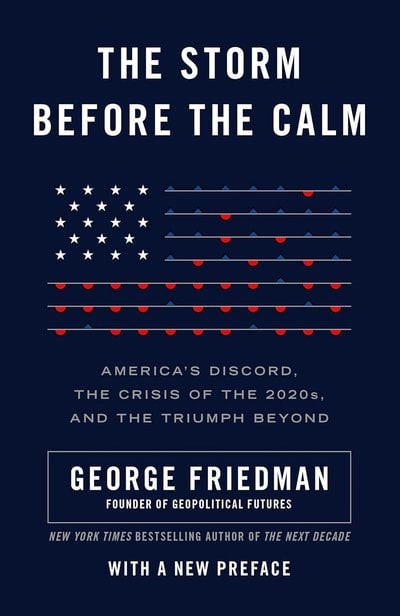
Friedman’s analytical frame is cyclical rather than catastrophist. He argues that American history runs on two overlapping institutional cycles – one roughly eighty years, one roughly fifty – and that the convergence of both cycles in the 2020s produces unavoidable systemic stress, the kind that looks like civilizational collapse from the inside but has, historically, produced institutional renewal on the far side. The economic dislocations of the last four decades, the collapse of Cold War consensus, the failures of the managerial class to deliver on its promises – all of these fit the cycle rather than marking a unique departure from American norms.
What makes Friedman’s analysis worth engaging seriously is the discipline of his realpolitik framework – he is not interested in ideological preferences, only in structural forces and historical precedent. The reader who disagrees with his conclusion, that the current crisis is temporary and resolution is coming, will still find the diagnostic apparatus useful. Understanding what kind of crisis you are in changes how you respond to it. Whether or not Friedman’s optimism is warranted, his mapping of the terrain is more rigorous than most of what passes for political analysis in the mainstream press.
“The United States has survived profound institutional failures before. The crisis is real. So is the recovery.”
- George Friedman, The Storm Before the Calm
The Consolations of Philosophy, Alain de Botton (2000)
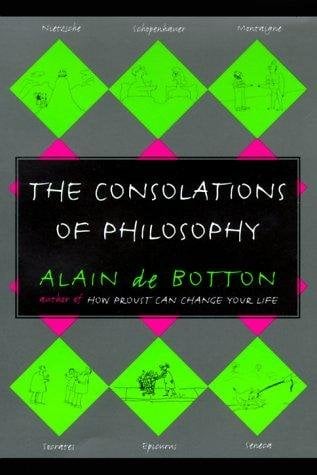
Philosophy enters this list because the structural analysis of the managerial state – however accurate – produces a particular psychological hazard: the paralysis of a man who sees the machine clearly and cannot see himself clearly at the same time. De Botton’s book is a practical intervention. He moves through six philosophers – Socrates, Epicurus, Seneca, Montaigne, Schopenhauer, Nietzsche – not as an academic survey but as a series of applied remedies for recognizable human difficulties. Unpopularity, insufficient money, frustration, inadequacy, broken hearts, difficulty. The Stoic and German Pessimist traditions, given particular attention here, are the ones with the most direct political relevance.
Seneca’s analysis of time and the tyranny of other people’s opinions reads as a direct antidote to the perception management culture that politics now runs on. The reader who internalizes Stoic discipline before engaging with surveillance states and neo-feudal oligarchies is better equipped than the one who does not. De Botton’s register is light without being shallow. This is philosophy made operational – which is what philosophy was always supposed to be before the academy converted it into a credentialing system.
“The philosopher Seneca was interested in one question above all others: how to be free.”
- Alain de Botton, The Consolations of Philosophy
The Happiness Hypothesis: Finding Modern Truth in Ancient Wisdom, Jonathan Haidt (2006)
Haidt’s project is to bring the accumulated moral psychology of ancient wisdom traditions into dialogue with contemporary cognitive science – and to ask which parts of what Plato, the Buddha, and the Stoics argued about the good life can survive contact with the experimental record. The answer is more of it than the secular academy expected. The emphasis on reciprocity, social embeddedness, earned rather than purchased status, and the corrupting effect of unbounded appetite appears across cultures and across centuries because it is tracking something real about human psychology rather than projecting local prejudice.
For political readers, the most important thread running through the book is the analysis of why people pursue status and what happens when they cannot achieve it through legitimate channels. A political culture that systematically blocks normal paths to earned standing – through credential inflation, economic immobility, the kind of neo-feudal stratification Kotkin documents elsewhere on this list – produces the resentment and social fragmentation now visible everywhere. Haidt does not draw that policy conclusion explicitly; the reader capable of connecting the psychology to the structural analysis will draw it without assistance.
“The mind is divided, like a rider on an elephant, and the rider’s job is to serve the elephant.”
- Jonathan Haidt, The Happiness Hypothesis
Influence: The Psychology of Persuasion, Robert B. Cialdini (1984)
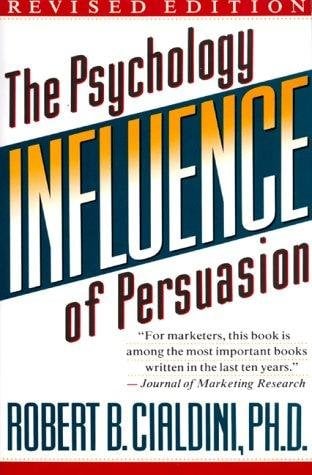
Cialdini identifies six principles – reciprocity, commitment, social proof, authority, liking, scarcity – through which human behavior is reliably moved without engaging the target’s rational deliberation. The book was written as a consumer protection manual of sorts: if you understand the mechanisms, you are harder to manipulate. That framing is accurate as far as it goes. But the more uncomfortable reading is structural: these mechanisms are not exploited only by car salesmen and direct mail marketers. They are the operational vocabulary of political campaigns, media framing, and the perception management operations through which the managerial state moves public opinion.
The chapter on authority is particularly relevant for anyone thinking about how regime legitimacy is manufactured and maintained. Deference to credentialed expertise – scientific, legal, bureaucratic – functions as a social-proof cascade that makes populations easier to govern and harder to mobilize in opposition. Understanding that the compliance mechanism is psychological rather than rational does not make it less powerful, but it makes it visible. Visible mechanisms can be resisted. Read this alongside the surveillance and propaganda books on the list and the picture of how modern governance actually operates becomes considerably clearer.
“The weapon of influence is simply a trigger for that compliance.”
- Robert B. Cialdini, Influence: The Psychology of Persuasion
The Undoing Project: A Friendship That Changed Our Minds, Michael Lewis (2016)
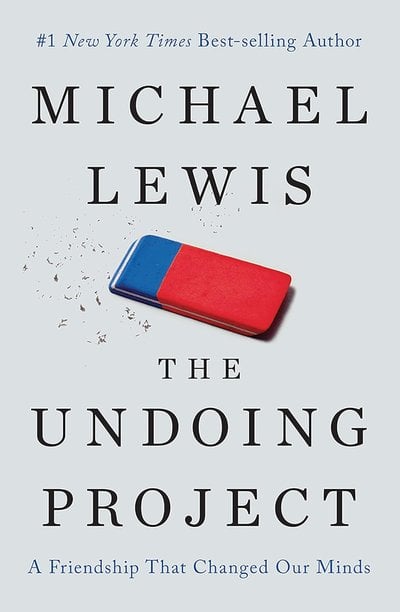
The rational actor model was not merely an academic assumption – it was the foundation on which an enormous architecture of public policy, economic regulation, and institutional design was built. If people reliably make choices consistent with their own interests when given accurate information, then the case for paternalistic intervention is weak, and the case for market processes is strong. Daniel Kahneman and Amos Tversky spent decades demonstrating, through controlled experiment, that the model is false. Human judgment is systematically biased in predictable ways, particularly under uncertainty, in ways that persist even after the subject is informed of the bias.
Lewis tells the story of the Kahneman-Tversky collaboration with the narrative skill that is his signature, but the ideas driving the book are the ones that matter. The political implications cut in multiple directions. The behavioral economics derived from their work has been used to justify statist nudge programs that substitute technocratic preference management for genuine choice. But the underlying finding – that expert judgment is also subject to systematic error – is an equally powerful argument against the managerial confidence that drives those same programs. The irony is baked in. Experts used the proof of human irrationality to justify expanding expert control over human behavior.
“The human mind is a pattern-seeking machine that finds patterns even when none exist.”
- Michael Lewis, The Undoing Project
12 Rules for Life: An Antidote to Chaos, Jordan B. Peterson (2018)

The controversy around this book is itself informative. Peterson’s argument is not novel in the history of moral philosophy – take responsibility for yourself before demanding the world reorganize around you, confront suffering honestly rather than resentfully, build the kind of order in your own life that makes civilization possible. These are old ideas with long pedigrees in both the Stoic and Judeo-Christian traditions. The fact that stating them in plain language in 2018 produced a coordinated institutional reaction says something about the current regime’s investment in preventing exactly this kind of moral independence in young men.
The book’s reach – millions of copies sold, a movement of readers who found it genuinely life-changing – reflects a real deficit. A generation of young men raised by institutions committed to atomization, grievance cultivation, and the replacement of earned self-respect with positive rights claims was not being served by the therapeutic culture or the political culture surrounding it. Peterson’s twelve rules are not a political program. They are prior to politics – the preconditions of a person capable of self-governance. That is why the panic was so acute. Self-governing people are harder to manage.
“Compare yourself to who you were yesterday, not to who someone else is today.”
- Jordan B. Peterson, 12 Rules for Life
The Lucifer Principle: A Scientific Expedition into the Forces of History, Howard Bloom (1995)

Bloom’s argument begins in microbiology and ends in geopolitics: violence, hierarchy, and the drive for dominance are not cultural pathologies grafted onto an otherwise peaceful species – they are structural features of life itself, present from the earliest organisms, operative at every level from the cell to the civilization. The Lucifer Principle is not that evil is triumphant but that it is inherent – a product of the same evolutionary machinery that produces cooperation, culture, and everything else human beings are capable of. Sanitizing this reality out of political analysis produces thinking that fails catastrophically when it meets the world.
The implications for political theory are significant. A politics built on the assumption of human perfectibility – that the right institutions, the right education, the right redistribution of resources will eliminate conflict and produce permanent cooperation – is not merely naive. It is dangerous, because it is a politics that cannot learn from failure. The realpolitik tradition, the classical conservative tradition, and the harder-edged strands of libertarian thought all share the premise that human nature is fixed and political design must account for it. Bloom provides the scientific foundation for that premise in terms the 21st century can engage with directly.
“Nature has cursed us with a desire for more than we can have, and the ambition of empires.”
- Howard Bloom, The Lucifer Principle
Final Thoughts
What this list reveals, read together rather than in isolation, is the shape of the system that has replaced the republic the Founding Fathers designed. The surveillance architecture, the neo-feudal concentration of property and access, the institutional rot inside the permanent security state, the psychological mechanisms through which compliance is manufactured – these are not separate problems. They are features of a single order: the managerial state, which legitimizes itself through expertise, administers through complexity, and expands by making its own intervention appear as the only solution to the crises it generates. That order has bipartisan support, a self-replicating credentialed class, and no internal mechanism for restraint.
The reader who finishes this list and wants to understand the theoretical skeleton beneath the empirical record should move directly to The Managerial Revolution by James Burnham. Written in 1941, before the postwar administrative state had fully consolidated, it predicted with structural precision the world these books document – the displacement of ownership by management, the replacement of political accountability by technocratic administration, the convergence of nominally opposed systems toward a single managerial logic. Burnham did not predict it as a warning or a wish. He predicted it as an analyst reading the forces already in motion. That it has proven so accurate is either encouraging, because it means the dynamics are legible, or alarming, because it means they are advanced. The books on this list argue, collectively, for clear eyes. Start there. For further reading in the same tradition, the libertarian canon and the literature on classical liberalism will fill out the picture considerably.