
 BY
BY Table of Contents
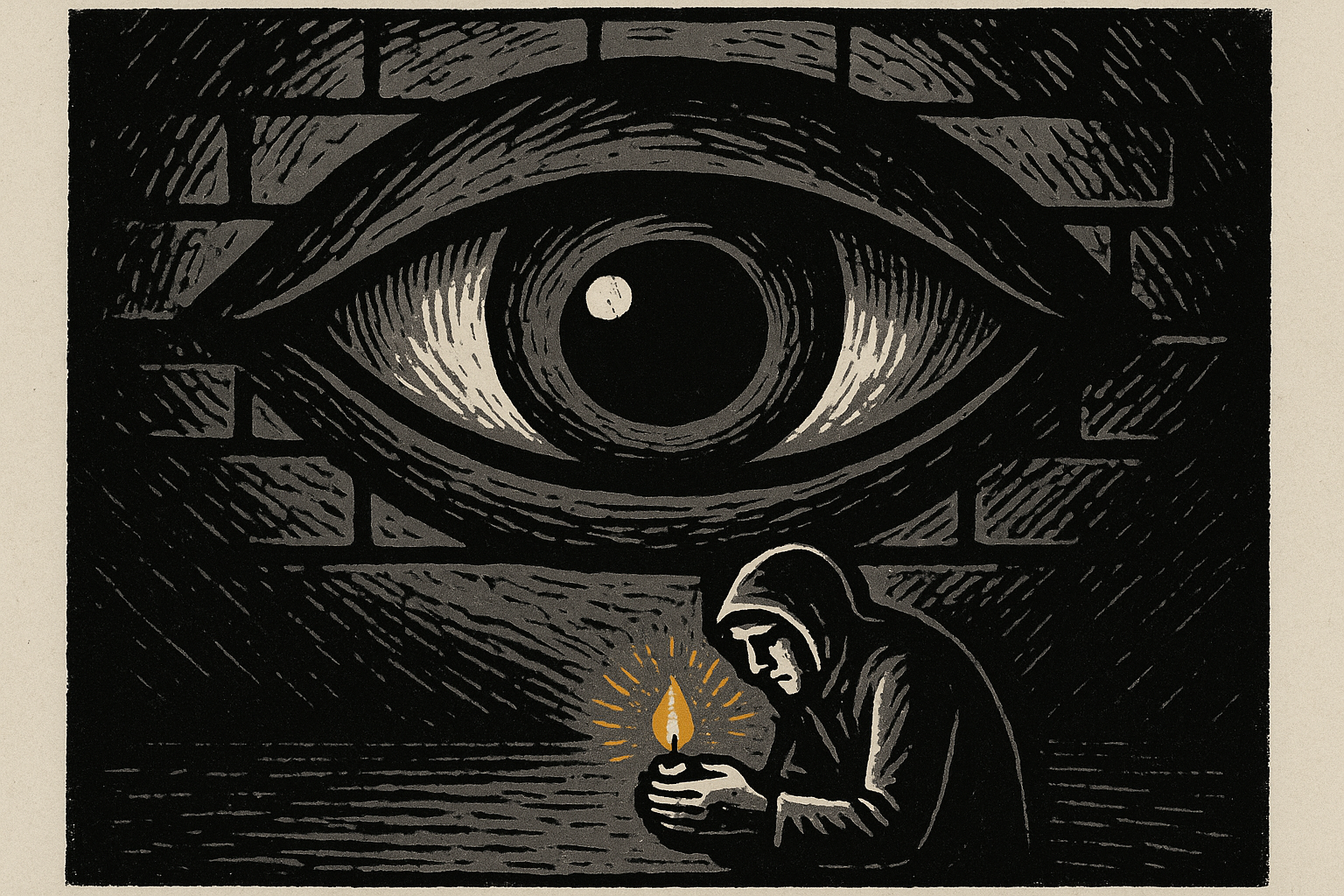
George Orwell’s Nineteen Eighty-Four is not a dystopian fantasy. It is a structural diagnosis – a dissection of how concentrated authority sustains itself through the control of language, memory, and perception. Published in 1949, the novel draws on Orwell’s direct experience with totalitarian movements in Spain and his observations of the emerging managerial state in postwar Britain. What he identified was not a peculiarity of fascism or Stalinism but a tendency inherent in any regime that subordinates the individual to a collective administered by a permanent bureaucratic class.
The mechanisms Orwell names – doublethink, the memory hole, thoughtcrime, the telescreen – are not relics of mid-century paranoia. They describe the operating logic of any system that requires its subjects to accept official reality over observed fact. When the Party commands Winston to reject the evidence of his own eyes and ears, it is not asking for mere compliance. It is demanding the internalization of helplessness. That demand, in various institutional forms, is not historically unique to Oceania.
The quotes gathered here come exclusively from Nineteen Eighty-Four. Read them for their diagnostic precision. Each line rewards slow attention – not as clever aphorism but as a precise description of a mechanism. Identify the mechanism, and you begin to see it operating in places Orwell never named.
On Power and Oppression
“You are a difficult case. But don’t give up hope. Everyone is cured sooner or later. In the end we shall shoot you.”
- George Orwell, Nineteen Eighty-Four
“The masses never revolt of their own accord, and they never revolt merely because they are oppressed. Indeed, so long as they are not permitted to have standards of comparison, they never even become aware that they are oppressed.”
- George Orwell, Nineteen Eighty-Four
“Orthodoxy means not thinking – not needing to think. Orthodoxy is unconsciousness.”
- George Orwell, Nineteen Eighty-Four
“Power is not a means, it is an end. One does not establish a dictatorship in order to safeguard a revolution; one makes the revolution in order to establish the dictatorship. The object of persecution is persecution. The object of torture is torture. The object of power is power.”
- George Orwell, Nineteen Eighty-Four
“’Who controls the past controls the future: who controls the present controls the past,’ repeated Winston obediently.”
- George Orwell, Nineteen Eighty-Four
“There will be no loyalty, except loyalty towards the Party.
There will be no love, except the love of Big Brother.
There will be no laughter, except the laugh of triumph over a defeated enemy.
There will be no art, no literature, no science. When we are omnipotent we shall have no more need of science.
There will be no distinction between beauty and ugliness.
There will be no curiosity, no enjoyment of the process of life.
All competing pleasures will be destroyed.
But always – do not forget this, Winston – always there will be the intoxication of power, constantly increasing and constantly growing subtler.”
- George Orwell, Nineteen Eighty-Four
“At the apex of the pyramid comes Big Brother. Big Brother is infallible and all-powerful. Every success, every achievement, every victory, every scientific discovery, all knowledge, all wisdom, all happiness, all virtue, are held to issue directly from his leadership and inspiration.”
- George Orwell, Nineteen Eighty-Four
“We know that no one ever seizes power with the intention of relinquishing it.”
- George Orwell, Nineteen Eighty-Four
“The object of terrorism is terrorism. The object of oppression is oppression. The object of torture is torture. The object of murder is murder. The object of power is power. Now do you begin to understand me?”
- George Orwell, Nineteen Eighty-Four
“What can you do, thought Winston, against the lunatic who is more intelligent than yourself; who gives your arguments a fair hearing and simply persists in his lunacy?”
- George Orwell, Nineteen Eighty-Four
On War and Struggle
“War is peace. Freedom is slavery. Ignorance is strength.”
- George Orwell, Nineteen Eighty-Four
“Everywhere there is the same pyramidal structure, the same worship of semi-divine leader, the same economy existing by and for continuous warfare. It follows that the three super-states not only cannot conquer one another, but would gain no advantage by doing so.”
- George Orwell, Nineteen Eighty-Four

“The old civilizations claimed that they were founded on love or justice. Ours is founded upon hatred. In our world there will be no emotions except fear, rage, triumph, and self-abasement. Everything else we shall destroy – everything.”
- George Orwell, Nineteen Eighty-Four
About Truth and Politics
“If the facts say otherwise, the facts must be altered.”
- George Orwell, Nineteen Eighty-Four

“If you want to keep a secret, you must also hide it from yourself.”
- George Orwell, Nineteen Eighty-Four
“The Party told you to reject the evidence of your eyes and ears. It was their final, most essential command.”
- George Orwell, Nineteen Eighty-Four
“It was a bright cold day in April, and the clocks were striking thirteen.”
- George Orwell, Nineteen Eighty-Four
About Manipulation
“You hate him. Good. Then the time has come for you to take the last step. You must love Big Brother. It is not enough to obey him: you must love him.”
- George Orwell, Nineteen Eighty-Four
“To keep them in control was not difficult. All that was required of them was a primitive patriotism which could be appealed to whenever it was necessary to make them accept longer working hours or shorter rations.”
- George Orwell, Nineteen Eighty-Four
“Every record has been destroyed or falsified, every book rewritten, every picture has been repainted, every statue and street building has been renamed, every date has been altered.”
- George Orwell, Nineteen Eighty-Four
About Surveillance
“Big Brother is watching you.”
- George Orwell, Nineteen Eighty-Four
“In the far distance a helicopter skimmed down between the roofs, hovered for an instant like a bluebottle, and darted away again with a curving flight. It was the police patrol, snooping into people’s windows.”
- George Orwell, Nineteen Eighty-Four
“The poster with the enormous face gazed from the wall. It was one of those pictures which are so contrived that the eyes follow you about when you move.”
- George Orwell, Nineteen Eighty-Four
“It was terribly dangerous to let your thoughts wander when you were in any public place or within range of a telescreen.
The smallest thing could give you away.
A nervous tic, an unconscious look of anxiety, a habit of muttering to yourself – anything that carried with it the suggestion of abnormality, of having something to hide.
In any case, to wear an improper expression on your face (to look incredulous when a victory was announced, for example) was itself a punishable offence.”
- George Orwell, Nineteen Eighty-Four
Final Thoughts
What makes Orwell difficult to dismiss is that he is not arguing from an ideological program. He is reporting on the functional logic of power – how it reproduces itself, how it degrades language to sustain compliance, how it replaces memory with managed narrative. The Party in Nineteen Eighty-Four is not a caricature of one particular regime. It is a model of what any governing class tends toward when the structural constraints on its behavior are removed. The question Orwell forces you to ask is not whether this could happen, but whether you would recognize it if it were already underway.
The voluntary dimension of unfreedom is the piece most readers underweight. Winston’s real defeat is not physical – it is the moment he genuinely loves Big Brother. Etienne de la Boetie identified this mechanism centuries before Orwell, in the essay that became The Politics of Obedience: The Discourse of Voluntary Servitude: tyranny does not persist by force alone, but because subjects habituate themselves to it and eventually cease to imagine alternatives. For those who want to understand why Oceania does not require constant overt coercion – and what that implies for present institutions – de la Boetie remains the essential companion text to Orwell.
Read these quotes as a diagnostic tool, not a literary exercise. Identify the mechanism in each line. Then look for where that mechanism appears in the institutional arrangements you actually inhabit – in the management of permissible speech, the revision of recent history, the demand that compliance shade into enthusiasm. Orwell’s vocabulary was not invented for Oceania. He borrowed it from the world around him, and the world around you is not categorically different.
For readers who want the structural diagnosis Orwell points toward but does not name, the next step is Leviathan and Its Enemies by Sam Francis. Where Orwell renders the totalitarian regime in fiction, Francis maps the actual managerial class that runs every modern bureaucratic order – the credentialed administrators, the corporate-government complex, the institutional apparatus that displaces both democratic accountability and traditional ownership. Read together they form a single argument: the surveillance state Orwell warned about is not coming. It already arrived, in a form he did not quite anticipate but would have recognized immediately.