
 BY
BY Agorism
Table of Contents
Agorism is the political philosophy, developed by Samuel Edward Konkin III, that advocates building a free society through counter-economics - voluntary market activity that operates outside state control, taxation, and regulation. The term derives from the Ancient Greek agora, the open marketplace at the center of civic life.
Agorism is the libertarian-anarchist strategy of building a free society not by winning elections or passing legislation but by expanding the sphere of voluntary exchange that the state cannot easily tax, regulate, or conscript. Samuel Edward Konkin III named it and theorized it; the Rothbard-adjacent paleolibertarian tradition recognized in it something older than any political program: the simple refusal to make the regime’s consent a precondition for living rightly.
Voluntary withdrawal from the state’s circuits is not avoidance. It is how civilization persists when the institutions that claim to represent it have become the primary threat to it. The cash side-business, the trade taught nephew-to-uncle, the parish benevolence fund that buries its own: these are not romantic gestures. They are the agora, rebuilt at human scale.
Where the Word Comes From
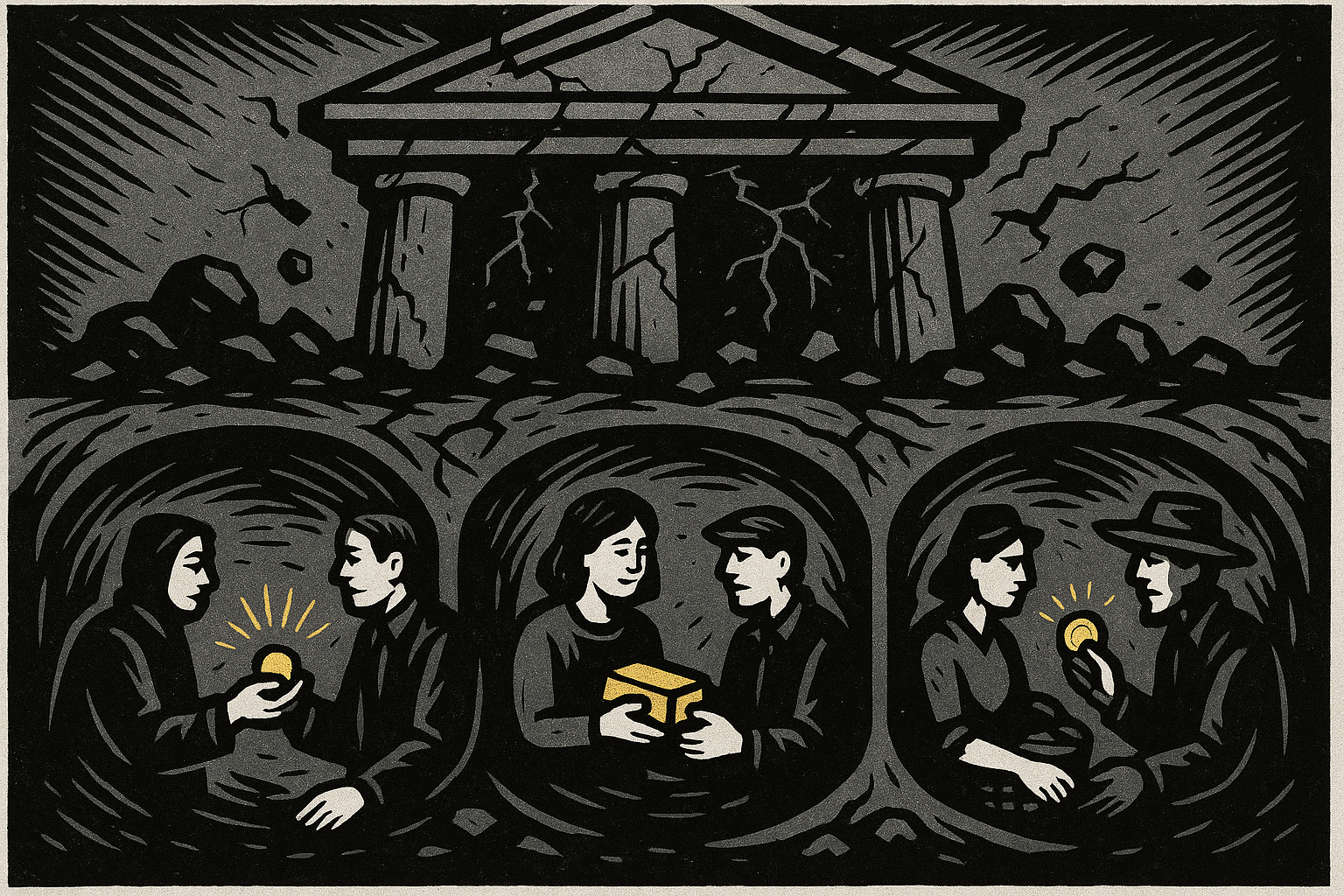
Picture the center of an ancient Greek city. Not the courthouse. Not the temple. The open square where men traded grain, argued prices, and settled debts on a handshake. That square was the agora.
Samuel Edward Konkin III - known in libertarian circles as SEK3 - coined the term agorism in the 1970s. He took that Greek image seriously. The agora was the model: free people exchanging freely, no bureaucrat in the middle.
Konkin was an American libertarian of the anarchist stripe. He read Mises. He absorbed Rothbard. But he broke with both on a fundamental question: how do you actually get from here to a free society?
The Debate That Defined the Movement
The early libertarian movement had an argument it never fully settled. Three camps fought over strategy, and the fight still matters today.
- The Party Route. Build a political party. Run candidates. Win offices. The Libertarian Party was the vehicle. Rothbard backed it hard in its early years. He saw electoral politics as a lever worth pulling.
- The Republican Route. Work inside the GOP. Find the libertarian factions already there. Use an established party’s infrastructure to move ideas from the fringe to the floor. A practical argument, even if it has never quite delivered.
- The Ideas Route. Spread the philosophy through universities, think tanks, and culture. Friedrich Hayek’s essay “Intellectuals and Socialism” was the text behind this strategy. Change what intellectuals believe, and policy follows.
Konkin rejected all three. He called conventional political activism “partyarchy.” His word, his contempt. Playing the state’s game, he argued, only legitimizes the state. You lose before you start.
Counter-Economics: The Agorist Method

Konkin’s answer was counter-economics. That means every transaction that happens outside the state’s reach. Cash sales. Barter. Side work off the books. Competing currencies. Businesses that never file the paperwork.
None of that is violent. That is the point. Agorism is a strategy of withdrawal and parallel construction, not confrontation. You do not march on the capital. You quietly stop feeding the machine.
The grey market is everyday cash transactions the state wants to tax but cannot easily trace. The black market is activity the state has banned outright - regardless of whether anyone is actually harmed. Both, in the agorist view, represent the real free market operating in the space the state cannot fully occupy.
The long-term vision: enough people transact outside the state’s reach, the state starves. Revenue dries up. Its ability to enforce regulations collapses. Alternative institutions - private arbitration, mutual aid, competing currencies - fill the gap. For a deeper look at how voluntary exchange contrasts with state-enforced obligation, see the entry on negative rights.
Konkin and Rothbard: Where They Split
Murray Rothbard was the giant of anarcho-capitalism. He and Konkin agreed on the destination - a stateless society based on voluntary exchange. They fought hard over the road.
Rothbard was a political animal. He loved coalition-building. He courted the Old Right. He courted the New Left. He saw the repeal of bad laws as a genuine victory worth pursuing through ordinary politics. For the full depth of Rothbard’s framework, read For a New Liberty.
Rothbard also had a concrete critique of counter-economics. Black markets, he pointed out, have existed throughout all of human history. The Roman Empire had them. Medieval kingdoms had them. Not once did they dissolve the state. The state adapted, cracked down, and survived.
Konkin’s reply was that Rothbard underestimated scale and technology. Modern encryption, digital cash, and decentralized networks change the math. The agorist project looks different now than it did in 1974.
For the deeper Rothbard position on anarcho-capitalism, his For a New Liberty remains the place to start.
What You Build When You Keep What You Earn
A man with a paid-off house and three months of savings in the bank can bury his neighbor. He can keep an apprentice on payroll through a slow winter. He can take in his sister’s kids when she hits a bad year. That is not a political theory. That is a fact about material capacity.
Strip that away - through taxes, inflation, compliance costs, and the thousand small fees the state extracts before you can open a business or swing a hammer legally - and his generosity becomes rhetorical. He can share a fundraising link. He cannot write the check.
This is what agorism is really after. Not the freedom to do whatever you want. The freedom to do what matters. Russell Kirk called them the permanent things: family, faith, the local community, the obligations you owe to people you can name. The state does not abolish those obligations. It just makes them harder to fulfill by taking the resources that would have funded them.
Counter-economics, at ground level, is a man keeping more of what he produces and directing it himself. The mechanic who takes cash and tithes it at his parish. The contractor who barters labor with the farmer down the road and has something left to give when the farmer’s wife gets sick. The woman who runs a home business off the books and pays her neighbor to watch the kids, keeping two families solvent without a single government form.
De la Boetie saw this clearly five centuries ago. The tyrant has nothing of his own. Everything he has, you gave him. Take it back - quietly, through a hundred small decisions - and the things you were supposedly giving it up to fund get funded anyway. By you. For people you actually know.
Agorism’s Place on the Map
Agorism sits in an unusual spot. It shares the anarcho-capitalist rejection of the state. But it has left-libertarian leanings too - Konkin was suspicious of corporate power and had sympathy for labor that works outside wage structures controlled by the state.
The minarchist tradition - limited government, not no government - has little patience for agorism. You cannot vote for a smaller state if you refuse to vote at all.
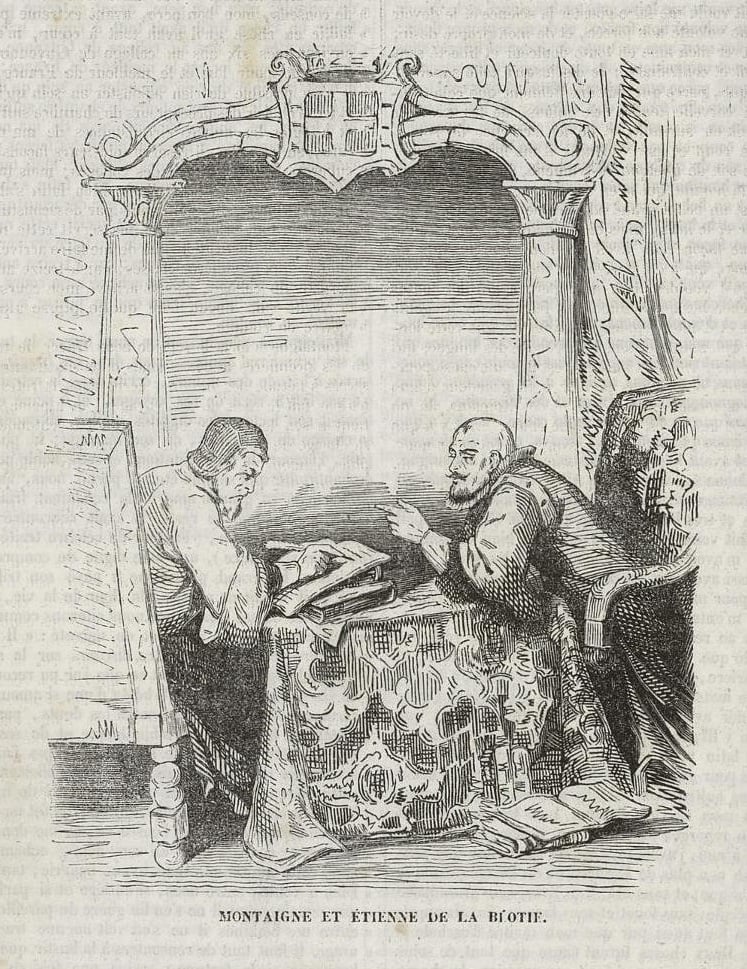
What animates the agorist is something older than the libertarian movement itself. Etienne de la Boetie made the core argument in the 16th century. In The Politics of Obedience, he asked why millions obey one tyrant. His answer: they supply him. Stop supplying him, and the tyranny collapses of its own weight. Konkin read that argument and built a modern strategy around it.
The practical turn in agorism today runs through cryptocurrency, encrypted communications, and what writers like Paul Rosenberg call the parallel society - building institutions that make the state’s services unnecessary rather than fighting the state directly. Rosenberg’s A Lodging of Wayfaring Men is the fiction version of this project. His newsletter Freeman’s Perspective is the working manual.
Whether it scales is still an open question. Rothbard’s critique has not been answered in full. But as the statist apparatus grows heavier - more surveillance, more regulation, more taxation - the agorist bet looks less naive than it once did.
« Back to Glossary Index