
 BY
BY Table of Contents
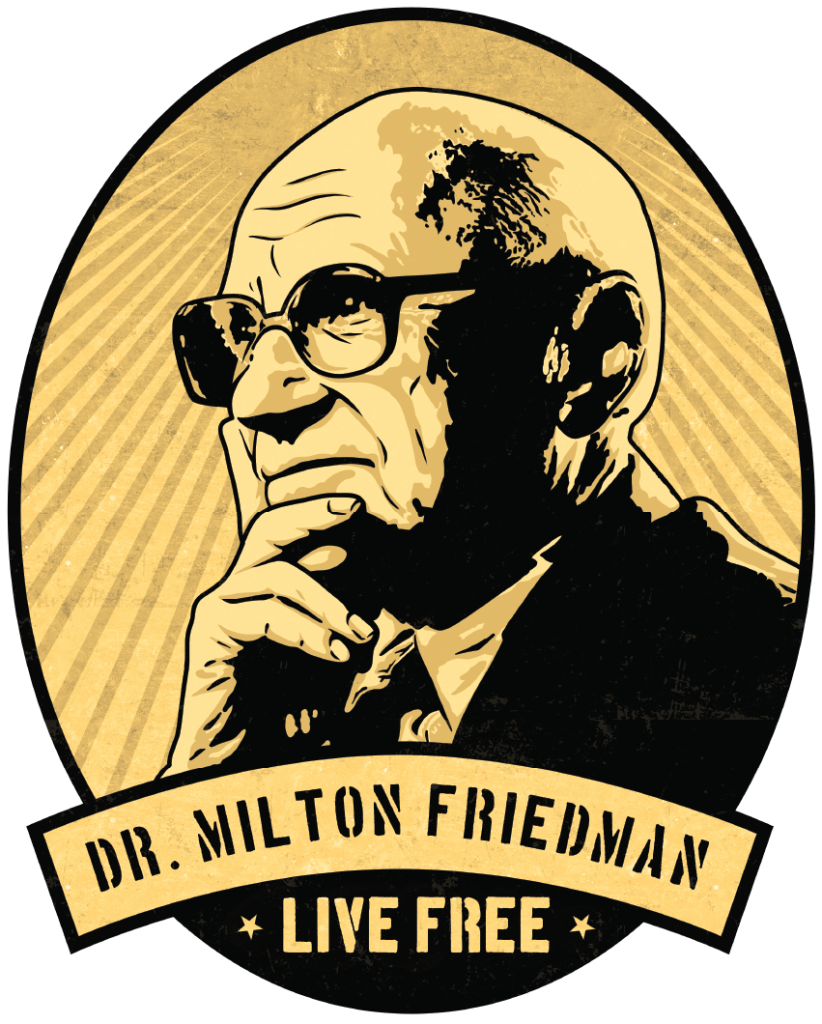
Milton Friedman understood something most economists are professionally trained to obscure: that every government program is ultimately a gun pointed at someone. Not metaphorically – literally. The state does not request compliance; it compels it. Friedman’s singular contribution was forcing that fact into the open, in plain English, in living rooms and lecture halls, against opponents who preferred the comfortable fiction that policy was just administration and redistribution was just arithmetic. He was the most effective popular defender of free markets the twentieth century produced – and effectiveness, in intellectual combat, is not a minor virtue.
The argument running beneath all of Friedman’s work is structural, not incidental. He was not merely criticizing bad legislation or inefficient agencies. He was diagnosing a disease: the permanent tendency of the managerial state to expand its jurisdiction, recruit its own constituency, and then cite the resulting disorder as justification for further expansion. Inflation, occupational licensing, the drug war, public schooling, Federal Reserve discretion – these were not separate problems requiring separate reforms. They were symptoms of a single pathology: concentrated power insulated from the consequences of its own decisions. Friedman kept dragging the argument back to that root, chapter after chapter, interview after interview, with a patience that never softened the underlying charge.
The quotes collected below – on freedom, inflation, greed, government growth, and the iron logic of unintended consequences – are not decorative. They are the load-bearing arguments, stripped to their essentials. Read them as Friedman intended them: not as reassuring aphorisms for the already convinced, but as direct challenges to assumptions most people absorb without examination and defend without thinking. If a quote stops you, that is the point. Sit with the friction. That is where the argument actually begins.
Friedman on Capitalism and Freedom
“A society that puts equality before freedom will get neither. A society that puts freedom before equality will get a high degree of both.”
- Milton Friedman
“It is widely believed that politics and economics are separate and largely unconnected; that individual freedom is a political problem and material welfare an economic problem; and that any kind of political arrangements can be combined with any kind of economic arrangements.”
- Milton Friedman, Capitalism and Freedom
“A major source of objection to a free economy is precisely that it gives people what they want instead of what a particular group thinks they ought to want. Underlying most arguments against the free market is a lack of belief in freedom itself.”
- Milton Friedman, Capitalism and Freedom
“I think that nothing is so important for freedom as recognizing in the law each individual’s natural right to property, and giving individuals a sense that they own something that they’re responsible for, that they have control over, and that they can dispose of.”
- Milton Friedman
“The great virtue of a free market system is that it does not care what color people are; it does not care what their religion is; it only cares whether they can produce something you want to buy.
It is the most effective system we have discovered to enable people who hate one another to deal with one another and help one another.”
- Milton Friedman
Friedman on Greed and Self-Interest

“Is there some society you know that doesn’t run on greed? You think Russia doesn’t run on greed? You think China doesn’t run on greed? What is greed? Of course none of us are greedy. It’s only the other fellow who’s greedy. The world runs on individuals pursuing their separate interests.”
- Milton Friedman, The Phil Donahue Show
“Is it really nobler to pursue political self-interest than economic self-interest? Where in the world are we going to find these angels who are going to organize society for us?”
- Milton Friedman, The Phil Donahue Show
“Businessmen who talk this way are unwitting puppets of the intellectual forces that have been undermining the basis of a free society these past decades.”
- Milton Friedman, The New York Times (1970)
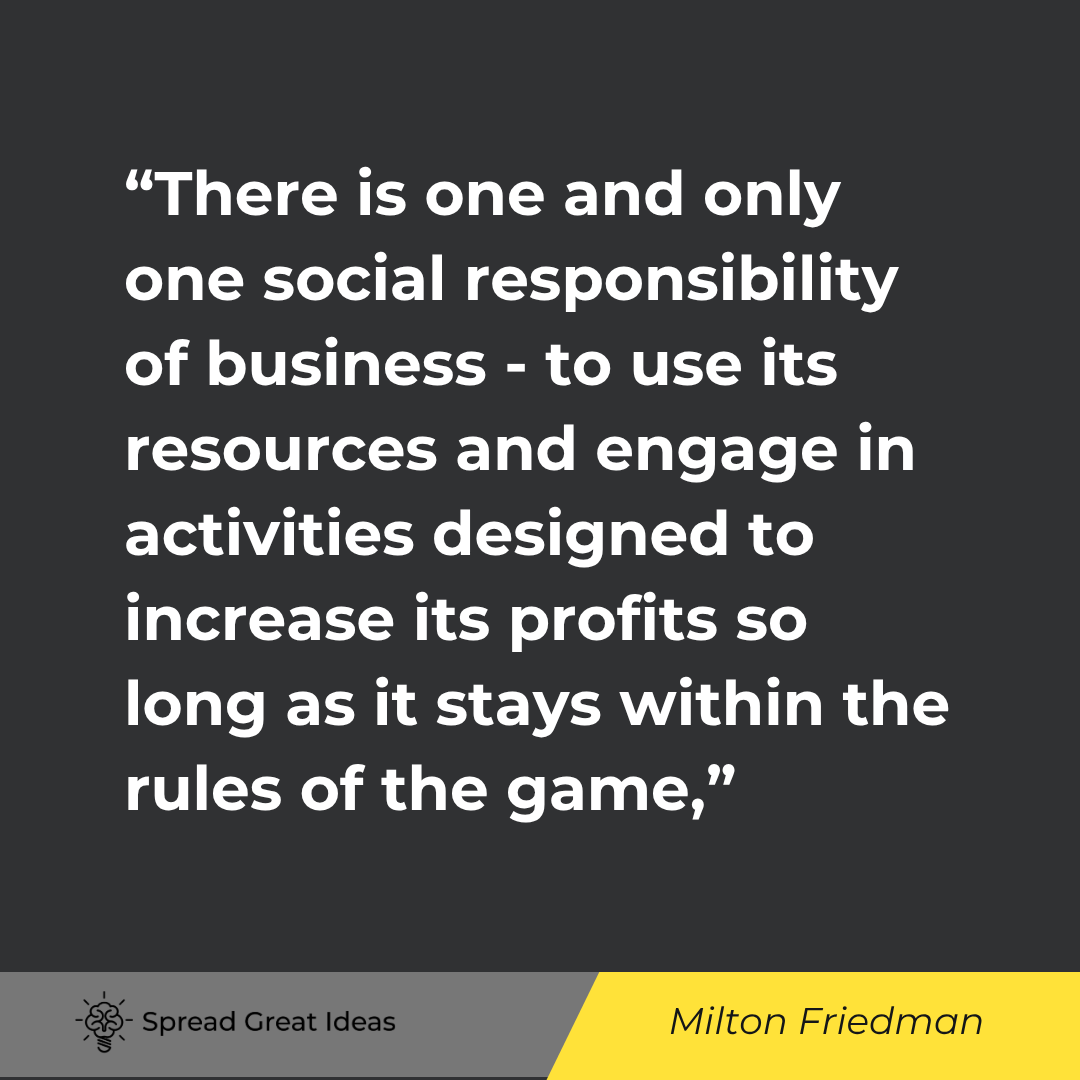
“There is one and only one social responsibility of business – to use its resources and engage in activities designed to increase its profits so long as it stays within the rules of the game, which is to say, engages in open and free competition without deception or fraud.”
- Milton Friedman, Capitalism and Freedom
Friedman on Government and Policy
“One of the great mistakes is to judge policies and programs by their intentions rather than their results.”
- Milton Friedman
“Nothing is so permanent as a temporary government program.”
- Milton Friedman
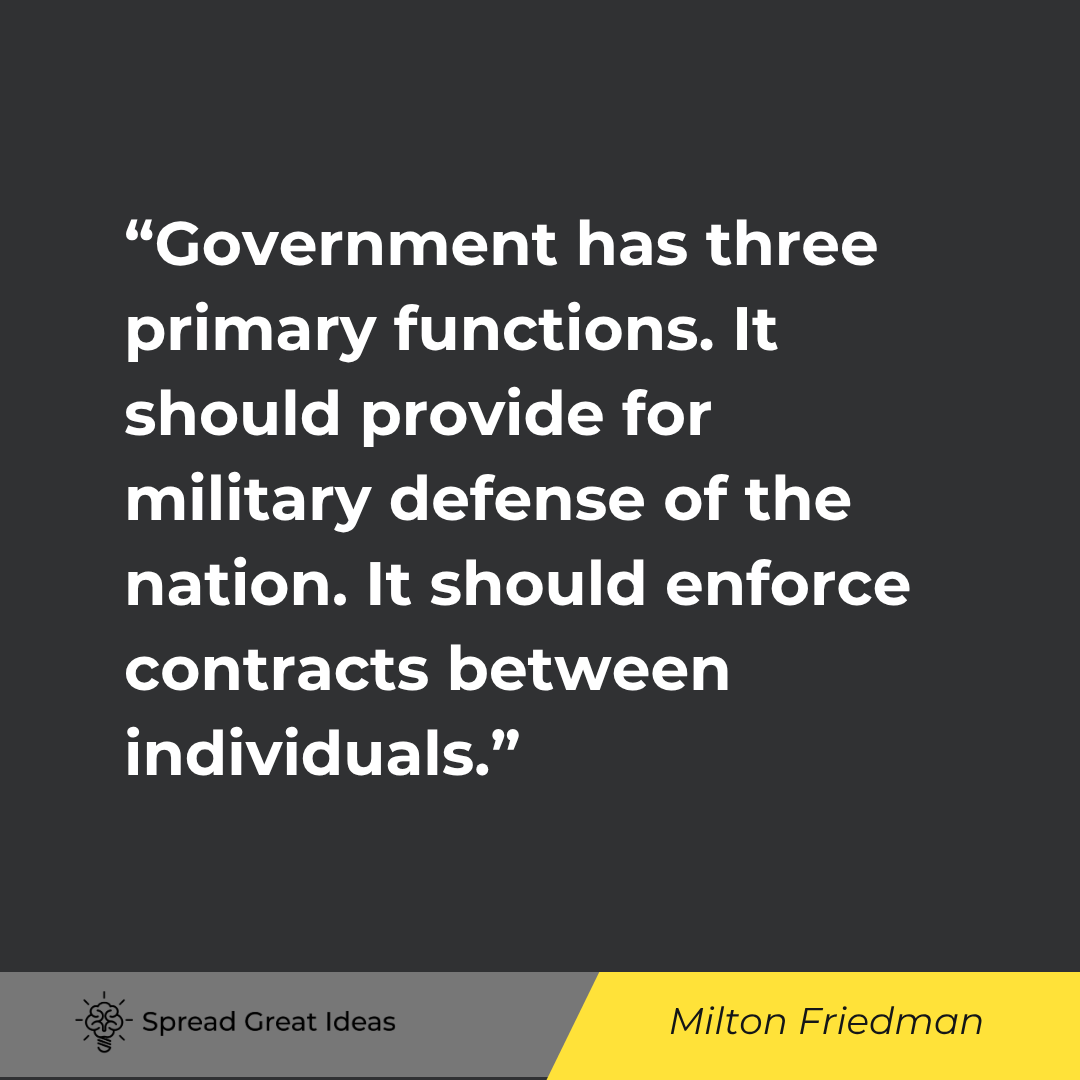
“Government has three primary functions. It should provide for military defense of the nation. It should enforce contracts between individuals. It should protect citizens from crimes against themselves or their property.
When government – in pursuit of good intentions – tries to rearrange the economy, legislate morality, or help special interests, the cost comes in inefficiency, lack of motivation, and loss of freedom. Government should be a referee, not an active player.”
- Milton Friedman, Forbes
“Many people want the government to protect the consumer. A much more urgent problem is to protect the consumer from the government.”
- Milton Friedman, Bright Promises, Dismal Performance
“See, if you look at the drug war from a purely economic point of view, the role of the government is to protect the drug cartel. That’s literally true.”
- Milton Friedman, Tyranny of the Status Quo
Friedman on Taxes, Spending, and Inflation
“I am favor of cutting taxes under any circumstances and for any excuse, for any reason, whenever it’s possible.”
- Milton Friedman, There's No Such Thing as a Free Lunch
“Nobody spends somebody else’s money as carefully as he spends his own. Nobody uses somebody else’s resources as carefully as he uses his own. So if you want efficiency and effectiveness, if you want knowledge to be properly utilized, you have to do it through the means of private property.”
- Milton Friedman, Milton Friedman on Economics
“Inflation is caused by too much money chasing after too few goods.”
- Milton Friedman, Money Mischief
“Inflation is the one form of taxation that can be imposed without legislation.”
- Milton Friedman
Final Thoughts
What the quotes on this page accumulate toward is a diagnosis, not a biography. Friedman identified, with unusual precision, the mechanism by which the managerial state expands: it captures the moral vocabulary of the public, converts good intentions into bureaucratic jurisdiction, and then insulates that jurisdiction from the market signals that would otherwise expose its failures. The problem he kept returning to was not that government officials are corrupt or stupid – it is that the institutional structure rewards expansion over correction, and that no amount of goodwill changes the incentive architecture. That is a structural argument, and it holds regardless of which party controls the relevant agencies.
The limitation worth naming is that Friedman remained, to the end, a reformer working within the regime’s own procedural assumptions. He wanted better rules, smarter monetary policy, a negative income tax instead of a welfare bureaucracy – revisions, not a reckoning with the nature of the state itself. For the next step in that argument, read Anatomy of the State by Murray Rothbard. Where Friedman diagnoses policy failures, Rothbard diagnoses the institution that produces them. The two read together close the gap between reform and analysis – between what the state does badly and what the state, by its nature, cannot do otherwise.
Friedman gave several generations a vocabulary for resisting the reflex that every problem demands a government solution. That vocabulary still works. Use it, then sharpen it.
Friedman’s structural critique of government incentives runs parallel to a much older problem: how does an individual maintain clarity and discipline when the institutional pressures around him reward expansion, self-deception, and the avoidance of hard feedback? Marcus Aurelius worked through exactly that problem from inside the most powerful administrative apparatus of the ancient world, and his answer was not procedural reform but a relentless internal audit – checking whether your own reasoning had been captured by comfort, status, or the approval of the crowd. Meditations by Marcus Aurelius will not tell you how to fix a welfare bureaucracy, but it will tell you something Friedman’s economics could not quite reach: that the same incentive corruption he diagnosed in institutions operates inside the individual, and that the precondition for any honest analysis of power is a prior willingness to apply that same scrutiny to yourself. Read it as a discipline manual for the kind of person who wants to think clearly in a world that rewards not thinking clearly.