
 BY
BY Table of Contents
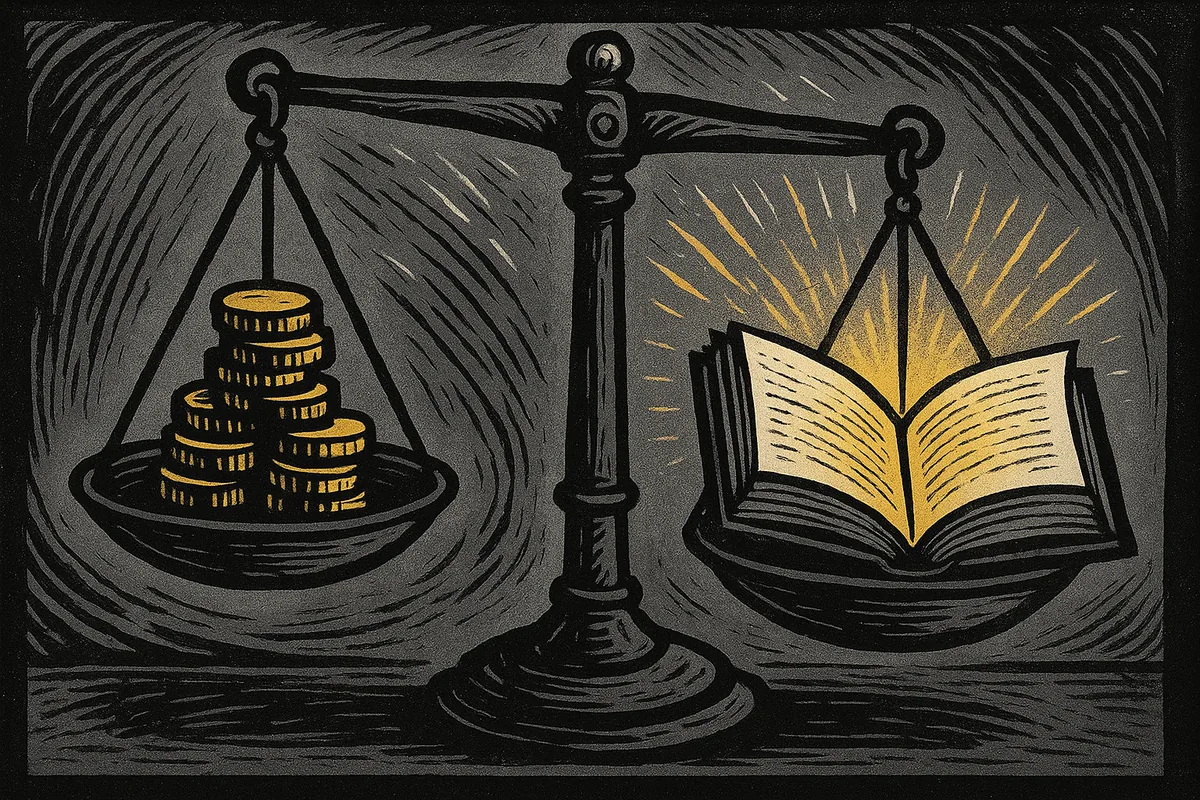
Aristotle called it eudaimonia – the human good. Not pleasure, not material accumulation, but a life lived in accordance with virtue and oriented toward genuine flourishing. The Stoics inherited the concept and sharpened it; the older religious traditions had been pointing at the same target from a different angle for centuries. Wealth, on this older measure, is a verdict rendered by your own values about whether your life is well-spent – not a number on a ledger. The confusion between wealth and money is not accidental, it is structural. A civilization organized around consumption, status signaling, and credential-chasing trains its subjects to pursue proxies for the good life rather than the thing itself. The result is a population that is, by any meaningful measure, impoverished at the moment of its greatest material abundance.
The question of how to measure wealth is therefore prior to the question of how to acquire it. Get the measurement wrong and more of the thing you are accumulating only deepens the disorder. Howard Hughes is not an outlier – he is the reductio ad absurdum of a value system that mistakes acquisition for achievement. Lottery winners who burn through windfalls in a few years are not uniquely foolish; they are people handed an answer before they had worked out the question.
The thinkers collected here – Stoics, political philosophers, novelists, and poets – arrive from very different starting points but converge on the same practical diagnosis: what you value determines what you have, and most people never examine what they actually value. Read these quotes as a diagnostic instrument for your own eudaimonia, not a comfort. The point is not to feel better about having less, but to get precise about what you are actually after.
What Wealth Actually Measures: Value, Character, and the Things Money Cannot Count

“I’d rather have roses on my table than diamonds on my neck.”
- Emma Goldman
“The greatness of a man is not in how much wealth he acquires, but in his integrity and his ability to affect those around him positively.”
- Bob Marley
“Remember that your real wealth can be measured not by what you have, but by what you are.”
- Napoleon Hill, Think and Grow Rich
“That man is richest whose pleasures are cheapest.”
- Henry David Thoreau
“I would rather be able to appreciate things I cannot have than to have things I am not able to appreciate.”
- Elbert Hubbard
“It is impossible to escape the impression that people commonly use false standards of measurement – that they seek power, success and wealth for themselves and admire them in others, and that they underestimate what is of true value in life.”
- Sigmund Freud, Civilization and Its Discontents
“Joy is not in things; it is in us.”
- Richard Wagner
Money as Means, Not End: Quotes on Using Wealth Without Being Used by It
“What we obtain too cheap, we esteem too lightly: it is dearness only that gives every thing its value. Heaven knows how to put a proper price upon its goods; and it would be strange indeed if so celestial an article as freedom should not be highly rated.”
- Thomas Paine
“Money is like gasoline during a road trip. You don’t want to run out of gas on your trip, but you’re not doing a tour of gas stations.”
– Tim O’Reilly
“If we command our wealth, we shall be rich and free. If our wealth commands us, we are poor indeed.”
- Edmund Burke
“I’d like to live as a poor man with lots of money.”
- Pablo Picasso
“So you think money is the root of all evil? Have you ever asked what is the root of money? Money is a tool of exchange, which can’t exist unless there are goods produced and men able to produce them.
Money is the material shape of the principle that men who wish to deal with one another must deal by trade and give value for value. Money is not the tool of the moochers, who claim you product by tears, or of looters, who can take it from you by force.
Money is made possible only by the men who produce. Is this what you consider evil?”
- Ayn Rand, Atlas Shrugged
“Receive [wealth or prosperity] without arrogance; and be ready to let it go.”
- Marcus Aurelius
The Dangers of Wealth: Quotes on Pride, Corruption, and the Cost of Too Much
“Those born to wealth, and who have the means of gratifying every wish, know not what is the real happiness of life, just as those who have been tossed on the stormy waters of the ocean on a few frail planks can alone realize the blessings of fair weather.”
- Alexandre Dumas, The Count of Monte Cristo
“Pride gets no pleasure out of having something, only out of having more of it than the next man. We say people are proud of being rich, or clever, or good-looking, but they are not. They are proud of being richer, or cleverer, or better-looking than others.”
- C.S. Lewis
“If ye love wealth better than liberty, the tranquility of servitude better than the animating contest of freedom, go home from us in peace.
We ask not your counsels or your arms. Crouch down and lick the hands which feed you. May your chains set lightly upon you, and may posterity forget that you were our countrymen.”
- Sam Adams
“Among the rich you will never find a really generous man even by accident. They may give their money away, but they will never give themselves away; they are egotistic, secretive, dry as old bones. To be smart enough to get all that money you must be dull enough to want it.”
- G.K. Chesterton
“And, for an instant, she stared directly into those soft blue eyes and knew, with an instinctive mammalian certainty, that the exceedingly rich were no longer even remotely human.”
- William Gibson, Count Zero
Final Thoughts
The quotes above converge on a point that most personal finance culture actively avoids: measuring wealth in money is a category error. Money is a medium. It is not a terminal value – it is a proxy for something else, and if you never name that something else, the proxy becomes the tyrant. This is not a moralizing claim about greed. It is a structural observation about how poorly calibrated metrics corrupt the people who live by them. The managerial state and the consumer economy both benefit from citizens who cannot articulate what they actually want, because those citizens are permanently available for direction – toward the next product, the next credential, the next status benchmark.
Getting the measurement right is therefore a prerequisite for everything else. Sam Adams understood that a man who trades liberty for comfort has already surrendered his capacity to value anything correctly. Marcus Aurelius understood that the hold wealth has on you is proportional to the hold it has on your attention. Both diagnoses are practical, not pious. If you want to go deeper on the question of how modern institutions systematically disorder the values of the people inside them, Etienne de la Boetie’s The Politics of Voluntary Servitude remains the sharpest short treatment available – written in the sixteenth century and still more current than anything produced by a contemporary think tank. The question de la Boetie asks – why do people willingly serve what diminishes them – applies to financial servitude as readily as to political servitude. The mechanism is the same.