
 BY
BY Table of Contents
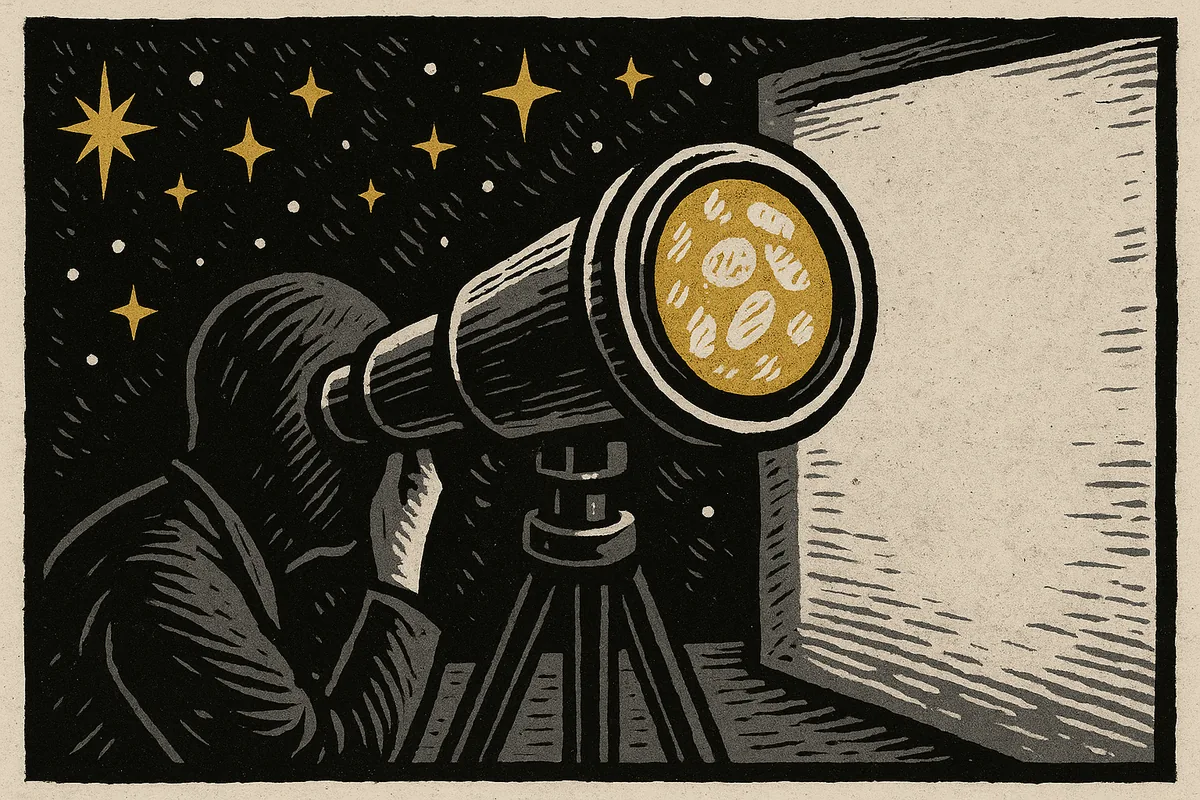
Motivated reasoning is not a flaw in otherwise sound thinking. It is the default state of the human mind. The brain is not a neutral instrument that receives evidence and renders verdicts. It is an advocacy engine that decides first and constructs justification second – and it is very good at concealing that sequence from its owner. The literature on cognitive bias has grown large enough that this is no longer a serious point of dispute among researchers. What remains disputed, because it is genuinely harder, is what follows from it.
What follows is this: every institution, every ideology, every professional class, and every tribe has a material or psychological stake in certain conclusions being true. Upton Sinclair mapped the salary version of this a century ago. Pascal mapped the vanity version three centuries before that. Orwell mapped what it looks like when the tribal mind takes over entire political movements and makes intelligent men cheerfully blind to atrocities on their own side. Kahneman spent fifty years running the controlled experiments that formalized what the literary observers had already noticed. The pattern across all of them is the same: the more a conclusion serves you, the less likely you are to examine it, and the more elaborate the rationalizations protecting it tend to become. Reality, as Philip K. Dick observed, is exactly that which does not go away when you stop believing in it – which means the cost of motivated reasoning is not embarrassment. It is contact with consequences you did not choose and did not see coming.
The quotes collected here are organized around four problems: why we fail to see what we are not paid – financially or socially – to see, how the tribal mind degrades individual judgment at scale, why the external world enforces its own standards regardless of internal conviction, and what it actually takes to work around machinery that is running inside your own skull. None of this is comfortable reading. That is the point.
Why We Don’t See What We Don’t Want to See
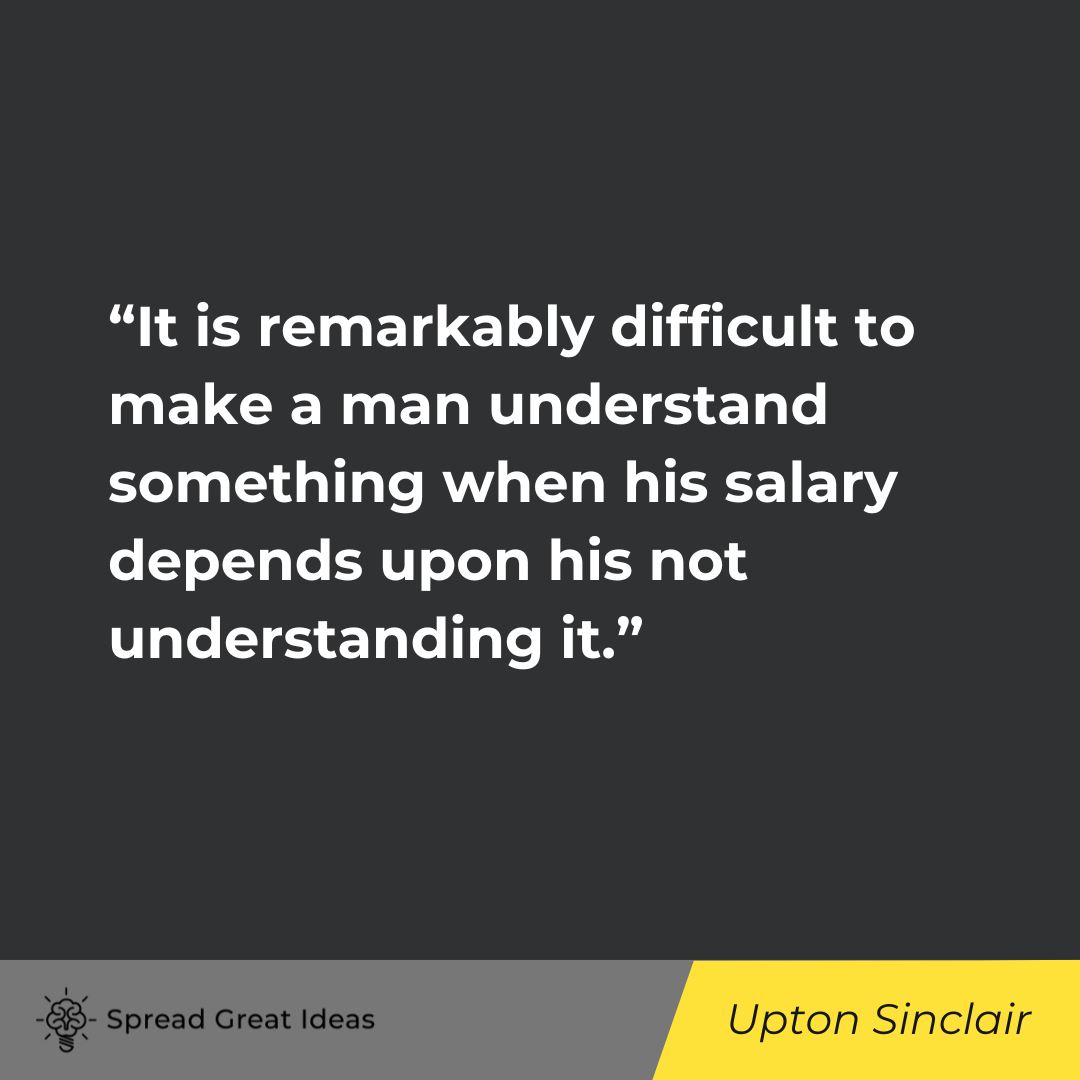
“It is remarkably difficult to make a man understand something when his salary depends upon his not understanding it.”
- Upton Sinclair, I, Candidate for Governor: And How I Got Licked (1934)
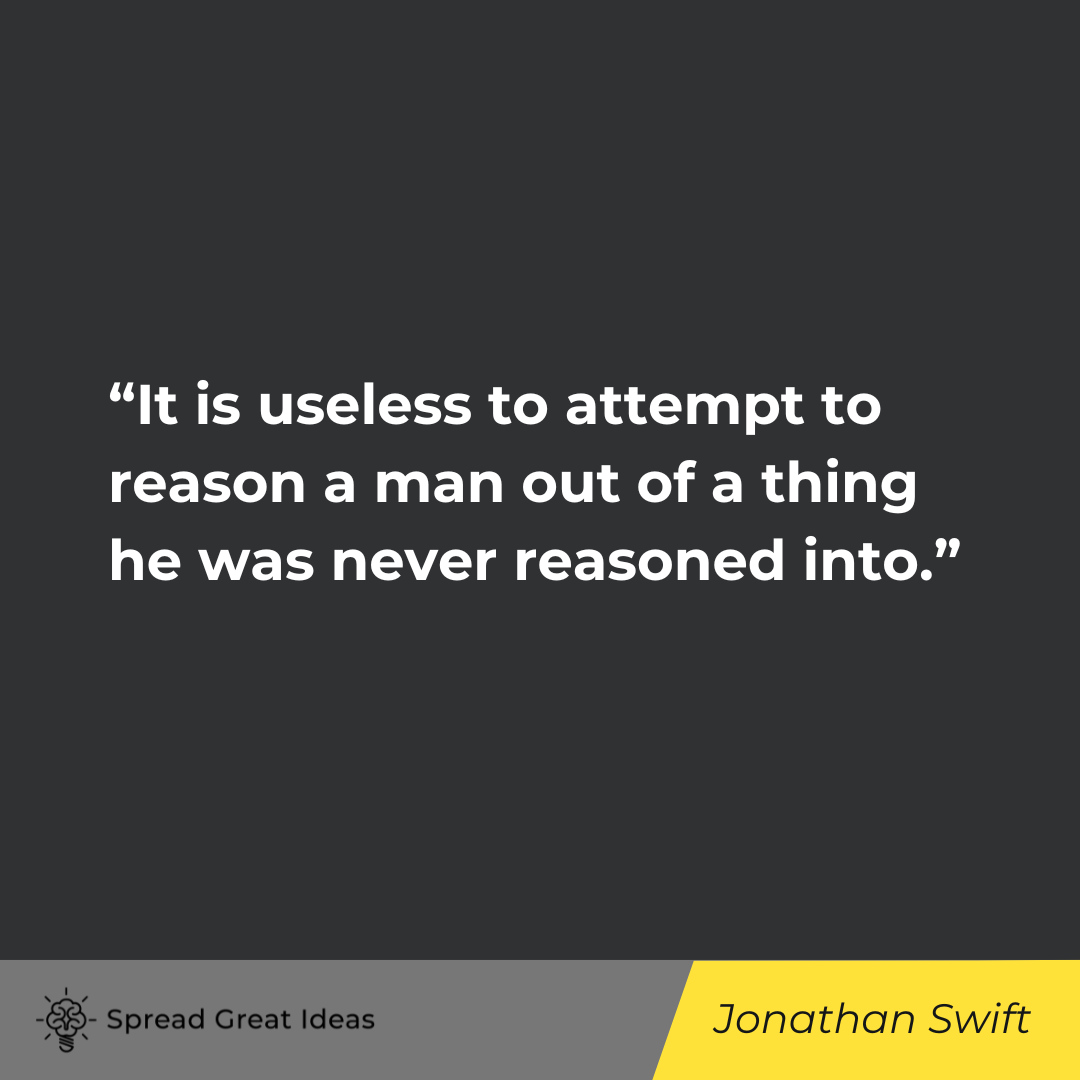
“It is useless to attempt to reason a man out of a thing he was never reasoned into.”
- Jonathan Swift
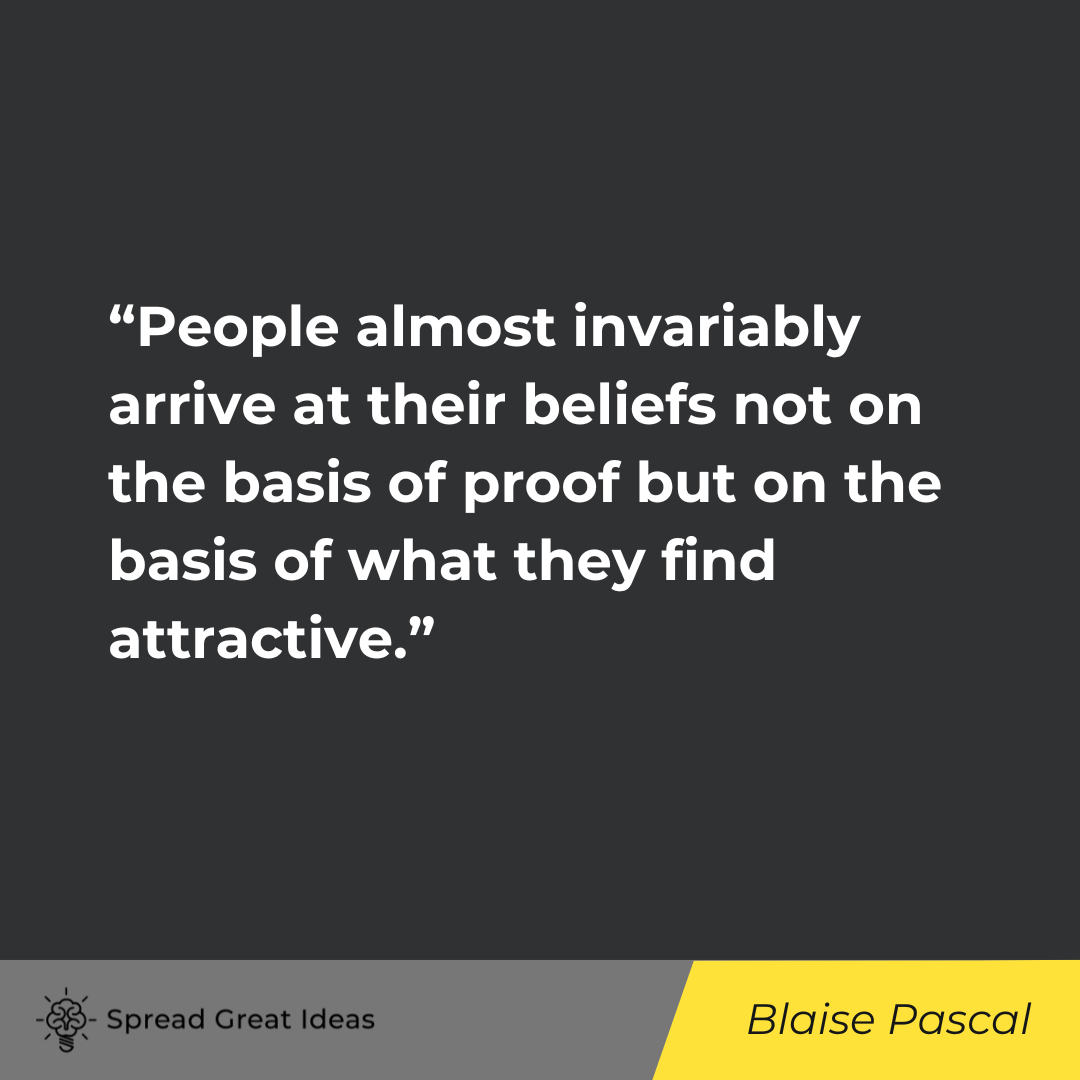
“People almost invariably arrive at their beliefs not on the basis of proof but on the basis of what they find attractive.”
- Blaise Pascal, Pensées (1670)

“In religion and politics people’s beliefs and convictions are in almost every case gotten at second-hand, and without examination, from authorities who have not themselves examined the questions at issue but have taken them at second-hand from other non-examiners, whose opinions about them were not worth a brass farthing.”
- Mark Twain, Autobiography of Mark Twain, Volume 1
Motivated Reasoning and the Tribal Mind
“The nationalist not only does not disapprove of atrocities committed by his own side, he has a remarkable capacity for not even hearing about them.”
- George Orwell, Notes on Nationalism (1945)
“How pleasant is the sound of even bad music and bad motives when we are setting out to march against an enemy!”
- Friedrich Nietzsche, Human, All Too Human (1878)
“The lies the government and media tell are amplifications of the lies we tell ourselves. To stop being conned, stop conning yourself.”
- James Wolcott
“Men judge generally more by the eye than by the hand, for everyone can see and few can feel. Everyone sees what you appear to be, few really know what you are.”
- Niccolò Machiavelli, The Prince, Chapter XVIII
“When dealing with people, remember you are not dealing with creatures of logic, but with creatures bristling with prejudice and motivated by pride and vanity.”
- Dale Carnegie, How to Win Friends and Influence People (1936)
Reality Doesn’t Care About Your Beliefs
“Reality is that which doesn’t go away when you stop believing in it.”
- Philip K. Dick, How to Build a Universe That Doesn't Fall Apart Two Days Later (1978)
“For the great enemy of the truth is very often not the lie-deliberate, contrived and dishonest- but the myth- persistent, persuasive, and unrealistic.
Too often we hold fast to the clichés of our forebears. We subject all facts to a prefabricated set of interpretations. We enjoy the comfort of opinion without the discomfort of thought.”
- John F. Kennedy, Commencement Address at Yale University, June 11, 1962
“Everyone is entitled to his own opinion, but not to his own facts.”
- Daniel Patrick Moynihan
“If we have data, let’s look at data. If all we have are opinions, let’s go with mine.”
- Jim Barksdale
Working Around Our Own Bias
“I have yet to see a piece of writing, political or non-political, that doesn’t have a slant. All writing slants the way a writer leans, and no man is born perpendicular, although many men are born upright.”
- E. B. White, E.B. White
“It turned out I was pretty good in science. But again, because of the small budget, in science class we couldn’t afford to do experiments in order to prove theories. We just believed everything.
Actually, I think that class was called Religion. Religion class was always an easy class. All you had to do was suspend the logic and reasoning you were being taught in all the other classes.”
- George Carlin, Brain Droppings (1997)

“For, after all, how do we know that two and two make four? Or that the force of gravity works? Or that the past is unchangeable? If both the past and the external world exist only in the mind, and if the mind itself is controllable – what then?”
- George Orwell, Nineteen Eighty-Four (1949)

“To know and not to know, to be conscious of complete truthfulness while telling carefully constructed lies, to hold simultaneously two opinions which cancelled out, knowing them to be contradictory and believing in both of them, to use logic against logic, to repudiate morality while laying claim to it, to believe that democracy was impossible and that the Party was the guardian of democracy,
to forget whatever it was necessary to forget, then to draw it back into memory again at the moment when it was needed, and then promptly to forget it again: and above all, to apply the same process to the process itself — that was the ultimate subtlety: consciously to induce unconsciousness, and then, once again, to become unconscious of the act of hypnosis you had just performed.
Even to understand the word ‘doublethink’ involved the use of doublethink.”
- George Orwell, Nineteen Eighty-Four (1949), on doublethink
Final Thoughts
The book on this subject is Daniel Kahneman’s Thinking, Fast and Slow (2011) – the synthesis of fifty years of experimental work on how the mind actually arrives at its conclusions, by the only psychologist to win the Nobel Prize in Economics. Read alongside George Orwell’s Notes on Nationalism (1945, free online), the case becomes specific: motivated reasoning is not a personality flaw of the people you disagree with – it is the default state of the human mind that has not deliberately built habits to resist it.
What ties these quotes together is not pessimism about human nature. It is something more precise: the recognition that the machinery of rationalization runs before the machinery of reason, and that the tribal mind in particular is very good at making motivated conclusions feel like honest ones. Sinclair’s salary line and Orwell’s nationalist are describing the same mechanism from different angles. So is Philip K. Dick, in his way. Reality does not negotiate. The belief that your group, your class, your party, or your profession has arrived at its positions through disinterested evaluation of evidence is, statistically speaking, the least likely explanation. That is not an insult. It is the baseline finding of a century of psychology, and the writers on this page knew it before the lab confirmed it.
The working-around-your-own-bias section of this page is the hardest one, and deliberately so. Knowing the names of your biases does not cure them – that is itself a documented finding, sometimes called the bias blind spot. What the literature actually suggests is slower: deliberate construction of habits, exposure to genuine opposition rather than the strawman version, and a standing suspicion of any conclusion that happens to be convenient. That last one is free to apply right now. You have just read a page full of quotes that probably confirmed things you already suspected. The question worth sitting with is what you have not read, and why.