
 BY
BY Table of Contents
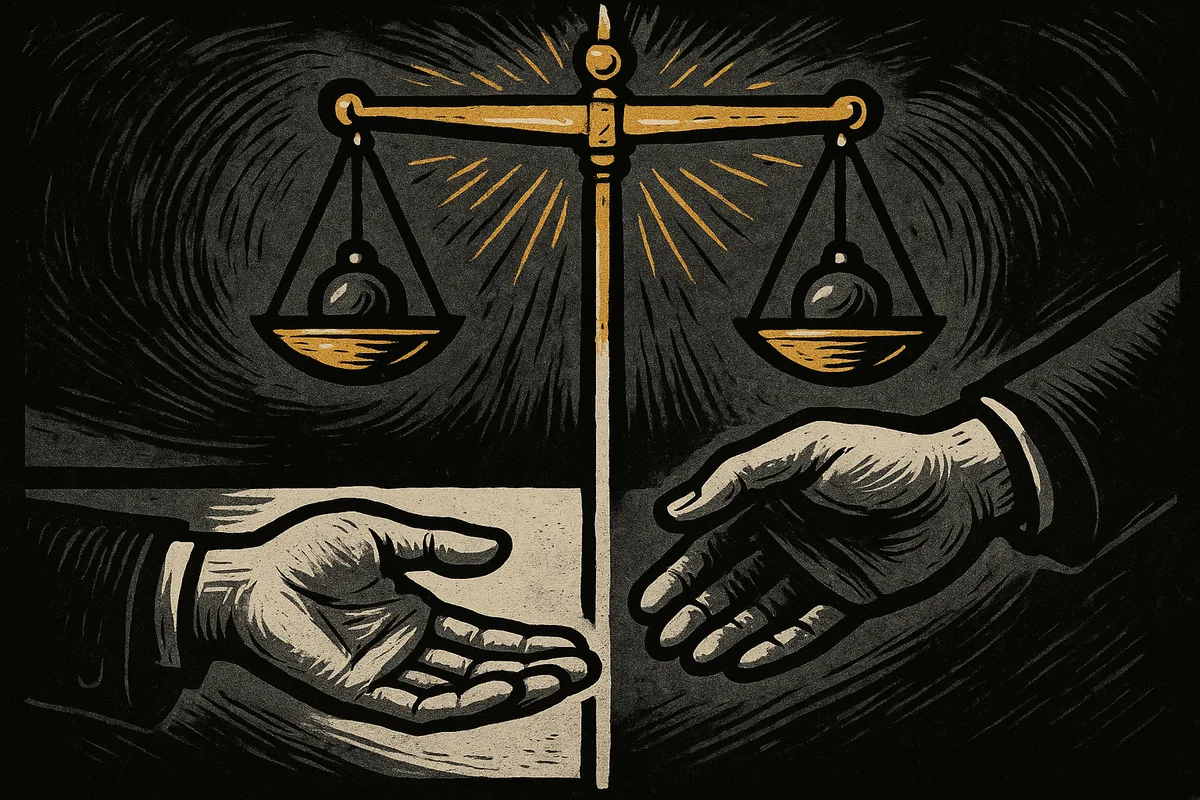
“Greed” is a moral indictment dressed up as a description. The word does not explain anything about how wealth is created or destroyed – it just signals that the speaker disapproves of the wanting. That rhetorical move is older than capitalism and considerably less honest: name the motive, damn the motive, skip the argument. What the writers collected here do, collectively, is refuse to skip the argument. They ask what self-interest actually produces when it operates freely, what it produces when it is suppressed, and who – precisely – tends to be holding the lever of suppression.
Adam Smith gave the structural answer two and a half centuries ago: voluntary exchange converts private want into public benefit without requiring anyone to intend the public benefit. Ayn Rand gave it the sharper moral edge – that living for your own sake, by your own judgment, is not a character defect but the precondition of a life worth calling human. Milton Friedman traced what happens when that precondition is dismantled by corporate managers who decide their job is to serve “society” rather than the people who actually own and work for the business – a doctrine that sounds elevated and functions as a blank check for whoever gets to define society’s interests. And the egalitarian critics, from Churchill through Sowell, make the arithmetic plain: penalizing the productive end of the distribution does not add to the bottom – it subtracts from the whole.
The disease the page diagnoses is not merely bad policy. It is the assumption, now running deep in the managerial class, that wanting things for yourself is spiritually suspect while wanting things for other people – especially when you get to administer the redistribution – is virtuous. That assumption has a long winning streak in respectable opinion. These quotes are a corrective. Read them as a set and the logic accumulates: by the time you reach the end you will find it difficult to hear the word “greed” again without asking who is deploying it, and why.
Self-Interest as a Productive Force
“Run for your life from any man who tells you that money is evil. That sentence is the leper’s bell of an approaching looter.”
- Ayn Rand, Atlas Shrugged (1957), Francisco's money speech
“A man’s ego is the fountainhead of human progress.”
- Ayn Rand, The Fountainhead (1943)
“The man who does not value himself, cannot value anything or anyone.”
- Ayn Rand, The Virtue of Selfishness (1964)
“To love is to value. Only a rationally selfish man, a man of self esteem, is capable of love – because he is the only man capable of holding firm, consistent, uncompromising, unbetrayed value. The man who does not value himself, cannot value anything or anyone”
- Ayn Rand, The Virtue of Selfishness (1964)
Selfishness Reframed: The Moral Case for Self-Respect
“An Individualist is a man who lives for his own sake and by his own mind; he neither sacrifices himself to others nor sacrifices others to himself; he deals with men as a trader – not as a looter; as a producer – not as a Attila.”
- Ayn Rand, Textbook of Americanism (1946)
“No man can have a right to impose an unchosen obligation, an unrewarded duty or an involuntary servitude on another man. There can be no such thing as ‘the right to enslave.’”
- Ayn Rand, The Virtue of Selfishness (1964)
“Selfishness is not living as one wishes to live, it is asking others to live as one wishes to live”
- Oscar Wilde, The Soul of Man under Socialism (1891)
“Nothing resembles selfishness more closely than self-respect”
- George Sand, Indiana (1832)
You Can’t Make the Poor Richer by Making the Rich Poorer
“You don’t make the poor richer by making the rich poorer.”
– Winston Churchill
“Don’t expect to build up the weak by pulling down the strong.”
- Calvin Coolidge, Speech at Wheaton College, June 19, 1923
“One of the sad signs of our times is that we have demonized those who produce, subsidized those who refuse to produce, and canonized those who complain.”
- Thomas Sowell, Is Reality Optional? and Other Essays (1993)
“I have never understood why it is ‘greed’ to want to keep the money you earned but not greed to want to take somebody else’s money.”
- Thomas Sowell, Barbarians inside the Gates and Other Controversial Essays (1999)
The Social-Responsibility Trap
“The doctrine of ‘social responsibility’ involves the acceptance of the socialist view that political mechanisms, not market mechanisms, are the appropriate way to determine the allocation of scarce resources to alternative uses.”
- Milton Friedman, Capitalism and Freedom (1962)
![Milton Friedman quote: [In a free society] there is one and only one social responsibility of business – to use its resourc...](https://spreadgreatideas.org/wp-content/uploads/2026/05/quotes-greed-in-a-free-society-there-is-one-and-only-one-social-responsib.png)
“[In a free society] there is one and only one social responsibility of business – to use its resources and engage in activities designed to increase its profits so long as it stays within the rules of the game, which is to say, engages in open and free competition without deception fraud.”
- Milton Friedman, Capitalism and Freedom (1962)
“Underlying most arguments against the free market is a lack of belief in freedom itself.”
- Milton Friedman, Capitalism and Freedom (1962)
“There is nothing inherently fair about equalizing incomes. If the government penalizes you for working harder than somebody else, that is unfiar”
- Arthur Brooks, Who Really Cares (2006)
“If you think spreading money around by force seems like an odd definition of fairness, you’re not alone.”
- Arthur Brooks, Who Really Cares (2006)
Final Thoughts
The book that anchors this page is Ayn Rand’s The Virtue of Selfishness (1964), the philosophical defense of rational self-interest as a moral position. Read alongside Francisco d’Anconia’s money speech in Atlas Shrugged (1957), Rand makes the case that the people who insist money is the root of evil are usually the ones who want to take it from the people who have earned it. For the economic case made independently of Rand’s philosophy, Capitalism and Freedom by Milton Friedman (1962) is the cleaner version – and the one that makes the same argument without the philosophical scaffolding.
What holds these quotes together is a distinction that most public argument works hard to prevent you from making: the difference between taking and earning. The word “greed” does not distinguish between a man who defrauds his customers and a man who builds something people voluntarily pay for. It collapses both into the same moral category and then uses that collapsed category to justify redistribution, regulation, and the social-responsibility doctrine that the page’s fourth section addresses. Once you see that the word is doing that work – once you notice that “greed” is almost always deployed against the second man and not the first – the rhetorical structure of a great deal of political argument becomes visible. That is the take-away. Not that self-interest is always virtuous, but that the charge of greed is almost never an economic argument. It is a substitute for one.
For a companion read, Henry Hazlitt’s Economics in One Lesson by Henry Hazlitt is the short version of everything Churchill’s line implies. The seen and the unseen. The immediate effect and the long-run effect on all groups. Hazlitt wrote it in 1946 for a general audience and it has not been improved upon. If the quotes above made the moral case, Hazlitt makes the mechanical one – and after you read both, the intuition that you can improve the poor by punishing the productive does not survive.