
 BY
BY Table of Contents
Self-government is not a mood. It is a demanding discipline, and the Founding Fathers knew this better than any ruling class that has come after them, because they had actually read the history of republics that failed. What they built between 1776 and 1789 was not an expression of optimism about human nature – it was a set of structural constraints designed precisely because they held no such optimism. James Madison did not write that men were not angels as a throwaway line. He wrote it as the load-bearing premise of an entire constitutional architecture.
The disagreements among these men were real and they are worth taking seriously. Hamilton and Jefferson were not arguing about tone or emphasis – they were arguing about whether concentrated executive power was a tool of order or a standing threat to liberty, a question that has never been settled and is not settled now. Adams was suspicious of democratic passion in ways the managerial gentry of our own moment would find scandalous, precisely because he understood what popular enthusiasm looks like when it has been organized and directed by people who do not share the public’s interests. What these seven men – Washington, Jefferson, Franklin, Madison, Hamilton, Adams, and Jay – shared was the conviction that durable self-government requires three things that cannot be separated from each other: limits on power, a citizenry literate enough to detect when those limits are being violated, and the personal character to act on that knowledge when it is inconvenient to do so.
The quotes collected here are organized around those three requirements and the statecraft that ties them together. Reading them as a body, rather than cherry-picking the ones that fit a bumper sticker, is the exercise. The Founding Fathers were not a branding campaign. They were men who understood that a republic is not the natural condition of mankind – it is an achievement, one that can be lost, and one that every generation has to re-earn from first principles. The first principles are below.
On Liberty and the Limits of Government
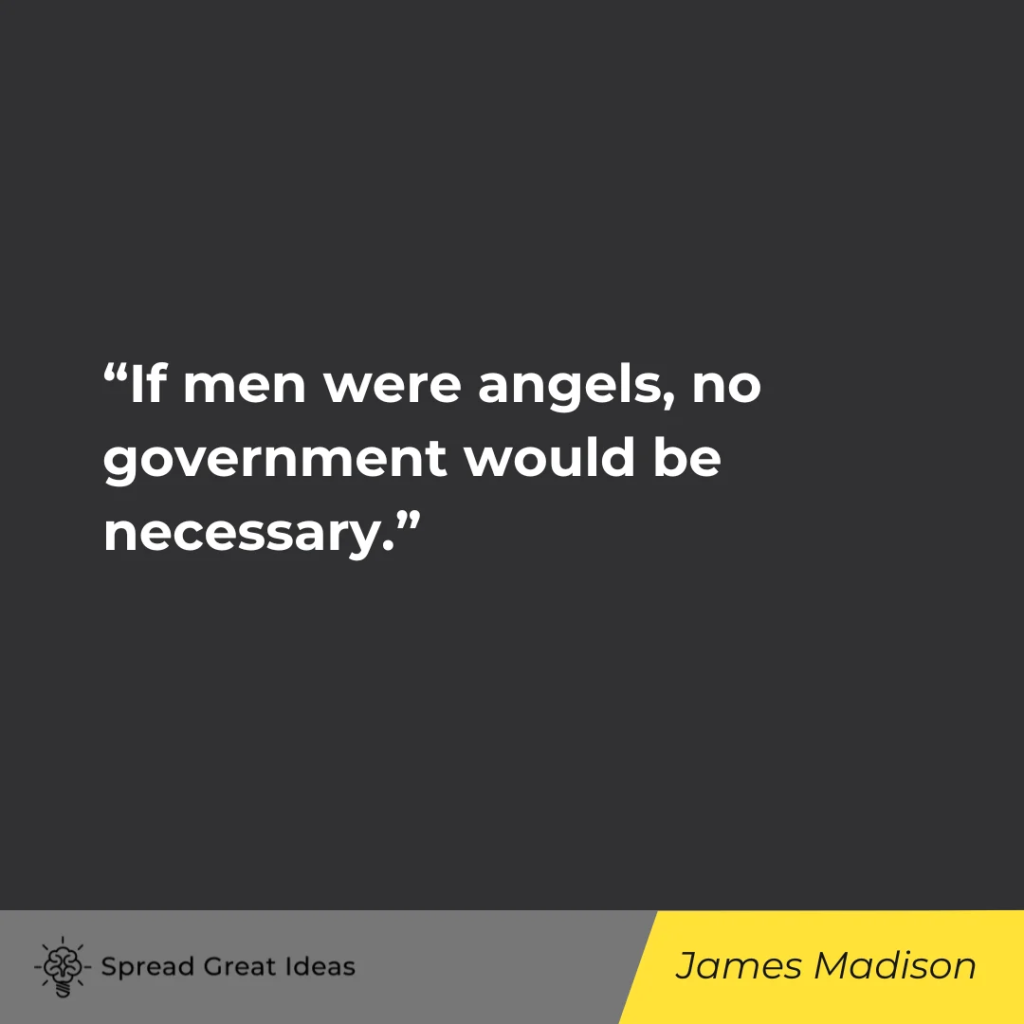
“If men were angels, no government would be necessary.”
- James Madison, Federalist No. 51 (1788)
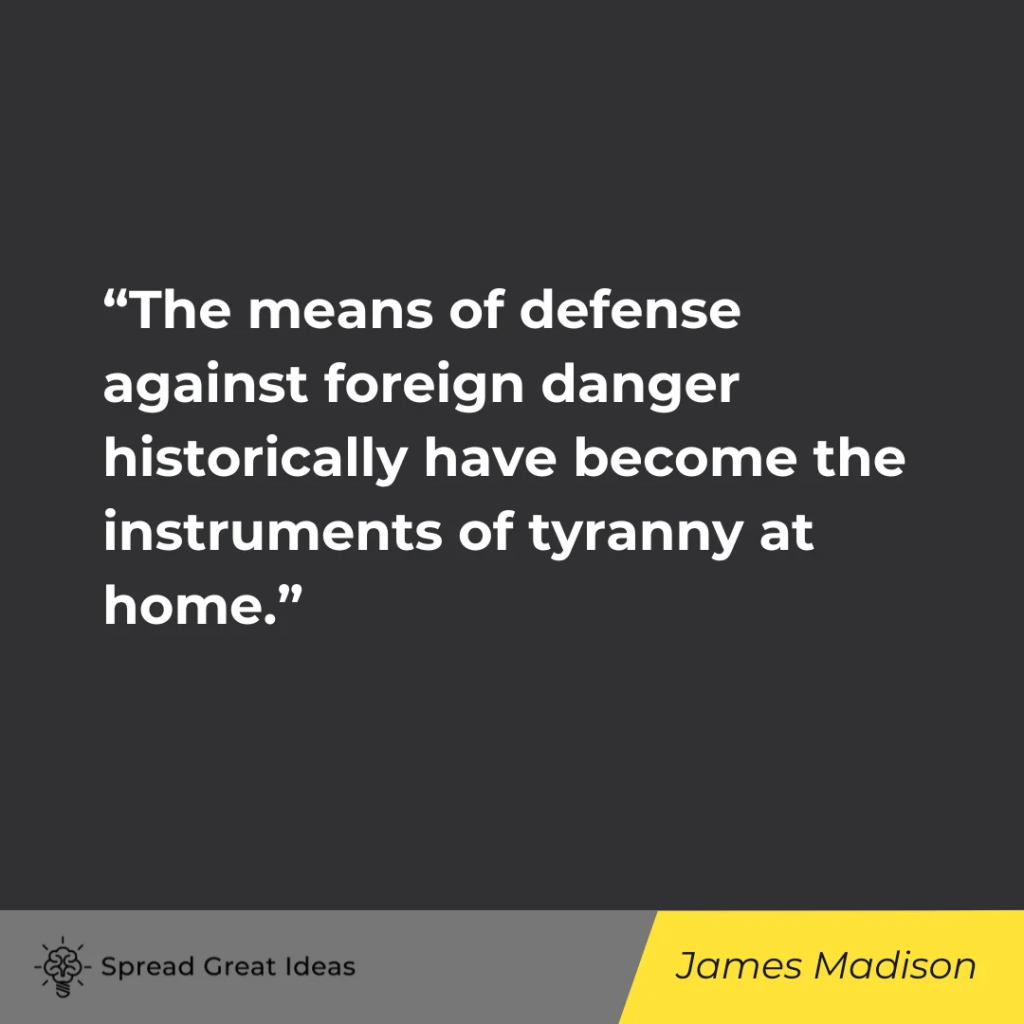
“The means of defense against foreign danger historically have become the instruments of tyranny at home.”
- James Madison, Constitutional Convention, June 29, 1787
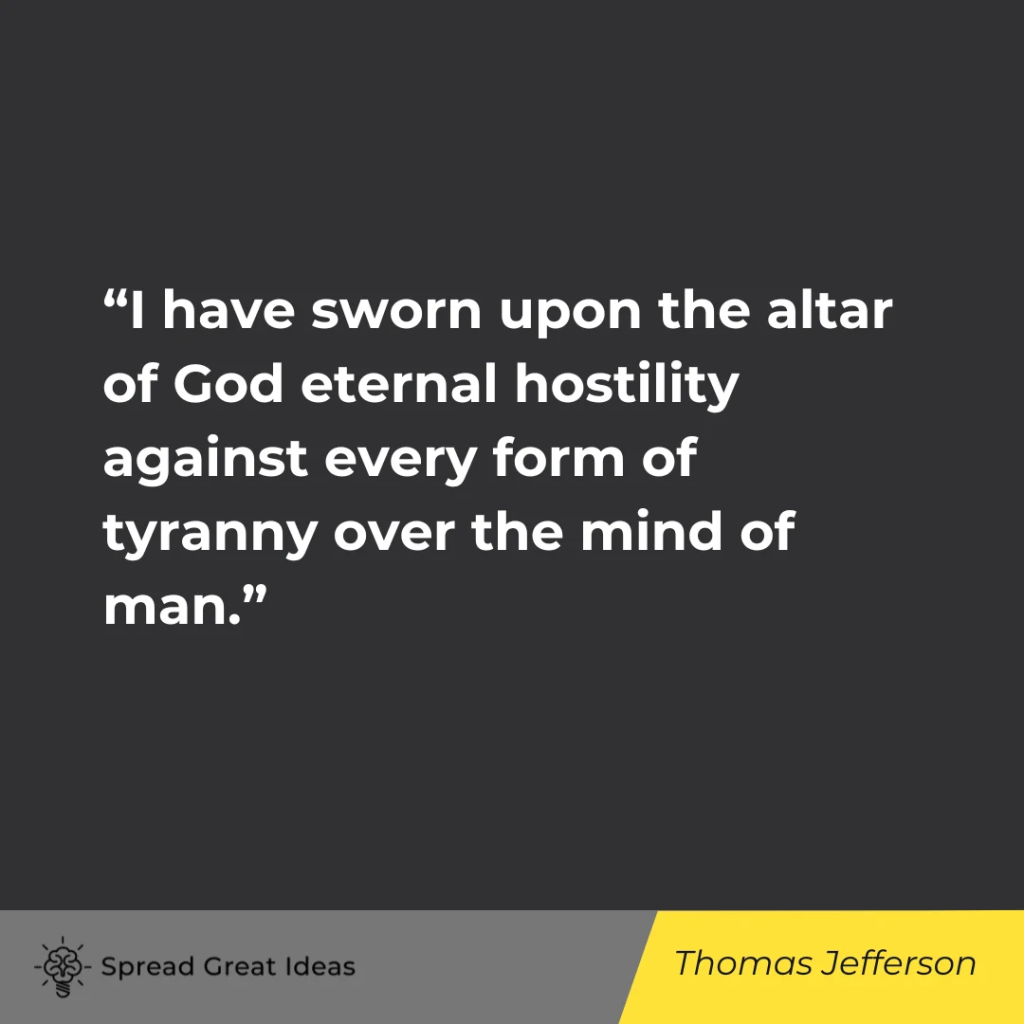
“I have sworn upon the altar of God eternal hostility against every form of tyranny over the mind of man.”
- Thomas Jefferson, Letter to Benjamin Rush, September 23, 1800
“Power over a man’s subsistence is power over his will.”
- Alexander Hamilton, Federalist No. 79 (1788)
“No power on earth has a right to take our property from us without our consent.”
- John Jay, Address to the People of the State of New-York (1788)
On Knowledge, Education, and Self-Government
“Knowledge will forever govern ignorance, and a people who mean to be their own governors must arm themselves with the power knowledge gives.”
- James Madison, Letter to W. T. Barry, August 4, 1822

“The advancement and diffusion of knowledge is the only guardian of true liberty.”
- James Madison

“An investment in knowledge pays the best interest.”
- Benjamin Franklin, The Way to Wealth (1758)
“Tell me and I forget. Teach me and I remember. Involve me and I learn.”
- Benjamin Franklin

“I cannot live without books.”
- Thomas Jefferson, Letter to John Adams, June 10, 1815
On Character, Conduct, and Republican Virtue
“Associate yourself with men of good quality if you esteem your own reputation; for ’tis better to be alone than in bad company.”
- George Washington, Rules of Civility & Decent Behaviour
“It is better to offer no excuse than a bad one.”
- George Washington
“Happiness and moral duty are inseparably connected.”
- George Washington
“Conscience is the most sacred of all property.”
- James Madison, Property, National Gazette (March 27, 1792)
“Well done is better than well said.”
- Benjamin Franklin, Poor Richard's Almanack (1737)
“Either write something worth reading or do something worth writing.”
- Benjamin Franklin
“By failing to prepare, you are preparing to fail.”
- Benjamin Franklin
“When angry, count ten, before you speak; if very angry, a hundred.”
- Thomas Jefferson, A Decalogue of Canons for Observation in Practical Life (1825)
“Facts are stubborn things; and whatever may be our wishes, our inclinations, or the dictates of our passions, they cannot alter the state of facts and evidence.”
- John Adams, Argument in Defense of the British Soldiers in the Boston Massacre Trials (December 4, 1770)
On Statecraft and the American Experiment
“Observe good faith and justice toward all nations. Cultivate peace and harmony with all.”
- George Washington, Farewell Address (1796)
“To be prepared for war is one of the most effective means of preserving peace.”
- George Washington, First Annual Message to Congress, January 8, 1790
“Men give me credit for some genius. All the genius I have lies in this; when I have a subject in hand, I study it profoundly.”
- Alexander Hamilton
“I predict future happiness for Americans, if they can prevent the government from wasting the labors of the people under the pretense of taking care of them.”
- Thomas Jefferson, Attribution contested
Final Thoughts
If you read one book to understand the Founders’ political theory, read The Federalist Papers by Madison, Hamilton, and Jay (1787-88, free at Project Gutenberg) – the original case for the Constitution and still the clearest statement of why the Founders thought what they built would work. For the case that lit the fuse five years earlier, read Common Sense by Thomas Paine (1776, also free) – the pamphlet that turned colonial dissatisfaction into independence. And for the human story behind the political one, 1776 by David McCullough is the readable account of the year the Founders bet their lives on the outcome.
What holds these quotes together is not sentiment about the past. It is a structural argument. Liberty, in the Founders’ usage, is a negative claim – the requirement that someone else, including the government, not interfere with your life, your property, or your conscience. Knowledge is the condition that makes self-government possible rather than suicidal. Virtue is what fills the gap between what the law permits and what a free society can actually survive. Statecraft is the attempt to design institutions that work even when the men running them are not angels – Madison’s words, and he meant them. These four categories are not decorative. They are load-bearing. Remove any one of them from the Founders’ thinking and the rest collapses into either tyranny or mob rule. That tension is not resolved in the quotes above. It was not resolved in Philadelphia in 1787. It is the permanent problem of republican government, which is why these men are still worth reading rather than merely commemorating.
For a book that takes the Founders’ framework seriously on its own terms – without the hagiography and without the revisionist flattening – read The Federalist in the Liberty Fund Gideon edition, edited by George W. Carey and James McClellan. The editorial apparatus matters here. Carey spent his career tracing how the Constitution’s internal logic was understood by the men who wrote it, not by the courts that later interpreted it. Read the primary text first. Then read the notes. The distance between what the Founders wrote and what their system became is exactly the distance you need to understand if any of the quotes on this page are going to mean something beyond a wall calendar.