
 BY
BY Deliberative Privacy
Table of Contents
Deliberative privacy is the principle that legislative bodies produce better law when the actual negotiation, horse-trading, and revision of positions happens away from public galleries and cameras. The public record captures decisions; deliberative privacy protects the process that makes good decisions possible. The Founders inherited this principle from Rome and applied it at Philadelphia in 1787.
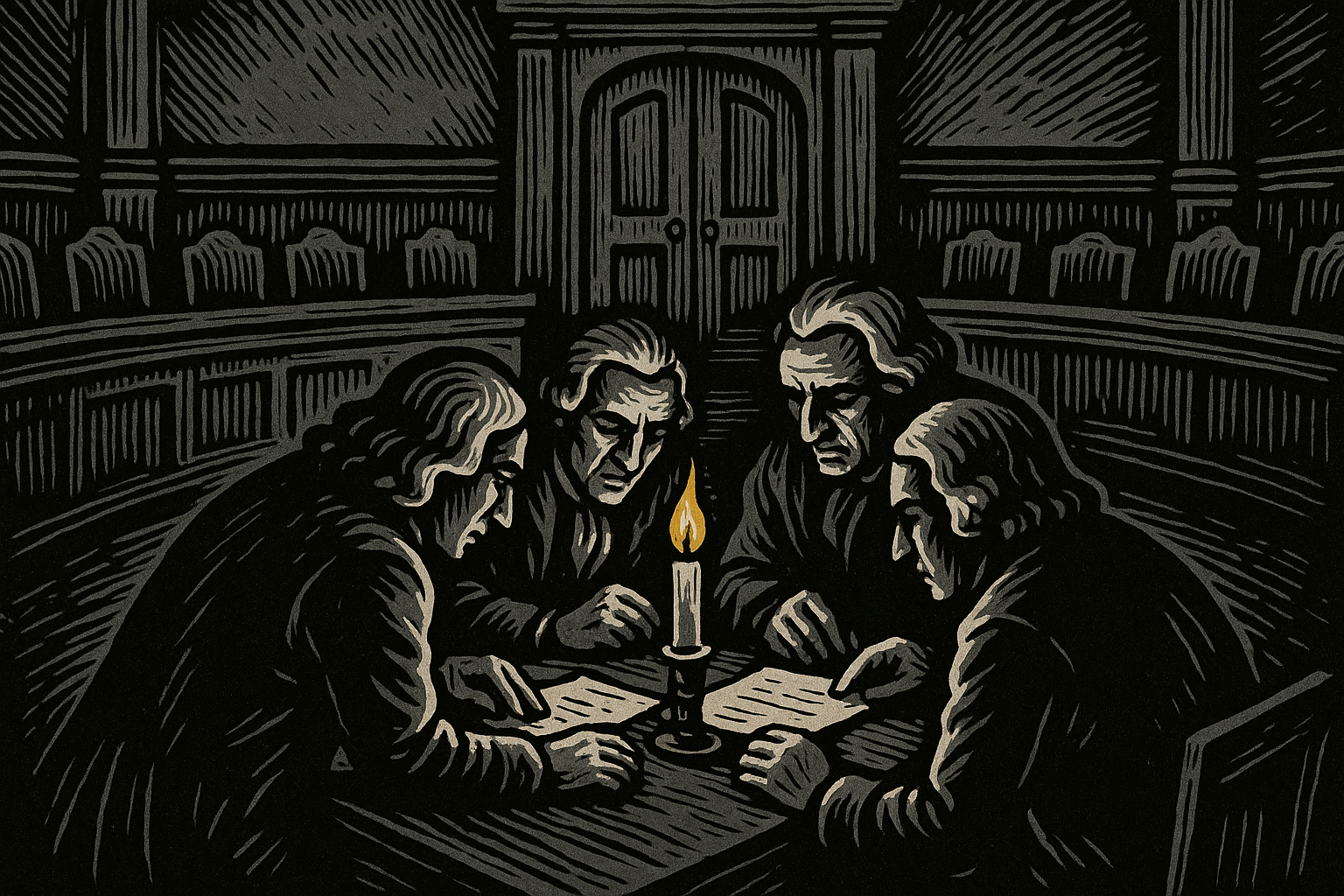
The temptation is to treat openness as a proxy for accountability. It isn’t. Accountability means that a legislator answers for the laws he produces. Deliberative privacy means that he produces them in conditions where changing his mind costs him nothing except being wrong.
Those are different things, and confusing them has cost the republic considerably. What the managerial state calls transparency often functions as a veto: any position staked out publicly becomes a position that must be defended publicly, and the legislator who cannot retreat without being called a sellout stops retreating even when retreat is right.
The argument for deliberative privacy runs twenty-four centuries before Philadelphia. The Founders inherited it. They did not invent it.
Not a subversive idea. Not a new one.
Cicero observed it in the Roman Senate. Article 1, Section 5 of the Constitution codified it. Alexander Hamilton made the affirmative case in the Federalist Papers. James Madison made a complementary one. The two arguments pointed in opposite directions, but both turned out to be right, and the proof arrived on October 26, 1970, when President Nixon signed the Legislative Reorganization Act and gave the country an unintended experiment in what happens when you take the principle away.
A Principle the Founders Inherited
The case for closed-door deliberation runs back twenty-four centuries before anyone in Philadelphia put a quill to parchment.
The Roman Senate conducted its deliberations in private. The Greek city-states distinguished between the deliberating assembly and the public record of its decisions. The constitutional logic that eventually reached the Founders had been tested across multiple republican experiments, and the conclusion that survived those experiments was consistent: the quality of a decision and the publicity of the process that produced it are in tension.
Russell Kirk in The Roots of American Order traces the line through Jerusalem, Athens, Rome, and London. Each layer of the Western inheritance added something to the architecture of self-governance. What the Roman and English layers contributed, above all, was a mature understanding of how institutions degrade under permanent public surveillance. The common-law tradition, the Parliamentary practice, the Senate procedures the Founders studied and argued about – all of them built in space for private deliberation, because without it the deliberation stops and the performance begins.
Hamilton was direct about the threat. Closed-door sessions, he argued, were a check on special-interest capture. Let the galleries fill and the press flood in, and the legislator is no longer talking to his colleagues. He is talking to whoever is watching. And whoever is watching, in any polity with concentrated wealth and organized interests, is not the general public.
Madison’s version was different in emphasis. Open-door sessions, he warned, would drive partisanship. The representative who must immediately justify every statement and every concession to the organized reactions of watchers has no room to move. He cannot explore a position he will later abandon. He cannot agree, provisionally, to a trade he will not finalize. Every remark is a hostage to the next primary. Every negotiation is conducted in public with every future opponent watching.
They were both describing real pathologies. The country has now watched both unfold in real time for fifty years.
October 26, 1970
The first two centuries of Congressional work proceeded almost entirely in closed committee.
That arrangement did not feel like a scandal, because it was the inherited norm. The Constitutional Convention itself, the foundational act of American self-governance, was conducted in secrecy. The delegates to Philadelphia understood, as Madison recorded in his notes, that the free exchange of argument required the freedom to change one’s mind without every earlier position being used as evidence against you. The secrecy was not a cover for corruption. It was the structural precondition for genuine deliberation.
The Legislative Reorganization Act changed that. Committee sessions were opened to public galleries. Television cameras were installed. The lobbying industry and the press walked in together. The Progressive-era argument had finally arrived in the committee room: good government requires sunshine, transparency is accountability, secrecy enables corruption.
The argument was not made naively. The reformers understood what open committees would produce. Some of them preferred it. An open committee dominated by the most organized and most attentive watchers is a better vehicle for managed outcomes than a closed one where the legislative bargain is made by the people actually in the room.
The empirical result was not ambiguous. In the decade following the Legislative Reorganization Act, special-interest capture increased. Campaign-finance dependence increased. Lobbying expenditures climbed. And the outcome that has come to define the political era that followed – partisan polarization – climbed with them. Trust in government fell along the same curve. The direction of causality is not complicated. The framers had predicted every one of those outcomes. The reformers who pushed for sunshine were not surprised by what the sunshine produced.
The Lobbyist as the Only Watcher
Here is the structural diagnosis, and it is arithmetic more than ideology.
Each member of Congress votes approximately one thousand times per year. The full record of Congressional activity – hearings, transcripts, markups, conference reports, floor amendments – runs to millions of pages. The subjects covered include taxation, trade policy, appropriations, defense procurement, pharmaceutical regulation, environmental compliance, agricultural subsidies, financial derivatives, telecommunications licensing, and hundreds of other domains requiring specialized expertise to evaluate.
Citizens do not follow this. They cannot. The topics are too complex. There is too much of it. Even dedicated students of Congress – scholars, civic advocates, self-described transparency activists – do not follow even a fraction of a percent of Congressional action in any session.
There is one class of actor that follows everything: the professional lobbyist.
The best lobbyists are twenty-year veterans of Capitol Hill. They hold advanced degrees in policy. Many are former members of Congress or former staffers, which means they understand the mechanics of the institution at a level that general citizens never will. They know which committee staffer writes the markup language. They know which conference-committee chair has discretion over which provisions. They know, because it is their profession to know, exactly when and where the smallest adjustment to a piece of legislation produces the largest benefit for whoever is paying them.
They report back to their clients: Amazon, Pfizer, Shell, the major financial institutions, the pharmaceutical trade associations, the agricultural conglomerates. Not to the general public. To the organizations with the resources to act on what they learn.
Open committees did not solve the information-asymmetry problem between organized wealth and the general public. They made it worse. The general public still cannot follow what Congress does. The lobbyist now has official standing in the committee room to watch it happen.
Primaried or Pilloried
Hamilton’s prediction about lobbyist capture is one half of the diagnosis. Madison’s prediction about partisanship is the other.
Both arrived on schedule.
The mechanism is concrete. A legislator who, behind a closed door, can entertain a position she has not committed to, probe a colleague’s red line without endorsing it, suggest a trade and walk it back if the trade does not hold – that legislator is engaged in deliberation. The legislator in the open committee cannot do any of those things. Every exploratory statement becomes a permanent public position. Every provisional concession becomes ammunition. The activist base monitoring the committee feed sees the compromise being explored and registers it as betrayal. The reporter watching the feed sees the same exploration and writes the headline.
By morning, the legislator who was trying to find a workable middle has two threats waiting. A primary challenger funded by the watchers on her left or her right. And a press cycle built on the real-time leak of her own provisional move.
She does not have to lose either fight. She just has to want a third term. The structural pressure does the rest.
The result is a legislature in which nobody can compromise. Not because the members lack the will. Not because the country lacks the votes for compromise positions. Because the procedural conditions that made compromise possible have been stripped out. Primaried or pilloried is the trap. Avoiding it requires never doing the deliberative work in the first place.
Senator Dale Bumpers, who served two decades in the Senate after the cameras went in, was one of many participants who documented the distortion from inside the chamber. A speech that would have run two minutes in a working session inflates to fill the airtime the cameras provide. The performance does not add information. It adds posturing, signal-sending to primary constituents, and the permanent record of a position that cannot be revisited without being called a flip-flop. The productive friction has moved out of the committee room and into the donor call and the cable segment.
Polarization is what this produces. It is not a cultural drift. It is not a generational mystery. It is a structural artifact of the post-1970 procedural regime. The same members, under closed-committee conditions, produced legislation with signatures from both parties as a matter of routine. The members did not change. The room changed.
Why Sunshine Cannot Do What Sunshine Claims to Do
The transparency argument depends on a premise that the evidence has consistently failed to support: that public access to deliberation functions as a check because the public will use that access.
It does not. It cannot. The ratio of total Congressional activity to any individual citizen’s available attention is not a problem that can be solved by posting more transcripts online or installing more cameras. The problem is scale. A body of 535 legislators, generating thousands of votes per session, operating across hundreds of committees and subcommittees, producing legislation that affects every sector of a $25 trillion economy, is not legible to any single citizen or any realistic cross-section of citizens.
The people who can make use of the transparency are the people who already have the resources to hire the expertise to extract value from it. Open government, at the scale of a national legislature, does not function as a check on organized wealth. It functions as a service to organized wealth: an early-warning system for regulatory changes, a staging ground for lobbying pressure, a vehicle for turning private concerns into public political events by telling sympathetic media exactly which legislators to target and when.
Aaron Swartz, who understood the machinery of information-capture better than most, put it plainly: sunlight just makes it easier for people to look at the pus.
Senator Dale Bumpers documented the distortion from the other side of the camera. A two-minute speech becomes a thirty-minute performance once the galleries are watching. The performance does not add information. It adds posturing, signal-sending to primary constituents, and the permanent record of a position that cannot be revisited without being called a flip-flop. The result is a legislature where the productive friction has moved out of the committee room and into the donor call and the cable segment.
Francis Fukuyama has called the transparency reflex a “dangerous populist illusion.” That is not a conservative critique. It is a structural one. The institution designed to aggregate and reconcile competing interests cannot do that work in public without the performance overwhelming the substance.
What Deliberative Privacy Recovers
The affirmative case matters more than the diagnosis.
The committee chairman who can move legislation without performing for the camera can actually move legislation. The conference committee that can meet in a room small enough to function – the actual mechanism the Constitution contemplates for reconciling House and Senate versions – can reconcile them. The cross-aisle deal that does not have to survive the next morning’s wire-service quote-mining has a chance of surviving the negotiation itself.
Think of what this looks like at the level of actual work.
A labor-state representative can horse-trade a steel-mill carve-out for a vote on an unrelated bill without forty industry lobbyists papering the committee room the moment the conversation starts. A rural-district representative can raise a real concern about an agriculture provision without a Politico headline appearing by morning that ends her next primary. A moderate in a swing district can explore a compromise position without that exploration being treated, by the organized interests on both sides, as a declaration of war.
The people this serves are not the people with the most to spend on post-session damage control. They are the people whose only leverage is the room they are in.
Working-class and rural representatives whose constituents cannot outspend Amazon’s, Pfizer’s, and Shell’s lobbying operations have one structural advantage under deliberative privacy: they are in the room, and the lobbyists are not. Open the room, and the advantage disappears. The only actors with the resources to track and respond to everything are back in control of the outcome.
The public record that matters – the final roll-call vote – stays public. Sunshine-law regimes were notionally designed to protect that record. They do. But the vote is only the terminal output. The deliberation that determines what that vote is about is where the substance lives. Restoring privacy to the deliberation while keeping the vote and the final bill text fully public recovers the Founders’ actual design: the accountability moment is the vote. The working session is not a press conference.
Mark Warren and Jane Mansbridge have documented from the political-science side what the framers understood from first principles: closed sessions enable perspective-taking. Legislators who know that their exploratory positions will not become tomorrow’s attack ads can actually reconsider their positions. That is what deliberation is. Without the structural protection to do it, you do not get deliberation. You get performance.
Your own voluntary associations already know this.
The parish council that gets anything done closes the door for the hard conversation and publishes the minutes when the decision is made. The neighborhood board that settles a zoning dispute does it in a working session, not in the public comment period. The trade-association chapter that negotiates its bylaws does it with the principals in a room, not in a live-streamed town hall. Every functional deliberative body in ordinary civic life operates this way because experience teaches the lesson that Madison articulated in 1787: the public record of a decision and the private process that produces it are different instruments serving different purposes.
The managerial-class reformers who installed cameras in committee rooms were not democratizing Congress. They were capturing it.
Why Election Reform Stops Short
Suppose all the upstream reforms work. The franchise tracks a genuine stake (see Qualified Democracy). Elections happen on a cycle that produces a broad and engaged electorate (see Election Timing). Votes translate to seats through districts that have not been drawn to predetermine outcomes (see Gerrymandering). The result is a Congress whose members genuinely represent the communities that sent them.
Then those legislators have to govern.
At the scale of a 535-member national body voting a thousand times per year on millions of pages of legislation, governance requires deliberation. And deliberation requires privacy. Not the privacy of the final vote. Not the privacy of the bill text. The privacy of the negotiation that precedes both.
Without it, the only organized force that can track the work is the professional lobbying class. The lobbyist fills the vacuum the open committee created. He is the one watcher who can actually keep up, and he reports to the institutions with the resources to act on what he learns. The sunshine does not reach the public. It reaches whoever can afford the expertise to stand in it.
The procedural architecture of a legislature is downstream of nothing. A more qualified electorate, on a better-timed cycle, represented by non-gerrymandered districts, sending genuinely representative members to Congress, still loses the legislative fight to the lobbying class if the committee room is a public performance space. The structural answer is deliberative privacy.
There is no place lobbyists hate more than the lobby.
(See the companion entries on Qualified Democracy, Election Timing, and Gerrymandering; Jefferson’s Hundreds extends the scale question one layer further.)
Final Thoughts
The reform case is not complicated.
Restore committee-level deliberative privacy for markups, conference, and party caucus deliberation. Keep the votes, the final bill texts, and the committee reports fully public. What is private is the negotiation. What is public is the decision and the record. That is the constitutional design. It is also the design of every deliberative body that has ever managed to make a decision worth making.
If you read two books on this, start with Robert Kaiser’s So Damn Much Money (2009). Kaiser is not a polemicist. He is a veteran Washington reporter who watched the lobbying industry grow in real time after the post-1970 sunshine reforms and documented what that growth actually looked like from the inside. The structural argument writes itself from his reporting. The companies that benefited from open committees did not become more accountable to the public. They became better at managing what the public saw.
Pair it with Madison’s Federalist 10 and Hamilton’s Federalist 22. The problems they diagnosed – faction, special-interest capture, the instability of large deliberative bodies exposed to organized manipulation, the structural difference between assemblies that can hold confidences and assemblies that cannot – are the problems the lobbying industry has converted into a business model. They were describing 1787. The mechanism they warned about has never been more legible than it is now.
The framers knew what private deliberation was for. The reformers who ended it knew what ending it would produce. The lobbyists who flooded into the open committee rooms knew exactly where they were.
« Back to Glossary Index