
 BY
BY The National Question
Table of Contents
The National Question is whether the United States has enough shared political culture, civic memory, and republican habit to sustain self-government under modern conditions. The term lives in the paleoconservative canon (Sam Francis, Pat Buchanan, James Burnham), but the question it asks is older than its current users.
Every polity rests on a people. The legal forms (constitutions, courts, elections) run on top of something older and less formal: a shared political culture. Common language, common memory, common assumptions about what self-government requires of its participants.
The National Question is whether that substrate still exists in modern America. Whether enough of the older order survives in current habits and institutions to sustain a republic that is genuinely accountable to its citizens rather than managed on their behalf.
Aristotle asked the question of the polis. Madison asked it in Federalist No. 10. Tocqueville asked it of the new American experiment. Burnham asked it of the managerial revolution he saw consuming the older order from within. The Founding Fathers asked it of the republic they were building. Benjamin Franklin’s “a republic, if you can keep it” was not a platitude. It was a statement about requirements.
What the National Question Asks
A nation-state in the European tradition was not simply a set of legal borders on a map.
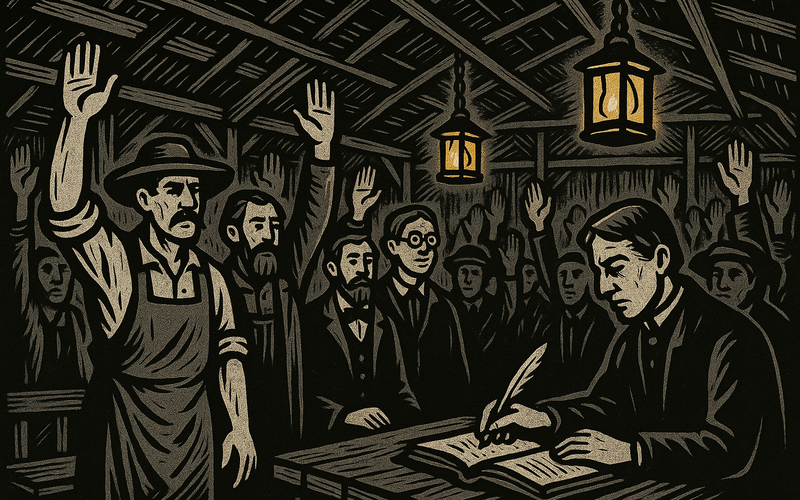
It was understood as the political expression of a particular people: a group bound together by shared language, shared history, shared religious inheritance, and shared habits of self-government. When 19th-century European nationalists debated the “national question” (Nationalitätenfrage in German), they were asking which peoples deserved or required a state of their own, and how a multi-ethnic empire like Austria-Hungary or the Russian Empire should manage the competing claims of its many constituent peoples.
Lenin and Stalin both wrote treatises on the national question as a Marxist political problem. For them it was a question of how to manage ethnic minorities within a revolutionary state without triggering breakup. For 19th-century nationalists it was the opposite problem: how to construct a coherent state out of a people that had one.
The American version is different from both, but it draws on the same structural concern.
The United States was not built on ethnic homogeneity. It was built on something the Founding Fathers believed was sufficient to replace it: a political creed, a set of republican habits, a shared attachment to self-government through local institutions. Benjamin Franklin’s “a republic, if you can keep it” was not a platitude. It was a statement about requirements.
The National Question, in its American form, asks whether those requirements are still being met.
Can the United States sustain self-government when its members no longer share a common political culture? When the institutions that transmitted that culture, the local church, the common school, the civic association, the neighborhood that more or less knew itself, have been thinned out, standardized away, or absorbed into the administrative apparatus of the national state?
That is the question. Everything else follows from how you answer it.
Where the Term Comes From
The term entered American paleoconservative discourse primarily through Sam Francis (1947-2005), one of the sharper political analysts the dissident right produced in the latter half of the 20th century.
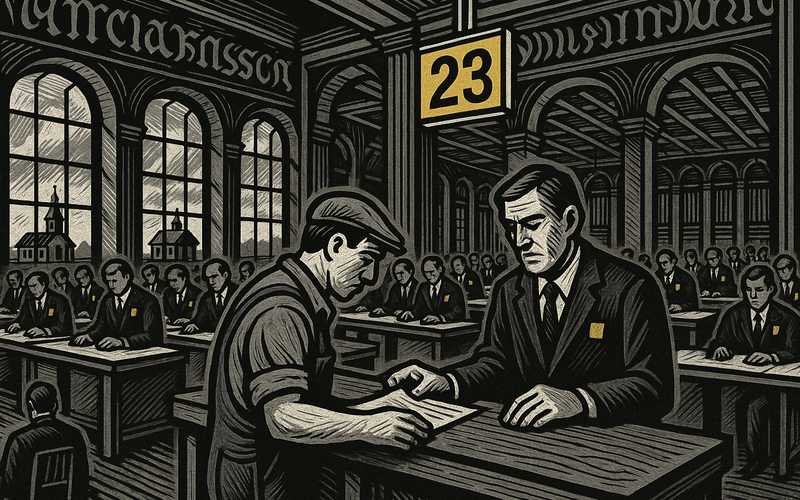
Francis was a protege of James Burnham, whose The Managerial Revolution (1941) and The Machiavellians (1943) had already diagnosed the structural shift underway in Western democracies: the old bourgeois ruling class was being displaced by a new managerial elite, technically credentialed, institutionally embedded, and fundamentally hostile to the older habits of local self-government and bourgeois independence.
Francis took Burnham’s structural analysis and applied it to the American case with more cultural specificity. His Beautiful Losers (1993) and the posthumous Leviathan and Its Enemies (2016) argued that the historic American nation, Anglo-Protestant in cultural inheritance, republican in political habit, decentralized in governance instinct, had been systematically displaced by the managerial state and the credentialed administrative class that staffed it.
The displacement was not primarily about race or ethnicity, though those were variables Francis tracked. It was about political culture. The specific habits, assumptions, and institutions through which American self-government had historically operated were being crowded out by a regime that had more interest in managing the population than in being accountable to it.
Francis coined “anarcho-tyranny” to describe the result: a state that fails to enforce basic order and law against genuine threats while meticulously regulating the behavior of the compliant and law-abiding. The compliance is managed; the disorder is permitted; the managerial class skims the difference.
Pat Buchanan, who worked alongside and parallel to Francis on the cultural-nationalist right, brought a more demographic and electoral version of the question to a broader audience. His Death of the West (2002) and State of Emergency (2006) framed the National Question around birthrates, immigration patterns, and the measurable displacement of the older American cultural mainstream. Buchanan was a primary-political figure, a three-time presidential candidate (1992, 1996, 2000), which meant the National Question briefly became a campaign issue before the mainstream political conversation closed back around it.
The Sam Francis Diagnosis
Francis’s version of the National Question deserves its own attention because it is the most analytically careful, and because it is routinely misread.
The misreading goes like this: Francis was concerned about demographic change, therefore his argument was an ethnic argument. That is a partial reading.
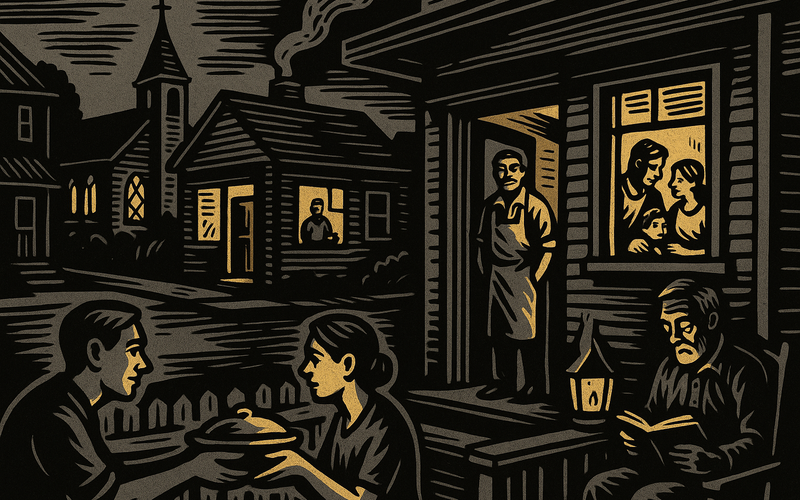
Francis’s argument was that the substrate of self-government was eroding. That substrate is political and cultural before it is demographic. It is made up of the habits, institutions, and shared understandings through which a people actually exercises power over its collective life. A republic requires citizens who know how to be citizens, who can deliberate, organize, hold officials accountable, and sustain the local institutions that make self-government real rather than nominal.
What the managerial state does, Francis argued, is dissolve exactly those habits. It centralizes decisions that used to be made locally. It replaces the authority of fathers, churches, and neighborhood associations with the authority of credentialed professionals and administrative agencies. It turns citizens into clients. The legal forms of the republic continue, elections, courts, constitutions, while the substance of self-government is transferred to a class that is neither elected nor accountable in any meaningful sense.
That is the National Question as Francis actually posed it. Not primarily who is in the country, but whether the country in any meaningful sense still has a people capable of governing themselves.
What It Means in Practice
The downstream consequences show up in predictable places.
The franchise question is one of them. If self-government requires a citizenry capable of deliberation and genuine stake-holding, then the question of who votes and under what conditions is not a technical question. It is the National Question applied to the electoral machinery. The entry on Qualified Democracy treats this directly.
The scale question is another. Jefferson’s proposal for governing wards, small enough that citizens could know the decisions being made in their name, was an attempt to build the substrate of self-government into the architecture of governance itself. The entry on Jefferson’s Hundreds covers that proposal. It is not a coincidence that Jefferson, by the end of his life, had grown pessimistic about the republic’s trajectory. He was watching the substrate erode in real time.
The forms survive while the substance is gone. The courts continue to meet. The elections continue to be held. The legislation continues to be produced. But the connection between those processes and the actual self-government of an actual people grows thinner with each generation.
Final Thoughts
People use “The National Question” because mainstream political vocabulary does not name what they are pointing at. What they are pointing at is the substrate sustaining American self-government. That substrate is eroding faster than the legal forms can adjust. The republic is becoming what Madison feared in Federalist No. 10: a nominal democracy that manages its population rather than a genuine republic that is accountable to it.
Different traditions emphasize different variables:
- Buchanan’s version emphasizes demographic and cultural change. If the people who built and transmitted a political culture are replaced or marginalized faster than that culture can be transmitted, the culture eventually doesn’t transmit.
- Francis’s version emphasizes managerial class capture. The administrative state is a political actor with interests of its own, and those interests run counter to genuine self-government.
- Kirk’s version emphasizes civilizational continuity. Order is downstream of culture, culture is downstream of shared inheritance, and shared inheritance requires active cultivation across generations, through families, churches, local institutions, and the habit of reading what came before.
These versions can be held simultaneously. They are not competing answers so much as different lenses on the same underlying concern.
The question itself is older than any of these formulations. Aristotle asked it of the polis. Madison asked it in Federalist No. 10. Tocqueville asked it of the new American experiment. Burnham asked it of the managerial revolution that was already eating the older order from inside.
What does a reader do with the National Question once they understand it? The answer is not primarily political. The more durable answer is the older one: build the things that last regardless of what happens in Washington. The parish that knows its people. The neighborhood association that solves local problems before they reach the county commissioners. The small business that hires the kid down the street because someone vouched for him. The family that keeps its own records, owns its own assets, and does not need an administrative intermediary to hold itself together.
The work is local, voluntary, and not waiting for a national settlement that may not come.
For further reading: Sam Francis, Beautiful Losers: Essays on Failure of American Conservatism (University of Missouri Press, 1993). James Burnham, The Managerial Revolution (John Day Company, 1941).
« Back to Glossary Index