Home > Concepts > Urban Atheists: The Most Religious People You Know
Table of Contents
Urban atheists are a unique breed. They hold strongly felt opinions about how the natural world works, and equally strong opinions about traditional religion, which they regard as a quaint thing their grandparents needed and they have moved past. What they hold almost no opinion about is how they themselves stand in relation to either one. There, the self-awareness goes dark.
So here is an experiment for your next dinner party. Ask one of them whether environmentalism is a religion. You will get a no, possibly a laugh. Then run the checklist together.
Does it have a penance system? Watch the Netherlands pay out billions for earthquake damage without asking whether an earthquake caused it. Does it sell indulgences? Watch Germany pay its own industry to survive the electricity prices its own doctrine created. Does it perform rituals? Concrete poured down gas wells, dynamite through cooling towers, so that no future generation can reopen the question. Does it prosecute heresy? Ask which it hates more: The dirtiest coal in Europe, or the zero-carbon technology that fails to demand sacrifice.
No pews. No incense. The liturgy is complete.
Nietzsche saw this coming. Everyone can quote his three famous words: God is dead. Almost nobody quotes the passage they sit in, from The Gay Science (Walter Kaufmann’s translation), and the passage is the point:
God is dead. God remains dead. And we have killed him. How shall we comfort ourselves, the murderers of all murderers? What was holiest and mightiest of all that the world has yet owned has bled to death under our knives: who will wipe this blood off us? What water is there for us to clean ourselves? What festivals of atonement, what sacred games shall we have to invent?
He was not celebrating. He was afraid, specifically, of what would rush into the vacancy left by traditional belief in the West, and much of Jordan Peterson’s public work is an extended footnote to that fear. Festivals of atonement. Sacred games. He even got the liturgy right.
This is an essay about energy policy, which I have come to think of as applied theology: What rushed into the vacancy, applied to the grid. Five countries supply the evidence, all of it recent, most of it from 2026.
Two Creeds Fight Over One Fuel Gauge
Strip away the engineering and nearly every energy debate runs on one of two creeds.
The first holds that the earth is benign and man is the stain on it. Nature is in balance until we disturb it, and the moral response to our appetites is to shrink them. Call it the sacrifice creed: The good life is the smaller life, and energy is the appetite most in need of restraint. Nietzsche named the instinct behind it in the Genealogy of Morals: The ascetic ideal, which he predicted would outlive the God it served. It has. It changed employers.
The second holds that the earth is dangerous by default, that cold, drought, and distance kill the unprotected, and that mastering energy is what stands between human beings and the elements. Call it the flourishing creed. Its clearest modern statement is Alex Epstein’s standard-of-value move: Judge energy policy by its effect on human flourishing, not by its effect on an untouched earth.
Michael Crichton, who called environmentalism “the religion of choice for urban atheists,” mapped the sacrifice creed’s architecture back in 2003, and I’ve analyzed that speech at length on this site: Eden, the fall, judgment day, sustainability as salvation. One line of his is worth re-hearing before the case studies:
We are all energy sinners, doomed to die, unless we seek salvation, which is now called sustainability.
What I want to add is why the blind spot matters. Carl Jung spent his 1937 Terry Lectures on exactly this pattern: The gods people do not know they serve are the ones that run them hardest. The creed’s adherents hold its tenets, and its high priests, beyond critique, and they can do that precisely because they do not file any of it under religion. A confessed faith can be argued with.
An unconscious one cannot.
You will notice this essay does not argue about temperature data. It doesn’t need to. When a belief system is unconscious, you don’t test it by debating its doctrines. You test it the way Matthew 7 suggests: By their fruits. So here are the fruits, from rule-of-law democracies that could see each other’s mistakes and made them anyway.
Penance: Groningen Pays for Sins Nobody Counts
The Groningen gas field made the Netherlands rich, and extracting it caused earthquakes. Minor ones by international standards, but the damage in the epicenter area was real, and the state and the gas company handled the victims badly: Corporate lawyers, denial, delay. The grievance was legitimate. Hold that thought, because every durable religion recruits on a legitimate grievance.
Then came the correction, and the correction is where the theology starts.
The Dutch parliament didn’t fix the claims process. It removed the need to establish cause at all. Mining damage became claimable anywhere ground motion had ever exceeded 0.55 millimeters per second, which is roughly what a basketball bouncing on a wooden floor produces, and for most of the province that threshold was crossed exactly once, by a single tremor in 2012. Investigation was dropped in stages: First €5,000 of repairs without causal inquiry, then €10,000, then up to €60,000.
The results, documented by the Dutch journalist Jesse Frederik in a remarkable piece for De Correspondent, read like satire. 2024 was the mildest seismic year in two decades and drew 42,790 damage claims. Over 70 percent of all claims come from zip codes where peak ground motion never exceeded what a truck driving over a speed bump sends through your living room. Total compensation has passed €3.9 billion, reaching 56 percent of all addresses in the designated earthquake zone. One wealthy town, where the maximum expected tremor is comparable to a passing train and an engineer put the odds of a quake-caused crack in an undamaged brick wall at 1 in 20,000, has collected €65 million, plus €14.5 million in green-energy subsidies reserved for quake victims.
The gas company, meanwhile, had spent €200 million on research. Groningen became the global center of induced-seismicity science, the whole province wired with sensors. The research was ignored. The parliamentary inquiry ran on what one international expert called “misinformation on a very serious scale,” and this time the science denial came mainly from the left.
Read that sequence as policy and it is incoherent. Payments rise as tremors fall; the best-instrumented province on earth is governed in defiance of its own instruments.
Read it as theology and it makes perfect sense. Once cause no longer matters, compensation is not a remedy. It is penance. The nation sinned against Groningen by extracting; the sin is absolved by paying; asking whether this particular crack came from this particular tremor is as beside the point as asking a penitent which specific sin each Hail Mary retires.
The finale was liturgical too. The wells were permanently cemented with roughly 550 billion cubic meters still in the ground, about 18 years of Dutch consumption. Experts asked that a few wells be left intact as an emergency reserve. Parliament said no. Sixty percent of the Dutch public now wants the wells kept as a strategic reserve, per an April 2026 Verian poll for De Telegraaf, but the concrete went in first, and it is not coming out. The Netherlands now imports most of what it burns, at a premium, partly as U.S. LNG, with higher emissions attached and more exposure to foreign autocrats.
And Groningen is still angry. Penance comforts the penitent. It rarely satisfies anyone else.
Indulgences: Germany Pays Itself to Obey Itself
Germany’s exit from nuclear power was decided in 2011, days after Fukushima: A tsunami-risk decision applied to a country with no tsunamis. Around 2000, nuclear supplied roughly 30 percent of German electricity. The last three reactors closed in April 2023.
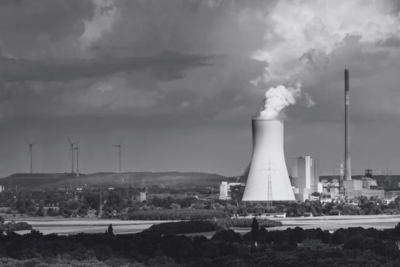
Then, in October 2025, the cooling towers at Gundremmingen were dynamited, four years after the plant stopped producing. The following January, Chancellor Friedrich Merz called the phaseout a “serious strategic mistake”. Note the order: First the demolition, then the confession, and the phaseout stands anyway. The Netherlands cemented its wells; Germany blew up its towers. Both made sure the question could never be reopened. A mistake that has merely been made can be corrected. A mistake that has been consecrated cannot, and demolition is consecration performed with explosives.
The bill, as compiled by the financial journalist Thomas Kolbe (figures his): Industrial power at 16 to 17 cents per kilowatt-hour, as much as 70 percent above U.S. and French competitors, steel output down about a quarter since 2018, and 325,000 new administrative positions created in three years just for regulatory compliance.
Which brings us to the indulgence. From January 1, 2026, the German state subsidizes the industrial electricity price, paying industry to survive the prices the state itself created. Brussels has restricted the relief to half of a firm’s consumption for three years. Cost estimates run from €4 billion a year (the German Economic Institute) to €50 billion (a number aired in a parliamentary hearing).
Sit with the shape of that. The doctrine raises the price. The price kills the industry. The state then sells the industry relief from the doctrine, without ever questioning the doctrine. That is not an energy policy. That is an indulgence: A payment that licenses continued operation inside the creed, sparing everyone the heresy of asking whether the creed was wrong.
Heresy: Nuclear Is the Tell
If the sacrifice creed were really about carbon, nuclear power would be its favorite technology. Zero-carbon, always-on, the densest energy humanity has ever tamed.
Instead, Germany closed zero-carbon baseload while continuing to burn lignite, the dirtiest coal in common use. If CO2 were the actual god, the reactors stay open and the lignite dies first. The creed required the machines to die ANYWAY. That is how you know the objection was never the carbon. Nuclear’s unforgivable sin is that it answers the prayer without demanding the sacrifice.
Australia makes the same point without closing anything, because it never allowed nuclear to exist. It holds roughly a third of the world’s uranium reserves and is the fourth-largest producer. It mines the vault for everyone but itself: Zero power reactors, mining still banned in two states, and a federal prohibition in place since 1998-99, born when John Howard traded a power-reactor ban for Senate votes to build a research reactor at Lucas Heights. A symbolic bribe, and even John Quiggin, an opponent of nuclear power, concedes it was purely symbolic at introduction. The symbol has now been frozen into 27 years of doctrine, through the AUKUS deal in which Australia decided it trusts reactors in submarines but not on land, and through household electricity prices running 1.5 to 2 times the U.S. average.
The honest counterweight: Australia has perhaps the best solar resource on earth, CSIRO’s latest GenCost ranks nuclear the most expensive option it models, and the agency reckons at least 15 years from lifting the ban to first power, with a workforce built from scratch. Maybe nuclear genuinely doesn’t pencil there.
But genuinely uneconomic things don’t need bans. They fail on their own. A ban exists to prevent capital from testing the question, and Australia’s energy minister gave the game away in July 2026 by declaring nuclear “not an answer for Australia any time.”
Never. Not “not yet.” Risk management says not yet. Theology says never. His line on small modular reactors in the same interview settles it: “It’s the next big thing and it always has been and in my view, it always will be.”
The Congregation That Believes It Is Humanist
South Africa is where the creed’s cost stops being a statistic and becomes a moral problem, because South Africa contains the First World and the Third World inside one border, in sight of each other.
On August 14, 2026, the Constitutional Court killed Shell’s Wild Coast exploration right outright. The consultation with affected communities had been defective, and the majority could have ordered it cured and redone. Instead it extinguished the right entirely, though the dissent offered a better remedy, turning a procedural failure into a locked vault: Roughly 30 billion barrels of oil equivalent locked offshore in a country with 33.6 percent unemployment.
And here is the part I find genuinely nuts: Both major South African parties are committed to Net Zero. At a third of the workforce unemployed, there is no political vehicle for asking whether the energy doctrine fits the country’s actual emergency. The courts have ruled, the parties agree, and so every institutional channel a rule-of-law democracy provides for auditing a policy (judicial review, opposition politics, the ballot) has been closed by consensus.
The people most committed to this arrangement are, by and large, environmentalists, and they are concentrated where life is already good, notably in the Western Cape. They would also tell you, sincerely, that they are humanists who care about their fellow citizens. Yet they support anti-growth policies whose cost falls on the fellow citizens across the buffer strips, the ones trying to climb out of the Third World, because that climb, at scale, would change how the First World enclaves look and feel. Rob Henderson calls beliefs like this luxury beliefs: Positions that confer status on the comfortable while their costs land on the poor.
Victor Davis Hanson pulled the same thread about his own state in his Mexifornia speech: Urban, coastal elites insulated from the destructive outcomes of the policies they champion, while the Central Valley lives with the results. The people who design an arrangement are the last to live inside its consequences, and the first to leave when the consequences arrive (see California’s migration to Texas and other red states). Insulation is what makes a luxury belief affordable. South Africa just has less of it than almost anywhere: The costs land in the same country, a taxi ride away.
That is the sacrifice creed’s sharpest edge. The sacrifice is real. It is just performed by someone else.
Failed Prophecy Has Never Embarrassed a Faith
A brief word about track records, because the creed’s defenders will say the science is settled and the skeptics are the cranks, and the record is more even than that.
In 1956 M. King Hubbert predicted U.S. oil production would peak by 1970 and decline forever. The 1970s consensus held that the population bomb would starve the world. Both prophecies failed comprehensively, U.S. output at record highs, global birthrates below replacement nearly everywhere, and the faith absorbed both failures without a tremor. Leon Festinger documented the mechanism in When Prophecy Fails in 1956, as it happens: Disconfirmation, for the committed believer, deepens commitment.
The skeptics’ side has its own sins against accuracy. Britain’s North Sea oil and gas output really is down roughly three-quarters from its turn-of-the-millennium peak, and the case that the U.K. threw away its endowment is real. Then Donald Trump claimed the North Sea holds 500 years of reserves, when analysis of the regulator’s own production data shows about 93 percent of likely lifetime production already extracted. A real critique welded to a fake number becomes a dismissible argument. By-their-fruits is a test both creeds have to take.
Which is why this essay leans on behavior, not forecasts. Forecasts are cheap. Cemented wells, dynamited towers, subsidy spirals, and locked vaults are conduct, and conduct is evidence.
By Their Fruits
Run the audit.
Norway sits on a comparable endowment to its neighbors, about 98 billion barrels of oil equivalent. It extracted, invested, and built a $2 trillion fund, roughly $400,000 per citizen, while running some of the cleanest domestic electricity on earth. The difference is institutions, not geology. It can be done.
Against that baseline: South Africa blocked the vault. Britain spent the vault. The Dutch cemented the vault. Australia mines the vault for everyone but itself. And Germany dynamited the machines that turned its vault into power.
Five different countries, five different legal systems, one identical refusal to leave the question open. That pattern is not explained by geology, or economics, or party politics, since the choices survive changes of government. It is explained by a creed, held mostly by people who would laugh at the suggestion that they hold a creed.
The flourishing creed submits to audit every single day. Its reactors either run or they don’t, its funds compound or they don’t, its grids hold in a cold snap or they don’t. The sacrifice creed defers its audit to a judgment day that keeps not arriving, and in the meantime asks for penance, sells indulgences, and burns its own options at the stake.
I don’t ask anyone to abandon their faith. I ask only that they notice they have one.
Because ideas have consequences, and unexamined ideas have the consequences nobody chose: Higher bills, exported industries, imported gas, and a vault door sealed by people who will not be there when their grandchildren need what is behind it.

 BY
BY