
 BY
BY Table of Contents

Economic freedom and racial equality are not in tension. That is not a controversial claim – it is the central finding of Walter E. Williams’s career, and the managerial state has spent fifty years trying to bury it. Williams, who held the John M. Olin Chair in economics at George Mason University from 1980 until his death in 2020, made the argument with receipts: the Davis-Bacon Act was passed explicitly to price Black laborers out of federal contracts, minimum wage floors eliminate the entry-level jobs that let low-skilled workers acquire the experience that commands higher wages later, and occupational licensing regimes exist to protect incumbents from competition, not consumers from harm. The regime’s preferred narrative runs the opposite direction – that markets are where discrimination lives and government is where justice lives. Williams spent four decades demonstrating, with the patience of a man who had already won his own court-martial, that this narrative had the causation exactly backwards.
His intellectual companionship with Thomas Sowell – whom he met at UCLA in 1969, and whose constrained vision of human nature he shared – was not incidental to his method. Both men were congenitally allergic to the kind of academic hedging that converts obvious truths into credentialed mush. Williams wrote direct declarative sentences about coercion, property, and the moral difference between voluntary exchange and political redistribution. He understood, following Mises and Hayek, that prices are not just numbers but information, and that when the state overrides them it does not improve on the market’s outcome – it destroys the signal that makes rational economic life possible. His 1982 book The State Against Blacks built that theoretical scaffold into a specific, falsifiable indictment of specific statutes, and nobody who read it carefully was able to answer it. They mostly chose not to read it carefully.
The quotes collected here move across the full range of his thinking: what capitalism actually is and where it comes from, why democracy without constitutional limits is just a polished form of mob rule, how politicians convert the language of compassion into instruments of control, and why property rights and genuine charity are complements rather than competitors. Read them as a course in the thing Conservative Inc. perpetually fails to teach and the academic left perpetually refuses to hear – the moral case for leaving people alone.
On Capitalism, Self-Interest, and the Free Market
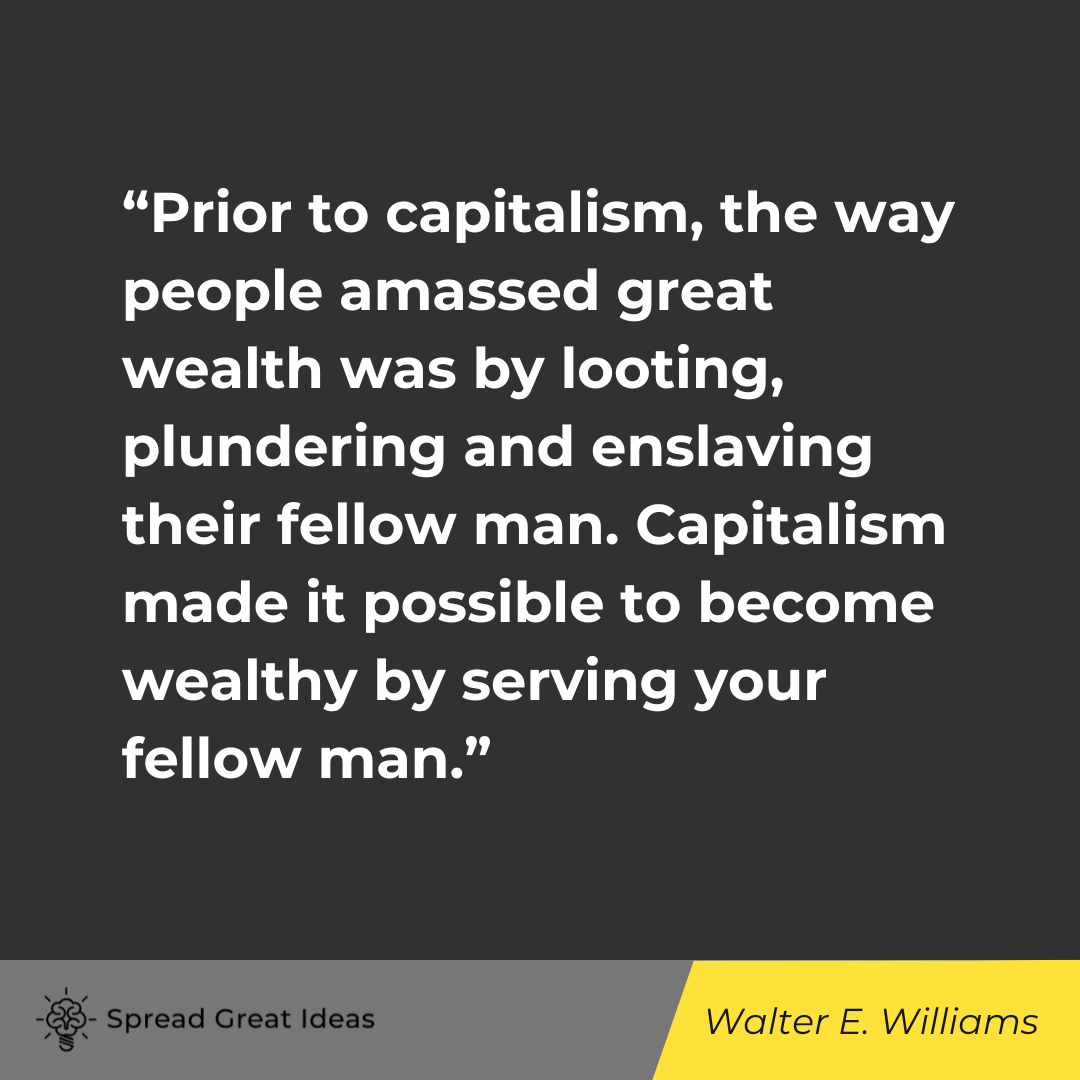
“Prior to capitalism, the way people amassed great wealth was by looting, plundering and enslaving their fellow man. Capitalism made it possible to become wealthy by serving your fellow man.”
- Walter E. Williams, American Contempt for Liberty
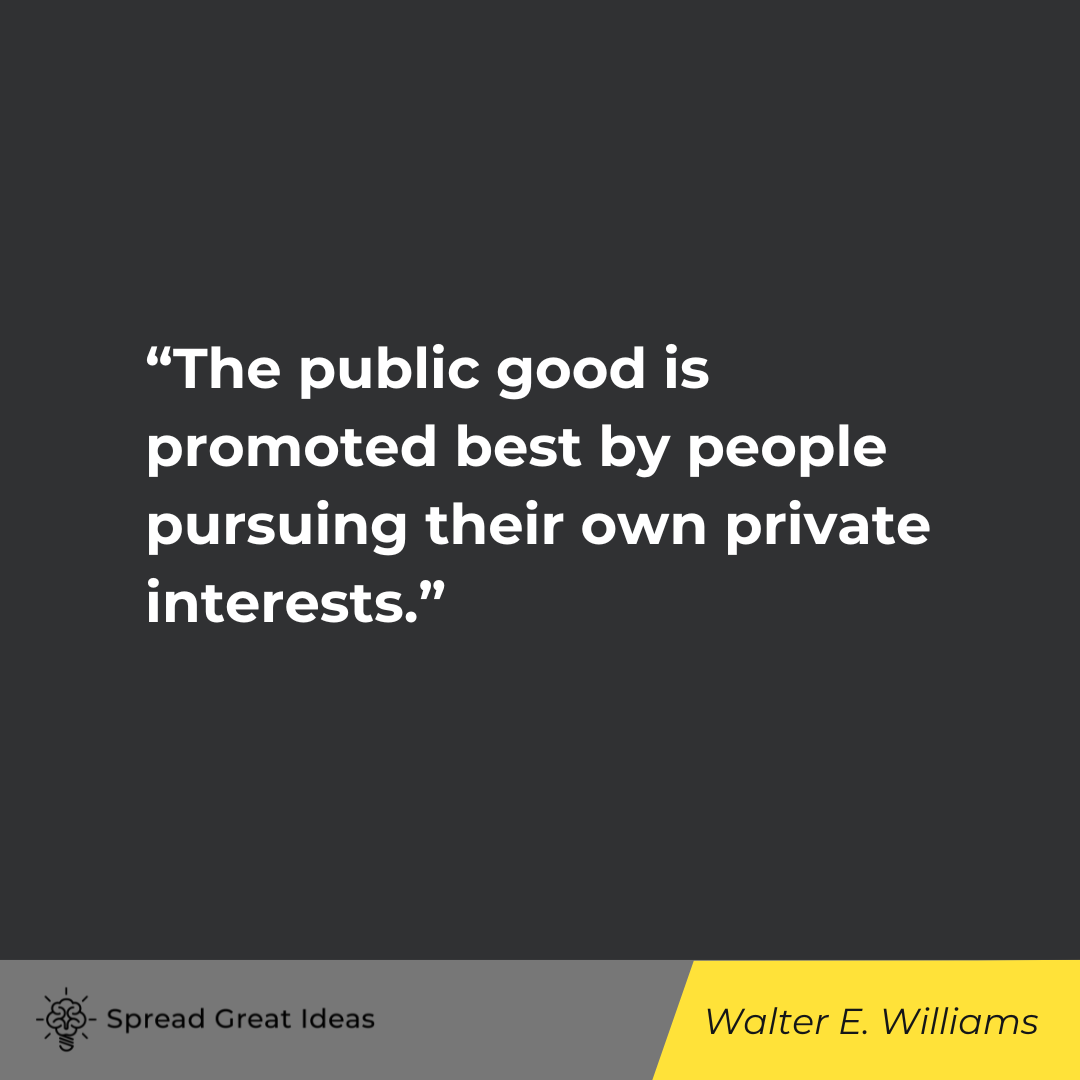
“The public good is promoted best by people pursuing their own private interests.”
– Walter E. Williams, Williams’s syndicated column
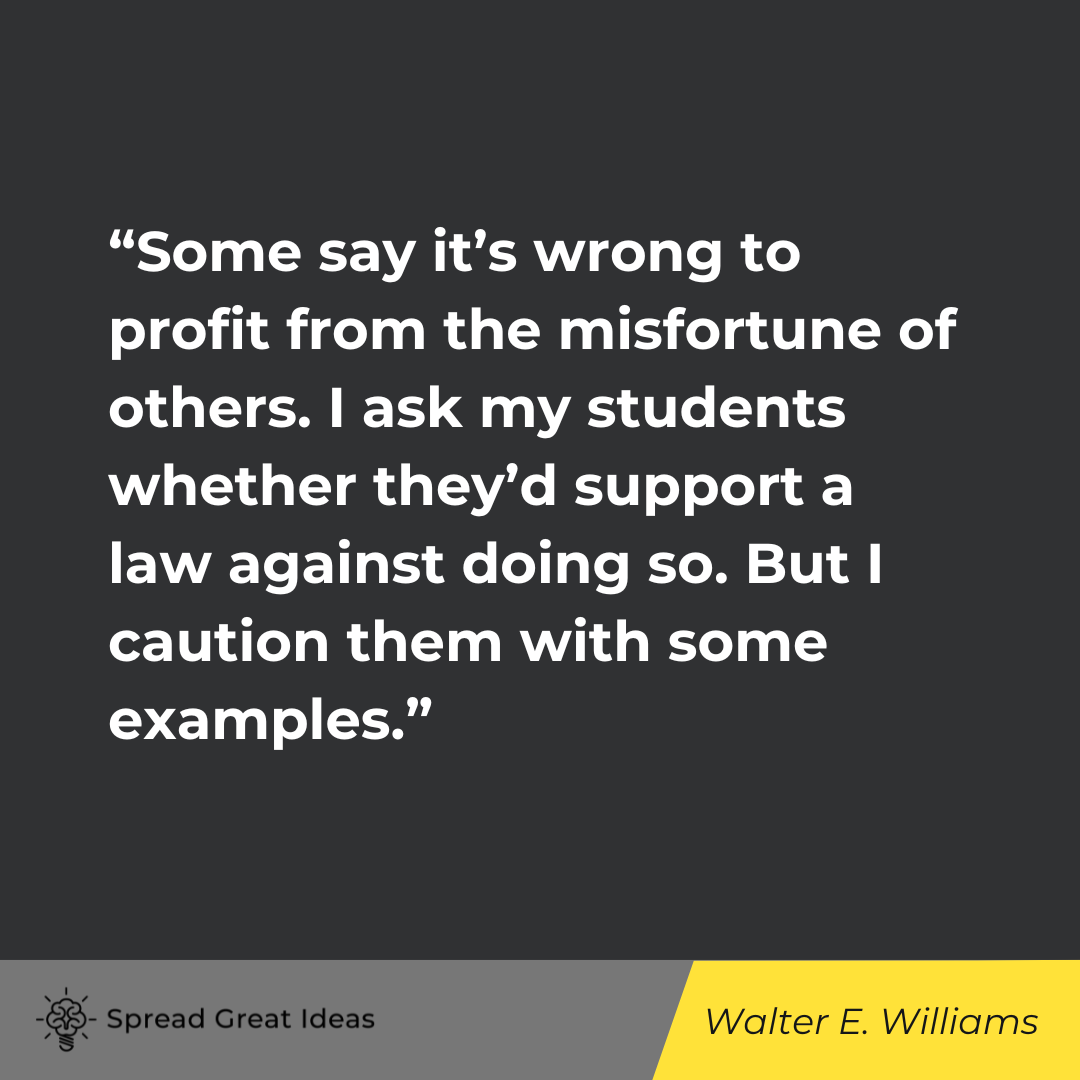
“Some say it’s wrong to profit from the misfortune of others. I ask my students whether they’d support a law against doing so. Then I point out that orthopedists profit from broken legs, collision repair shops profit from car wrecks, and I make my own living off student ignorance of economic theory.”
- Walter E. Williams, American Contempt for Liberty
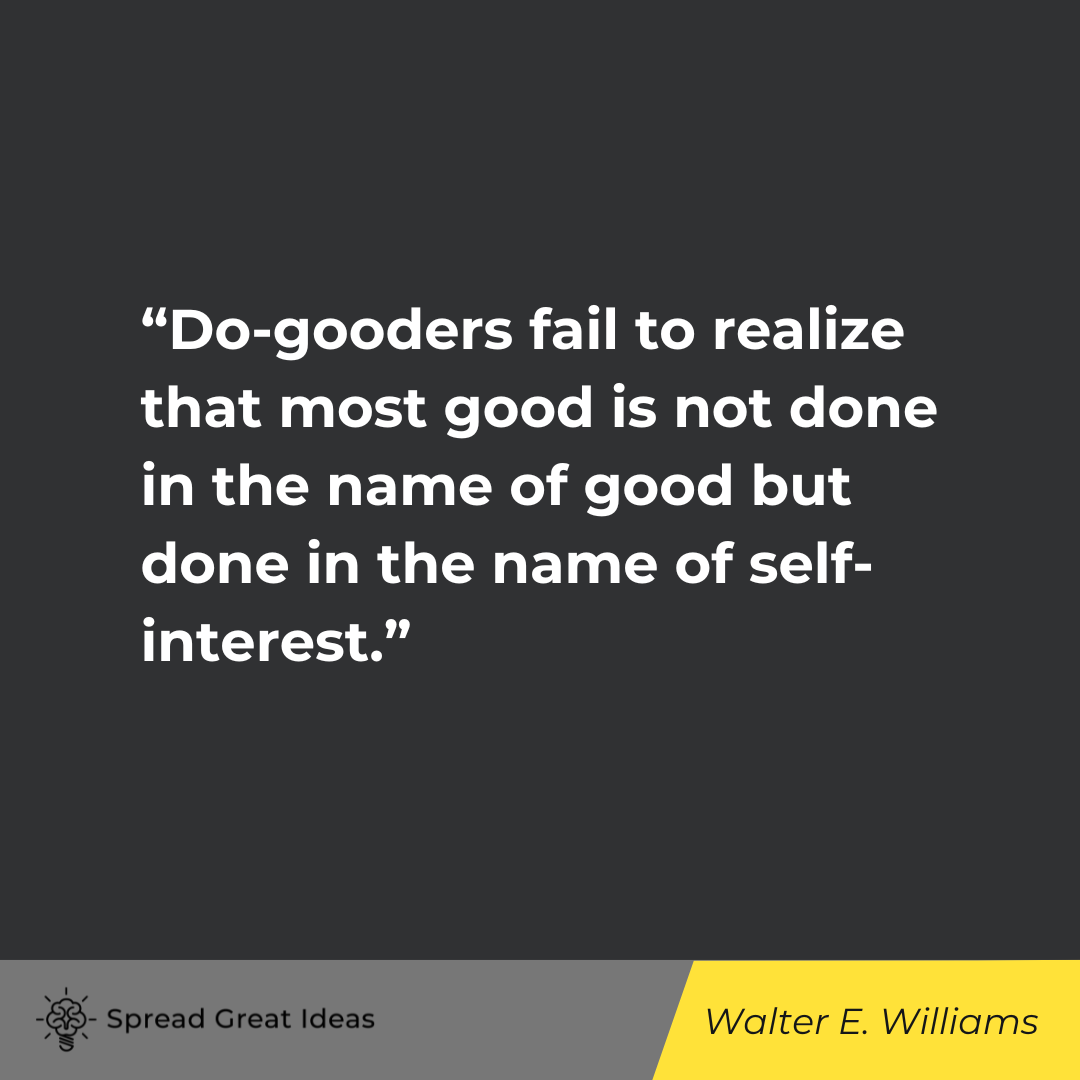
“Do-gooders fail to realize that most good is not done in the name of good but done in the name of self-interest.”
- Walter E. Williams, American Contempt for Liberty
On Liberty, Democracy, and Constitutional Rights
“Democracy and liberty are not the same. Democracy is little more than mob rule, while liberty refers to the sovereignty of the individual.”
– Walter E. Williams, Williams’s syndicated column
“If we’re ignorant of the historical sacrifices that made our liberties possible, we will be less likely to make the sacrifices again so that those liberties are preserved for future generations.
And, if we’re ignorant, we won’t even know when government infringes on our liberties. Moreover, we’ll happily cast our votes for those who’d destroy our liberties.”
- Walter E. Williams, American Contempt for Liberty
“Nothing in our Constitution suggests that government is a grantor of rights. Instead, government is a protector of rights.”
- Walter E. Williams, Liberty Versus the Tyranny of Socialism
“If we buy into the notion that somehow property rights are less important, or are in conflict with, human or civil rights, we give the socialists a freer hand to attack our property.”
– Walter E. Williams, Williams’s 2005 syndicated column on Kelo v. New London
On Government, Politicians, and Coercion

“Believing that presidents have taxing and spending powers leaves Congress less politically accountable for our deepening economic quagmire. Of course, if you’re a congressman, not being held accountable is what you want.”
- Walter E. Williams, American Contempt for Liberty
“It’s government people, not rich people, who have the power to coerce and make our lives miserable. Coercive power goes hand in hand with government.”
- Walter E. Williams, American Contempt for Liberty
“Politicians have immense power to do harm to the economy. But they have very little power to do good.”
- Walter E. Williams, Williams's syndicated column

“The best good thing that politicians can do for the economy is to stop doing bad. In part, this can be achieved through reducing taxes and economic regulation, and staying out of our lives.”
- Walter E. Williams, American Contempt for Liberty
On Property, Charity, and the Welfare State
“But let me offer you my definition of social justice: I keep what I earn and you keep what you earn. Do you disagree? Well then tell me how much of what I earn belongs to you – and why?”
- Walter E. Williams, All It Takes Is Guts: A Minority View
“The act of reaching into one’s own pockets to help a fellow man in need is praiseworthy and laudable. Reaching into someone else’s pocket is despicable.”
– Walter E. Williams, Williams’s syndicated column

“The welfare state has done to black Americans what slavery couldn’t do, and that is to destroy the black family.”
- Walter E. Williams, Williams's 2017 syndicated column
“The law-abiding black citizen who is passed up by a taxi, refused pizza delivery, or stopped by the police can rightfully feel a sense of injustice and resentment.
But the bulk of those feelings should be directed at those who have made race synonymous with higher rates of criminal activity rather than the taxi driver or pizza deliverer who is trying to earn a living and avoid being a crime victim.”
- Walter E. Williams, Race & Economics: How Much Can Be Blamed on Discrimination?
Final Thoughts
Williams was the rare academic who insisted on writing for ordinary readers and refused, until the end, to dress up his arguments to fit fashions in his profession. He was also one of the few economists who treated the moral question, who has the right to do what to whom, as inseparable from the empirical one.
If you read one of his books, the right starting point is American Contempt for Liberty (Hoover Institution Press, 2015), the late-career collection that pulls together his clearest essays on the questions you find on this page. Race & Economics (Hoover, 2011) is the more focused successor to The State Against Blacks and remains the most rigorous case ever made for the proposition that government did more damage than discrimination. And his autobiography Up From the Projects (Hoover, 2010) is the personal version of the same argument: a man who walked it, not just said it.