
 BY
BY Table of Contents
The U.S. has enough money to bomb faraway places in sneak attacks – Iran being the most recent example – and yet doesn’t seem to have the money to fund, or at least administer, what it calls American Citizen Services i.e. ACS.
ACS is part of the U.S. State Department, and it is the most likely touchpoint for most American expats because ACS is who handles passport issuance and renewals abroad.
I flew to Warsaw recently to get another U.S. passport. Not because I wanted to visit Warsaw. Because the consulates closer to me here in the E.U. had two-to-three-month wait times in the appointment system. So I did what the system forced me to do: I booked a flight to a different country to get in front of my own government in a timely manner.
The Prologue: Getting to a Human at ACS
In the week prior to my Poland flight, I called the ACS Warsaw line multiple times. Office hours, no holidays. Nobody picked up.
I emailed. Got an autoresponder directing me to a website form. The website form is a locked Microsoft Forms instance. Built in ~2007, it did not have the options I actually needed.
Eventually a human responded. One or two sentences. Every time I replied to that human, the autoresponder fired again. The thread became a loop: human response, autoresponder, silence, my reply, autoresponder, silence.
It is a system designed to absorb inquiries. Not to answer them. To make you feel grateful when you do actually get a thinking, feeling competent person on the other end of your inquiry.
The Friction Economy Starts on the Sidewalk
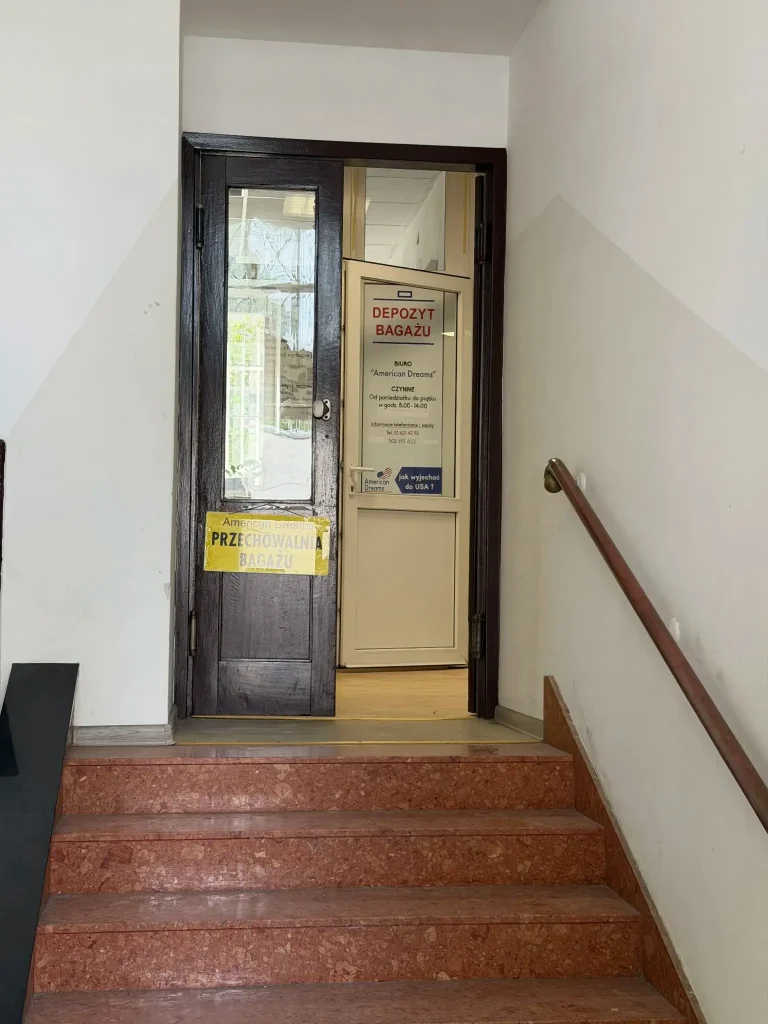
Landing in Warsaw, I went right to the U.S. embassy. That was a mistake.
You cannot bring a bag in. No suitcase, no laptop, no headphones. No one tells you this ahead of time when you book your appointment.
Coming direct from the airport, I had a rolling suitcase. Across the street, an enterprising local had set up a small bag-storage operation. 20 PLN or $5 to store your stuff for an hour. The owner told me he’d been running it for 25-30 years.
Twenty-five to thirty years.
The Polish security guard at the embassy – the one who is armed – pointed right at it. Politely told me to walk up the stairs and to the left.
The embassy knows the shop exists. It’s probably been there since 9/11. Doesn’t matter who is in charge in Washington, the State Department and their outposts have little incentive to solve the inconvenience itself. So the solution has been outsourced to a private citizen who noticed the gap and filled it a quarter-century ago.
Then I went inside.
What the Building Is Telling You
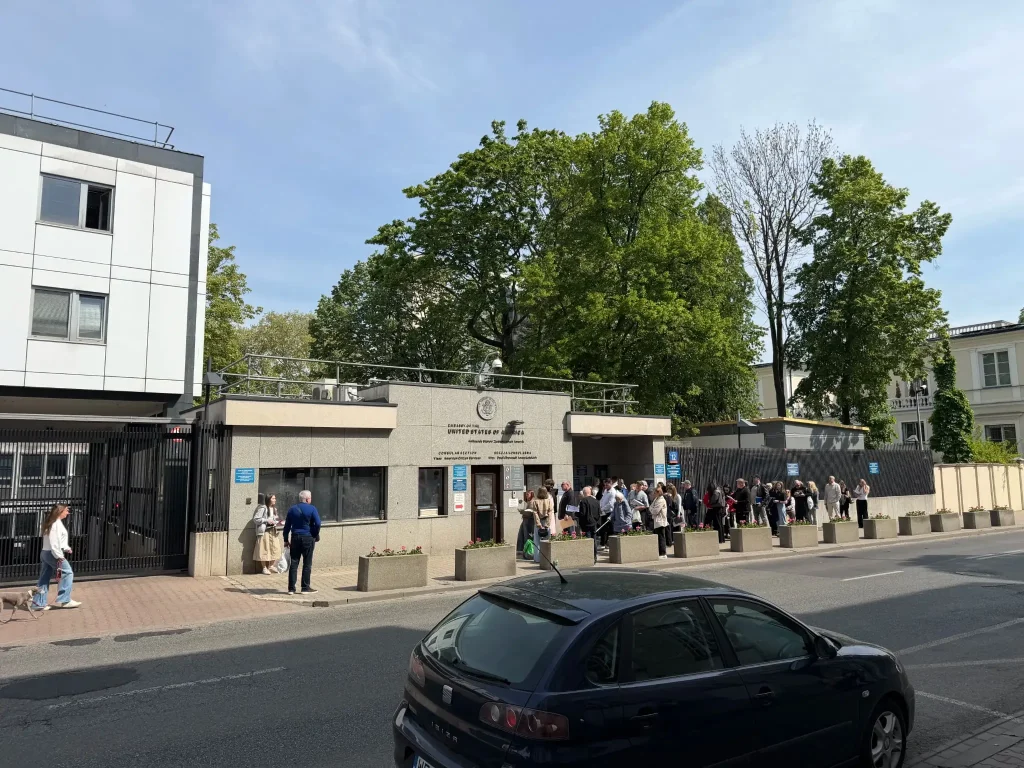
There were two queues outside. One for visa applicants – Polish, Ukrainian, others. One for people with appointments, which is where I went. Both queues feed into the same building. The line you stand in changes nothing about what the building is.
The phone went off at the door. AirPods too. I handed everything over.
Metal detector. Jacket off. I was scanned.
Cameras everywhere. Metal-barred doors. Guards polite – genuinely polite – but there was no ambiguity about the power structure in the room. Everyone was armed but me. The guards had weapons. I had been stripped of my devices. I was the only unarmed actor in the space.
The exterior of these buildings – even in NATO ally countries like Poland – looks like it belongs in Mogadishu or Baghdad. Fortified prisons. Not diplomatic facilities. The U.S. Embassy in Warsaw looks like it was designed by the same person who designed Brushy Mountain State Penitentiary.
On the other side of the metal detector: bulletproof glass. Consular officers behind it, visible, unreachable. I was not in the same room as them in any meaningful sense.
There were forms. Paper forms, handwritten, even though the same information was on the digital submission I had completed before arriving. I wrote my friend’s name. I wrote the address where I wanted my passport sent. I captured the courier number. By hand, on paper, in a room where I could verify nothing.
Here is the extra turn: because they had my phone, I could not photograph the form for my own records. The institution removes your communication tool and your memory aid in a single move.
When I got to the payment window, I learned that U.S. dollars are no longer accepted.
Think about that. You are standing on sovereign American soil, inside the official representation of the United States government abroad, and the currency of the United States is not legal tender. You need a bank card. Or local currency.
If you came with only your phone – Apple Pay, tap to pay, the way most Americans actually live – you have no phone. You handed it over at the door.
I had a card. But the awareness was sharp: if I hadn’t, the building would have simply waited. It does not accommodate. It processes.
You Are Not a Citizen Here. You Are an Applicant.
Here is the structural insight that landed while I was standing in that room.
Most Americans deal with their government through the IRS or the DMV. These are genuinely unpleasant institutions. The IRS can audit you, levy your accounts, make your life miserable for months. The DMV is designed, somehow, to feel like punishment for wanting to drive.
But they are domestic agencies operating under domestic legal constraints. You have standing. You have a congressman you can call. You have a court that will hear you – slowly, expensively, but it will hear you. You can invoke rights. You can raise due process. The Fifth Amendment exists between you and the IRS auditor in a way that carries real operational weight.
The embassy is different in kind, not just degree.
Consular officers operate under State Department protocols with near-total discretion on decisions. There is almost no judicial review of consular refusals – a legal doctrine called “consular nonreviewability” that U.S. courts have enforced for well over a century. The consular nonreviewability doctrine was briefly challenged in Kerry v. Din (2015) and survived. You can appeal to the officer’s supervisor. That is the review process. That is all of it.
Inside that building, your citizenship is a historical fact, not an operating credential.
You are not a citizen with rights. You are an applicant with a need.
The architecture – the glass, the barred doors, the cameras, the surrendered devices, the handwritten forms that duplicate your digital submission – is the institution being honest about what the relationship is. The inconvenience is not incidental. It is communicative.
Taxed Like a Citizen, Serviced Like a Petitioner
Here is the part that I keep coming back to as an expat.
Americans abroad pay U.S. taxes regardless of where they live. The United States is one of only two countries in the world that taxes its citizens on worldwide income. The other is Eritrea. Every other government on the planet uses residence-based taxation. You pay where you live. Move out, stop paying. Not for an American.
The one service your tax dollars are theoretically funding for you specifically – the ability to renew your passport – costs $130, takes weeks, and in Warsaw they won’t ship it outside Poland.
You need a Polish friend to receive it through a Polish-only courier service. Your friend pays for the courier at the door. You cannot prepay. You then hope your friend forwards it to you.
An expat is taxed like a resident citizen and serviced like a foreign petitioner. The asymmetry is total.
There is no internal constituency at State for whom the expat experience is a measurable problem. So it isn’t measured. So it doesn’t change.
What the Founding Fathers Already Knew
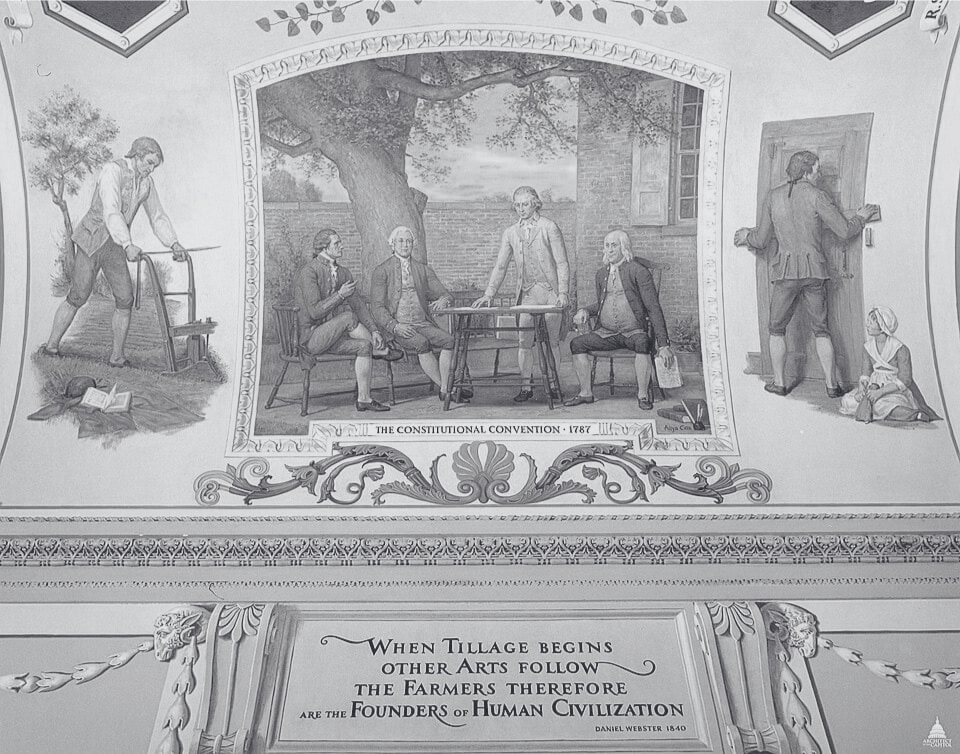
The Founding Fathers wrote the Constitution against exactly this gradient.
They had lived it. They were colonial subjects petitioning a Crown they could not vote out, appealing to officials who had discretion and no accountability to them personally. The Bill of Rights is not a list of gifts the government decided to offer. It is a set of constraints wrested from an institution that had demonstrated, concretely, what it looks like when those constraints don’t exist.
Jefferson put it plainly, and Glenn Greenwald quotes it in No Place to Hide:
“In questions of power, then, let no more be heard of confidence in man, but bind him down from mischief by the chains of the Constitution.”
The chains. Not the goodwill. Not the better instincts of officials. The chains.
Most Americans absorb the Bill of Rights as a positive description of what their government is. It is actually a negative description of what their government is constrained from doing – and the framers wrote it that way because they understood from lived experience what the unconstrained version feels like.
What Snowden Was Pointing At, In Microcosm
Greenwald’s No Place to Hide is ostensibly about the Snowden revelations and the NSA. It is actually about what happens when an institution accumulates power faster than the accountability structures meant to constrain it. His analysis of how compliance gets produced – the mechanism of it, not the politics – is one of the clearer explanations of why the Founding Fathers were so insistent on chains rather than confidence.
The essence of a menacing surveillance state is not the active watching. It is the knowledge that one can be watched at any time by unseen authorities. The watching does not have to be happening. The possibility is enough. It produces compliance.
The embassy is the small version made physical. The larger version is not theoretical. It is just less visible.
The embassy gave me the intuition. Greenwald supplied the framework.
The Experience Most Americans Never Have
The Americans I grew up with have a theory of their government built almost entirely on domestic interactions. The IRS. The DMV. Social Security. Local courts. These are bad, but they are bad in a way that preserves the fiction of standing. You may lose, but you are a party who can lose. You have the procedural dignity of being a party.
The embassy strips that away.
Most Americans go their entire lives without noticing this, because most never leave – or when they do, they travel to places where the American passport is a magic document and they never need to enter their own government’s building abroad.
I was not a tourist at a foreign embassy, dealing with bureaucracy that owes me nothing. I was an American citizen at MY OWN COUNTRY’S EMBASSY, and I was, functionally, a supplicant.
The Founding Fathers were not paranoid. They had memory of what the unconstrained version feels like. Most Americans have no such memory.
They’ve never had to fly to a different country just to talk to it.