
 BY
BY Table of Contents
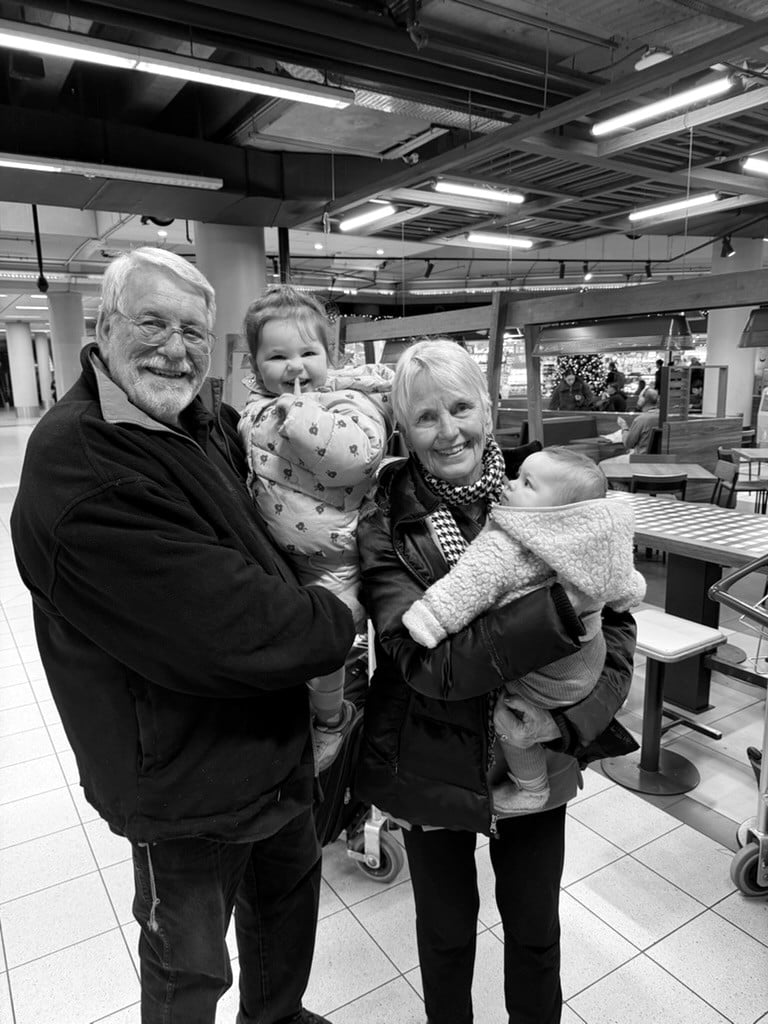
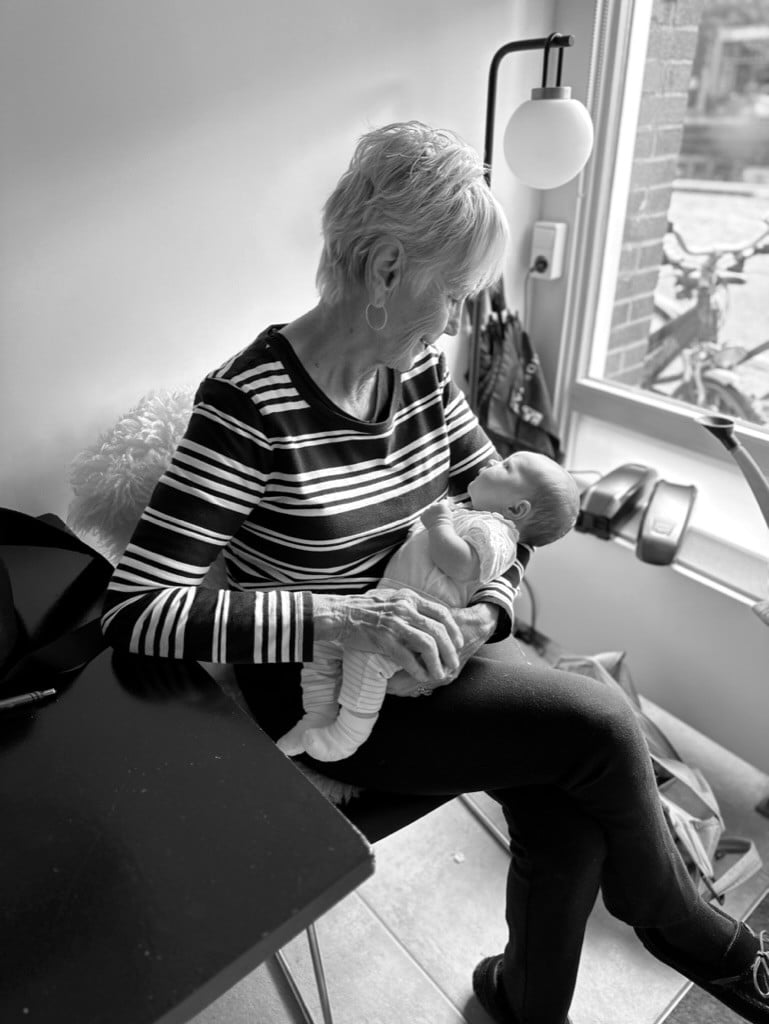
My parents live on the other side of the Atlantic from their grandkids. When they tell people that, the reaction is always the same: how sad that you never get to see them.
It is about the furthest thing from the truth.
Last year my mom was in town, within walking or biking distance of our home, for three months, and my dad for roughly two. This year they have been here two months, and that was just the summer. Christmas was another three weeks for both of them. 2024 and 2023 were multi-month years too.
Here is the part people don’t expect. They have never once stayed with us.
They stay two blocks away. We wrote letters, physical letters, and dropped them through the mailboxes of our neighborhood, looking for people going on vacation who wanted a paid sublet while they were gone. We were specific about what we needed. Not up a few flights of steep stairs. A bed big enough for my dad. A price inside what they could afford.

Photo: Diarmid Lambert, Wikimedia Commons, CC BY-SA 3.0

The leads came back, and year by year my parents have built up a roster of flats they return to. They get to know a different corner of the city each visit. Close enough that my three-year-old can walk there holding someone’s hand. Far enough that nobody has to perform at breakfast. They stay for a month and it is good for the whole month. If they were in our guest room they would stay for five days, and days four and five would be spent managing each other.
I started calling it proximity without intimacy. A term I stumbled into backwards, without knowing it, because it works so well for us. Eventually I went looking for whether anyone had studied it.
They have. For sixty years. And the literature says something more interesting than “live near your parents.”
The Concept Has a Name
In 1963 two Austrian gerontologists, Leopold Rosenmayr and Eva Köckeis, published a paper describing a pattern they kept finding in European families: Aging parents and adult children who lived geographically close but deliberately not in the same household. They called it intimacy at a distance.
The same arrangement I had been calling proximity without intimacy, with the words in the other order. Theirs is named from the grandparents’ side, mine from ours.
The phrase went global because it named something people were already doing without a word for it. Six decades on, researchers still describe it as holding across Western industrialized countries. Proximate living, as the field calls it, is routinely characterized as the ideal arrangement, because both generations get frequent contact while keeping autonomy and privacy.
Note what that is not. It is not a compromise between the traditional multigenerational household and the modern isolated one. It is its own thing, and by the numbers it is the majority Western preference, not a fallback.
Distance Is the Wrong Variable
Here is what surprised me. When you look for the optimal distance, there isn’t one. What you find instead is that the measured benefits are flat across a very wide band, and that the thing which actually predicts whether the arrangement works is not how far apart you live but how many independent doors sit between you.
Compton and Pollak, writing in the Journal of Urban Economics in 2014, found that close proximity to a mother or mother-in-law raised the probability of employment and labor force participation for married women with young children by four to ten percentage points, with childcare as the mechanism. Their “close” was twenty-five to thirty miles. Same metro area. Not same street. Twenty-one percent of married women living within thirty miles of their mother received work-related childcare from her.
One caveat before you import those numbers: this is an American study, and the miles are American miles. Twenty-five miles of grandmother assumes a car, a highway, and parking at the other end. In a dense European city the same mechanism runs on foot, by bike, and by tram, and the radius compresses to a fraction of that. The part worth importing is the test itself, whether they can take the kids on a random Tuesday.
So the benefit curve is broad. Walking distance buys you frequency and spontaneity. It doesn’t buy you a different category of help.
What does change the category is shared territory. Studies of married women’s subjective wellbeing consistently find coresidence with parents or in-laws worse than living near them, with the quality of the intergenerational relationship explaining part of the gap. The strain comes from obligation without exit, not from being close.
This is why the Dutch and Belgians have a word, kangoeroewoning, for a house with a self-contained unit for a parent, and why the Australians say granny flat and the Americans say ADU. All three are solving the same problem: Buy a door, not a mile. Distance is simply the cheapest way to buy a door when you can’t afford architecture.
Christopher Alexander got there in 1977 without the data. A Pattern Language sets an upper limit of about twelve households on a workable house cluster, with six to eight as a natural average, and prescribes that each household inside a larger family group must at all costs have a clearly defined territory of its own that it controls. Independent dwellings, shared ground. Danish cohousing converged on the same shape independently: Sættedammen, the first modern cohousing community, has run since 1972 on twenty-seven independent households sharing common facilities.
Everyone I can find who has taken this seriously has arrived at the same answer. Separate doors, shared ground.
I have seen the fully committed version of it. Living in Bali, I watched multigenerational families run their whole lives inside a single walled compound, the pekarangan: separate sleeping pavilions for each household, a shared kitchen, a granary, the family temple, all arranged around a central courtyard called the natah. The layout isn’t improvised. It follows a codified design system, Asta Kosala Kosali, and the anthropologists who mapped the social side, Hildred and Clifford Geertz in Kinship in Bali, described compounds holding multiple households of a single patriline. Separate doors, shared ground, taken literally, and as far as I could see it worked well for the Balinese. It has worked for them for centuries.
It is not how I would choose to live, and the architecture itself says why. The compound has separate doors but one gate. Literally one: the angkul-angkul, the single narrow entrance in the wall, with a screen behind it to baffle spirits, who can only travel in straight lines. Nobody inside chose the arrangement and nobody renegotiates it. Sons are born into the fence and stay; brides enter it at marriage and stay. What the two-blocks version adds is the exit. A rented flat two blocks away delivers the same daily contact as the compound while leaving every party free to change the terms next year. The fence is the difference between an arrangement and an inheritance.

Photo: Michael Gunther, Wikimedia Commons, CC BY-SA 4.0

The Right Distance Changes With Your Parents’ Mobility
The flat benefit curve holds only while your parents are independent. This is the part I hadn’t thought through.
There are two thresholds and, as you’d suspect, the research weighs them very differently.
While parents are net providers, giving childcare, absorbing school runs, the effect operates at twenty-five to thirty miles. But once a parent has a disability and becomes a net recipient, the hours of help they receive from an adult child are strongly contingent on that child living within about five miles. Errands, medications, appointments, the fall at two in the morning: None of it survives a commute.
There is a name for what happens next. Lin and Rogerson’s three-stage model describes separation when children leave home, stabilization through mid-life, then a final stage in which a parent’s rising care needs, often compounded by widowhood, drive proximity-enhancing moves by one party or the other. Silverstein calls it geographic convergence. It shows up in the data: Widowhood, declining health, stroke, heart attack and heart failure all reliably pull the generations back together.
And here is the finding I would build a paragraph around if I were arguing this in front of a hostile audience. Among widowed Europeans, those living within twenty-five kilometers of their nearest child showed smaller increases in depressive symptoms than those living with a child. Weekly contact buffered grief. Receiving instrumental support was associated with larger increases in depression.
In other words, near beat living with, and being helped was worse than not being helped.
Being cared for is corrosive to the person receiving it. Being in contact is not. Any arrangement that collapses the two, that makes proximity and dependence the same thing, damages the person it is meant to protect. This is the strongest argument I know against the sentimental case for moving Grandma into the spare room, and it comes from people who studied grief, not from people with a thesis about the family.
We lived a version of this in my own family. My grandparents on my dad’s side had moved to Florida to be closer to us. When we left Florida for Tennessee, they moved into a retirement home, and my grandfather died there. My grandmother was alone in that home when she fell and broke her hip. She was being cared for, professionally and around the clock, and she was not doing well.
My dad moved her to an assisted living facility near my parents’ home in Tennessee. She did okay there. Then my parents made the decision the data above would seem to warn against: they turned a spare bedroom into her room and moved her in. A nurse came every day or two to wash and bathe her. Everything else was family. She ate my mom’s cooking at my parents’ table. By then my sister and I were out of the house, so it was the three of them.
Her prognosis at the assisted living facility had been six months. She lived about three more years in that house.
This squares with the finding once you look at the options she had left. By the time she moved in, my grandmother’s options were no longer near versus with. They were family versus institution, and family won by two and a half years. The widowhood data compares arrangements available to people who still have options. The point of everything in this essay is to arrange your geography while the options are still open, so the choice never has to collapse to a spare bedroom or a facility.
Now the Children, Which Is the Real Argument
Jordan Peterson, in Rule 5 of 12 Rules for Life, puts the parental obligation about as sharply as it can be put. Parents, he argues, have a duty to act as proxies for the real world. Merciful proxies, caring proxies, but proxies. That obligation, he says, outranks any responsibility to ensure a child’s happiness, foster their creativity, or boost their self-esteem, and it outranks fostering individual identity too. The primary duty of parents, in his phrase, is
to make their children socially desirable.
I think he’s right. My own run at this is only a few years old, but everything in it says the same. And I think he understates the problem, because he locates the duty inside the nuclear household, and there are exactly two of you there. Two people cannot be a proxy for the world. Two people are a sample of two.
Two people are also the entire staff. The nuclear household is a heavy burden as-is: two adults covering the income, the logistics, and the whole emotional weather of small children. Peterson’s duty lands on that same pair, on top of everything else. The duty is right. The staffing is wrong.
There is data on the extension. Attar-Schwartz and colleagues surveyed 1,515 secondary students in England and Wales and found that greater grandparent involvement predicted fewer emotional problems and more prosocial behavior. Across the grandparenting literature, prosocial behavior is the outcome with the most robust and consistent association. In one replication, controlling for parental involvement wiped out the association with general adjustment difficulties, but the association with prosocial behavior survived. Grandparents were not simply more of what the parents were already providing.
The theoretical bridge is Sarah Blaffer Hrdy’s cooperative breeding thesis in Mothers and Others. Humans are unusual among apes in that mothers permit others to hold their infants, and Hrdy argues that our capacity for reading intentions and seeking approval was selected for precisely because human infants had to work out who besides mother would care for them. That’s a hypothesis, not a finding. But it explains why the extended family is not a nice-to-have. It is the environment the equipment was built for.
The Correction That Should Stop You
Then I ran into the finding that broke my own argument, and I think it is the most important thing in this essay.
Cameron, Erkal, Gangadharan and Meng published a study in Science in 2013 using China’s One-Child Policy as a natural experiment. They ran economic games on more than four hundred Beijing residents born just before and just after 1979, isolating the causal effect of growing up as an only child. The result: Significantly less trusting, less trustworthy, more risk-averse, less competitive, more pessimistic, less conscientious.
Now the detail. In their own working paper the authors note that each little emperor had two parents and four eager grandparents doting on them exclusively.
Maximum extended family density. The exact configuration I have spent this essay arguing for. And those children came out measurably worse.
Grandparent proximity did not compensate for sibling absence. It is not implausible that it made things worse.
So the mechanism is not “more people.” It is more people of roughly equal status whom you can neither command nor escape.
Siblings supply that more reliably than anything else I can find. Perner, Ruffman and Leekam titled their 1994 Child Development paper “Theory of mind is contagious: you catch it from your sibs,” and found that three and four year olds from larger families were better at predicting a character’s false-belief-driven action than children from smaller ones. The follow-up literature argues about whether older siblings matter more than younger ones, and I wouldn’t lean on birth order. But the core result has held for thirty years. Children learn that other minds contain beliefs different from their own by living with someone whose beliefs are inconveniently different and who cannot be sent home.
That gives us three distinct training sets, and they are not interchangeable:
- Parents. Authority. Teaches rules, self-regulation, and the shape of legitimate hierarchy. This is Peterson’s chapter.
- Grandparents and extended kin. Unconditional love without obligation. Teaches a child how to be wanted by adults who owe them nothing.
- Siblings and cousins. Equals under forced proximity. Teaches negotiation, conflict, repair, and theory of mind. Nobody else can seemingly teach it as well.
Four doting grandparents and no siblings trains charm with no counterweight. That is a defensible read of the little emperor result, and it is worth sitting with if your plan for family life is one child and a lot of adults.
The honest caveat, since a sharp reader will supply it if I don’t: The sibling case is a social competence case, not a general one. Blake’s resource dilution model holds that each additional child reduces parental investment per child, with real costs to educational attainment, and Polit and Falbo’s meta-analyses found only children do fine or slightly better on achievement. Siblings buy social capability. They are not free.
The Referee Problem
There is a version of this argument that has already reached a mass audience, and it is worth borrowing because it supplies the missing half.
Jonathan Haidt’s central claim in The Anxious Generation is that two trends, overprotection in the real world and underprotection in the virtual world, are the major reasons children born after 1995 became anxious. The frame he uses, taken from Peter Gray, is the replacement of a play-based childhood with a phone-based one. Gray’s definition of free play is the part that matters: Activity freely chosen and directed by the participants, undertaken for its own sake. Physical play, outdoors, with children of mixed ages, is the healthiest and most beneficial form.
Haidt’s summary of what play actually teaches is the sentence to underline. Children in play learn to coordinate, to be empathetic, to make up rules, to enforce rules, to be flexible with rules, and to work out what to do when they don’t get their way.
Make up rules. Enforce rules. Be flexible with rules. That’s not a list of social skills. That’s a description of governing yourselves, performed by eight-year-olds, in a vacant lot, badly, for years, until they’re good at it.
Gray puts the same point in a single line:
Play requires suppression of the drive to dominate and enables the formation of long-lasting cooperative bonds.
Read Gray’s definition again and notice the word unsupervised. A refereed soccer match is play. It is not this.
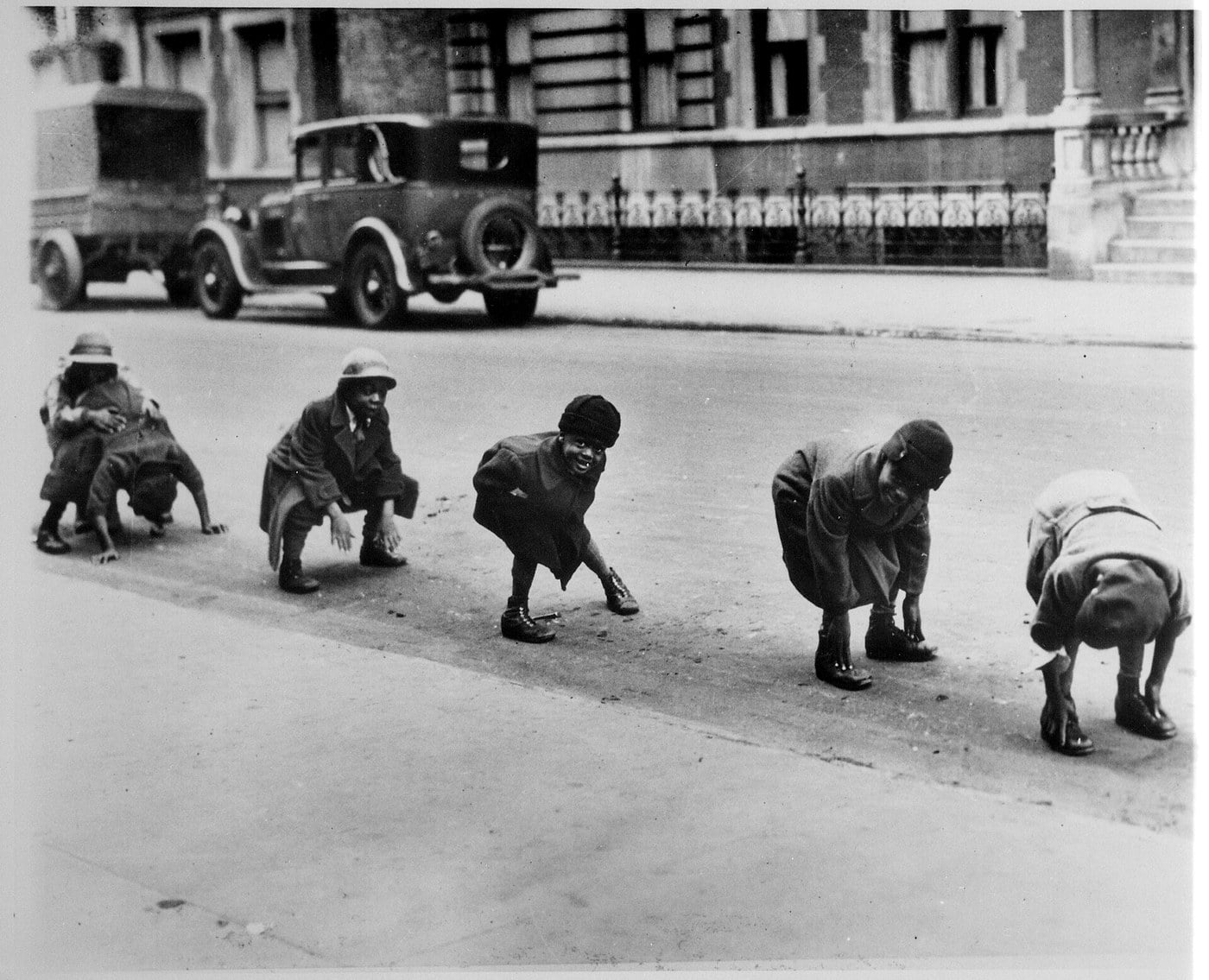
Photo: public domain, via Wikimedia Commons
And there is a measurement that ought to end the argument about which version is safer. Mariana Brussoni, a play researcher at the University of British Columbia, points to research showing the risk of injury per hour of free physical play is lower than the risk per hour of adult-guided sports, while delivering more developmental benefit, precisely because the children have to make every choice, set and enforce the rules, and resolve all the disputes themselves. Her design principle is the one worth stealing:
Keep them as safe as necessary, not as safe as possible.
So the referee teaches the wrong lesson and doesn’t even deliver the safety he was hired for.
The animal literature is where this stops being a cultural argument and becomes a biological one, and it is far more solid than the smartphone research. Sergio Pellis and colleagues have spent decades on rough-and-tumble play in rats, which is the most common form of play the species has. Deprive rats of peer play during the juvenile period and you get adults with socio-cognitive deficiencies, correlated with measurable physiological and anatomical changes to the neurons of the medial prefrontal cortex. Play-deprived rats escalate encounters with strangers. The pattern of deficit resembles what you get from directly damaging the prefrontal cortex, the region responsible for selecting appropriate actions and inhibiting inappropriate ones.
The mechanism is the interesting part. Competition during rough-and-tumble play generates constant ambiguity about whether the other animal is taking unfair advantage. Resolving that ambiguity requires communication, or the encounter escalates into real aggression, or the rat who plays too rough gets ostracized. Pellis argues that creating and resolving that ambiguity, balancing competition against cooperation in real time, is the vehicle through which young mammals train socio-cognitive skills.
That is a rat learning to settle a dispute without a referee. It is the same circuitry and the same function in our children, and the physicality is not incidental to it. Mammals work things out through graded physical conflict because roughhousing tells a kid more, faster, than words ever do, and the feedback arrives immediately. You find out where the line is by crossing it and getting bitten slightly harder than you expected. That is the curriculum, not a defect of childhood to be engineered away.
Which brings us to the thing I think both Haidt and Peterson gesture at without quite naming.
When an adult adjudicates, the child does not learn to negotiate. The child learns to appeal.
Every conflict resolved by summoning an authority is a repetition that trains one skill, the skill of summoning an authority. Do that for an entire childhood and you produce an adult whose first instinct under friction is to find someone with the power to impose a settlement, because that is the only move they have ever practiced.
What the Adult Version Looks Like
If that were true, the institutions serving those adults would have grown a matching organ. They have.
Haidt describes the reporting infrastructure that appeared on American campuses in the 2010s: Bias Response Teams, and at NYU a number posted in every bathroom telling students how to report a professor who says something they dislike. He notes his host institution had one too. This isn’t a metaphor for an appeal instinct. It’s a literal appeal mechanism, purpose-built, staffed, and funded, because there was demand for it.
He closes that talk with Van Jones, who names the disposition more precisely than any academic in the literature. Jones draws the distinction between wanting to be physically safe, which he endorses, and wanting to be safe ideologically and emotionally, which he does not:
I don’t want you to be safe ideologically. I don’t want you to be safe emotionally. I want you to be strong. That’s different. I’m not going to pave the jungle for you. Put on some boots and learn how to deal with adversity. I’m not going to take all the weights out of the gym, that’s the whole point of the gym. This is the gym.
His objection is that a student who hears unwelcome speech now treats it as a problem for the administration to solve.
And it comes from a progressive activist talking to a friendly audience, which makes it hard to dismiss.
Alison Gopnik, quoted in the same talk, supplies the why:
Trying to eliminate all such risks from children’s lives might be dangerous.
The mechanism Haidt draws out of that line is a psychological analog to the hygiene hypothesis: shielding children from every risk leads them to react with exaggerated fear to situations that carry no risk at all. His example is a campus speaker saying things you hate.
There is a homelier version of the same idea, and it comes from a failed experiment. When the designers of Biosphere 2 built their enclosed rainforest, many of the trees grew fast and then fell over before reaching maturity. Nobody had realized that young trees need wind. When wind bends a tree it tugs at the roots on the windward side and compresses the wood on the other, and the tree answers by expanding its root system where the load is and restructuring the compressed cells into what foresters call reaction wood. Trees that meet strong winds early become trees that can stand in strong winds later. Trees raised in still air fall down under their own weight.

Photo: Jesuiseduardo, Wikimedia Commons, CC BY-SA 4.0

The same principle showing up in trees and in immune systems is usually how you find out the principle is real.
So the chain has an observable endpoint. A childhood in which every dispute is adjudicated, and then an adult institution whose growth industry is adjudicating disputes on request.
Where I Am Speculating, and What Would Settle It
I want to mark this seam clearly, because the rest of this essay rests on published research and this part does not.
Nobody has shown that childhood adjudication predicts adult political disposition. Not Haidt, not Pellis, not anyone. What exists is a mechanism established in rats, a set of norms that demonstrably changed in the 1990s, an institutional form that appeared roughly twenty years later, and an analogy to the immune system. Timing plus analogy is how a great many wrong theories have been sold, and I’m not going to pretend otherwise.
Haidt is careful about this himself. Presenting the self-harm data in that lecture he states flatly that he can’t prove causality, and describes a literature review still in progress. If the source disclaims causation, the essay built on it cannot claim more than the source does.
Here is what would settle it, and I would like someone to run it.
Take the measure Haidt collects informally from every audience he addresses: At what age were you first allowed out of the house without an adult. It is a single number, people recall it reliably, and it varies enormously by birth cohort and by country. Pair it with a behavioral measure of adult conflict response, not a self-report survey. Then look for the association.
The variable has already moved far enough to be worth measuring. A 2015 Pew survey found American parents saying a child should be at least ten before playing unsupervised in their own front yard, twelve before being left home alone for an hour, and fourteen before going to a public park without an adult. The same respondents, asked about themselves, report being turned loose at six, seven, or eight, in a decade that was measurably more dangerous than the one their children are growing up in.
The cross-national version is better still, and nobody has exploited it. The sociologist Frank Furedi, whose work on the 1990s turn to fearful parenting Haidt leans on heavily, makes the point bluntly:
The idea that responsible parenting means the continual supervision of children is a peculiarly Anglo-American one.
Furedi points to research finding that German and Scandinavian parents were far more likely to let young children walk to school than British ones, who felt compelled to drive them even short distances. That is naturally occurring variation in the independent variable, sitting there unused, with a named comparison group already identified.
I think the result would be striking. I don’t know it, and neither does anyone else, and that distinction is worth more to me than a cleaner paragraph.
Two Caveats Before the Turn
Haidt’s causal claim about smartphones is contested by serious people, and the objections are specific enough to name rather than gesture at. Candice Odgers reviewed The Anxious Generation for Nature and argued that hundreds of researchers, herself included, have gone looking for effects of the size Haidt describes and come back with a mix of null, small and mixed associations. The empirical anchor under that position is Orben and Przybylski’s 2019 paper in Nature Human Behaviour, which ran a specification curve analysis across three datasets totaling 355,358 adolescents and found that digital technology use explained at most 0.4 percent of the variation in well-being. Przybylski’s methodological complaint is the sharper one: Counting studies is not the same as weighing them, and nineteen weak results do not outrank three strong ones.
Haidt and Gray, once close enough to co-found Let Grow together with Lenore Skenazy, have since fallen out over related questions.
None of that reaches the argument I’m making here. Cite Haidt for the framing. Lean on the animal work for the mechanism. The rat data isn’t in the replication fight.
And the campus material above comes from a 2018 lecture. The specific temperature of American universities has moved since. The institutional form is the durable part, not the weather.
What You Are Actually Buying
Here is where this stops being a parenting essay.
Every function the extended family used to perform has a state-provided substitute. Childcare, eldercare, income support in widowhood, the insurance of having someone nearby when things go wrong. Robert Nisbet’s argument in The Quest for Community was that the state does not merely fill the vacuum left by intermediate associations. It expands into the space they vacate, and it has a hand in the vacating.
The trade was real and most people took it without ever adding up what it cost. We accepted institutional substitutes for kin so that we could move wherever the work was. That bargain built enormous wealth. I’ve taken it repeatedly, and I’m about to take it again by moving my family six thousand miles.
But notice what the research says the substitutes cannot deliver. They cannot deliver the widowed parent whose depression is buffered by weekly contact rather than by services. They cannot deliver the second and third training set for a child. A state can fund your mother’s care. It cannot make your daughter socially desirable.
This is the practical case for liberty that I keep circling back to, and it is not abstract. The reason to want fewer of your obligations handled by institutions is not that institutions are always worse at the task. Sometimes they are better. It is that the obligations themselves are the load-bearing structure of a family, and a family that has outsourced all of them has nothing holding it together but affection, which is not enough.
The Design Brief
We’re moving to Africa in October. Two adults, two daughters under four, four grandparents on two continents.

Photo: Olga Ernst, Wikimedia Commons, CC BY-SA 4.0
What the evidence says to do:
Build the option, not the arrangement. Buy the plot with room for a second structure and don’t build it yet. Distance is fixed the day you sign. A cottage can go up in the year you need it. Today the right number is two blocks. In fifteen years it’s fifty meters and a shared path, and by then nobody should be driving, which is the real constraint hiding inside that five-mile figure.
Separate doors, always. Every serious tradition that has looked at this, from Alexander to the Danes to the Dutch with their kangaroo houses, lands on independent territory plus shared ground. Never one household with a spare room.
Adjust the numbers downward for where you actually are. The five-mile threshold assumes drivable roads and a driving parent. The geography and driving conditions where we’re headed shrink the effective radius. Whatever the American number is, take less.
Don’t mistake grandparents for a substitute for siblings. They are a different training set entirely. Sophia and Josie have each other, which is the part I can’t buy with real estate and the part that matters most.
Site for the play group, not just for the grandparents. This is the piece I nearly missed. Gray’s healthiest form of play is outdoors, mixed-age, unsupervised. For most of human history the extended family supplied that group. Cousins of assorted ages, in one place, out of earshot. When families scattered, they didn’t just lose the eldercare and the childcare. They lost the pack of mixed-age kids, and no institution has replaced it yet, because the institutions that try keep staffing it with adults.
The neighborhood couldn’t step in either, and Furedi explains why. The abuse scandals of the 1980s and 1990s, some real horror stories and some outright moral panic, produced what he calls the breakdown of adult solidarity. Parents had always worked on the assumption that if their child got into trouble, some other adult, often a stranger, would step in. After the scandals, adults absorbed the reciprocal lesson: Stay away from other people’s children. Don’t talk to them, don’t correct them, don’t get involved. Once that assumption dies, supervision has nowhere left to go but back onto the two parents, and the unsupervised mixed-age group becomes impossible to staff even when the cousins are still in town.
So what you are actually shopping for is not square footage. It’s a neighborhood where children can leave the house and not come back for three hours, and where the other adults still think that is normal.
The old arrangement was one household, three generations, no exit. The modern arrangement is one household, one generation, no one within five hundred miles. Both are wrong, and the correct answer has been sitting in the gerontology literature since 1963 with a name on it.
Two blocks. Separate doors. Shared ground.
Sources
- Rosenmayr, L. and Köckeis, E. (1963). “Propositions for a sociological theory of aging and the family.” International Social Science Journal 15(3): 410-426.
- Compton, J. and Pollak, R.A. (2014). “Family proximity, childcare, and women’s labor force attachment.” Journal of Urban Economics 79: 72-90.
- Choi, H. et al. (2021). “Close enough? Adult child-to-parent caregiving and residential proximity.” Social Science & Medicine.
- Lin, G. and Rogerson, P.A. (1995). “Elderly Parents and the Geographic Availability of Their Adult Children.” Research on Aging 17(3): 303-331. Silverstein, M. on geographic convergence.
- Jessee, L., Kim-Knauss, Y., Schmitz, A., Nashef-Hamuda, R., Köttl, H., Cohn-Schwartz, E. and de Paula Couto, M.C.P. (2025). “When Parents Grieve: Adult Child Support and Depressive Symptoms Among Men and Women After Widowhood.” Research on Aging. Eight waves of SHARE data, 2,600 widowed women and 896 widowed men, fixed-effects panel regression.
- Attar-Schwartz, S., Tan, J.P., Buchanan, A., Flouri, E. and Griggs, J. (2009). “Grandparenting and adolescent adjustment in two-parent biological, lone-parent, and step-families.” Journal of Family Psychology 23(1): 67-75.
- Perner, J., Ruffman, T. and Leekam, S.R. (1994). “Theory of mind is contagious: you catch it from your sibs.” Child Development 65: 1228-1238.
- Ruffman, T. et al. (1998). “Older (but not younger) siblings facilitate false belief understanding.” Developmental Psychology 34: 161-174.
- Cameron, L., Erkal, N., Gangadharan, L. and Meng, X. (2013). “Little emperors: behavioral impacts of China’s One-Child Policy.” Science 339(6122): 953-957.
- Hrdy, S.B. (2009). Mothers and Others: The Evolutionary Origins of Mutual Understanding.
- Alexander, C. et al. (1977). A Pattern Language, patterns 37 (House Cluster), 75 (The Family), 79 (Your Own Home), 129 (Common Areas at the Heart).
- Geertz, H. and Geertz, C. (1975). Kinship in Bali. University of Chicago Press. Chapters on the houseyard and household and the houseyard cluster; descent patrilineal, residence virilocal.
- On the form of the Balinese traditional house: the walled pekarangan, the single angkul-angkul entrance with its aling-aling screen, the natah courtyard, and the Asta Kosala Kosali design rules.
- Peterson, J.B. (2018). 12 Rules for Life, Rule 5, p. 143.
- Nisbet, R. (1953). The Quest for Community.
- Blake, J. (1981) on resource dilution; Polit, D. and Falbo, T. meta-analyses on only children.
- Haidt, J. (2024). The Anxious Generation: How the Great Rewiring of Childhood Is Causing an Epidemic of Mental Illness.
- Haidt, J. “The Three Terrible Ideas Weakening Gen Z and Damaging Universities and Democracies.” Penn State lecture, 2018. Transcript published at spreadgreatideas.org.
- Lukianoff, G. and Haidt, J. (2018). The Coddling of the American Mind.
- Gopnik, A., on a psychological analog to the hygiene hypothesis, quoted in the above.
- Taleb, N.N. (2012). Antifragile.
- Gray, P. (2011). “The Decline of Play and the Rise of Psychopathology in Children and Adolescents.” American Journal of Play 3(4).
- Furedi, F. Paranoid Parenting, on the breakdown of adult solidarity and the Anglo-American character of continual-supervision norms; discussed at length in Haidt (2024), ch. 3.
- Brussoni, M., University of British Columbia, on injury rates in free play versus adult-guided sports and the “as safe as necessary, not as safe as possible” design principle; quoted in Haidt (2024), ch. 3.
- Pellis, S.M. and Pellis, V.C. (2007). “Rough-and-Tumble Play and the Development of the Social Brain.” Current Directions in Psychological Science.
- Pellis, S.M., Himmler, B.T., Himmler, S.M. and Pellis, V.C. “Rough-and-Tumble Play and the Development of the Social Brain: What Do We Know, How Do We Know It, and What Do We Need to Know?”
- Panksepp, J. (1998). Affective Neuroscience.
- Odgers, C. (2024). “The great rewiring: is social media really behind an epidemic of teenage mental illness?” Nature, 29 March 2024. Review of The Anxious Generation.
- Orben, A. and Przybylski, A.K. (2019). “The association between adolescent well-being and digital technology use.” Nature Human Behaviour 3: 173-182. Specification curve analysis across three datasets, n = 355,358.
- Pew Research Center (2015), on American parents’ stated minimum ages for unsupervised play, being home alone, and visiting a public park.